IN Brief:
- Indurent is progressing approximately 408,000ft² of industrial and logistics space across two Knowsley developments.
- The 199,420ft² Indurent 200 building is under construction, while a further 208,000ft² scheme has secured planning approval.
- Both projects target EPC A+, BREEAM Excellent, enhanced solar provision, EV charging infrastructure, and net-zero-ready operation.
Indurent is progressing two logistics developments in Knowsley that will provide approximately 408,000ft² of new industrial space within the Liverpool City Region.
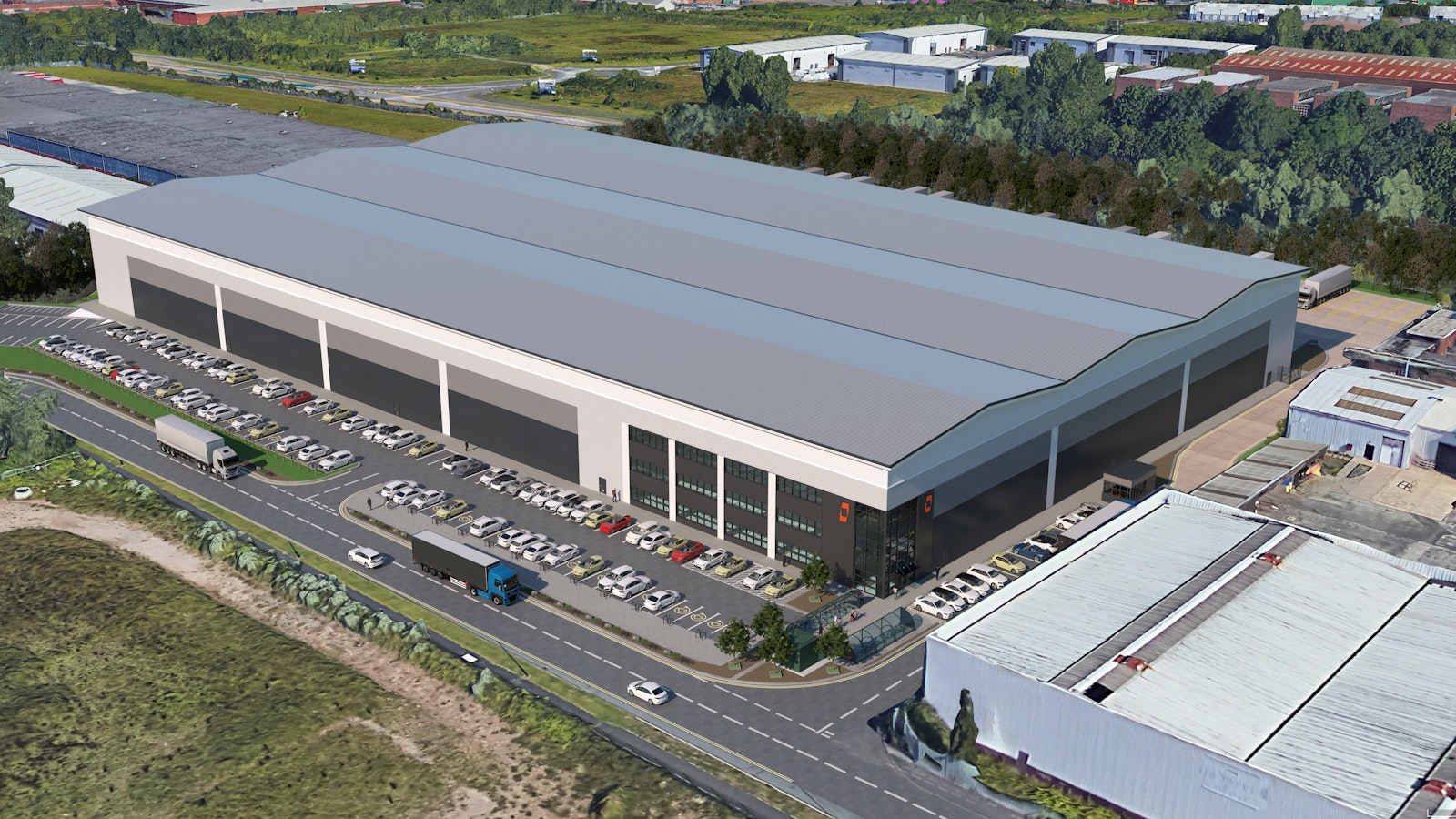
Planning permission has been secured for around 208,000ft² at Indurent Park Knowsley, on land behind the developer’s existing Moorgate Point estate. A separate 199,420ft² building, Indurent 200, is already under construction at Knowsley Business Park and is scheduled for completion during the first quarter of 2027.
Indurent 200 will comprise approximately 184,700ft² of warehouse accommodation and 14,700ft² of first-floor offices. Its specification includes a 15.25-metre eaves height, 18 dock loading doors, three level-access doors, a secure 68-metre yard, floor loading of 50kN/m², and power provision of up to 1.2MVA.
Positioned around one mile from Junction 4 of the M57, the site provides access towards Liverpool, Manchester, the M62, and the M6. Liverpool John Lennon Airport lies approximately 12 miles away, while Prescot station is around 1.5 miles from the development.
Both schemes are being delivered under the Indurent Code, targeting EPC A+ and BREEAM Excellent. Net-zero-ready construction, enhanced photovoltaic roof capacity, electric-vehicle charging infrastructure, and FSC-certified materials have been incorporated into the design.
Power provision is becoming a leasing constraint
Warehouse occupiers increasingly assess electrical capacity alongside floor area, yard depth, and motorway access, since automation, fleet charging, refrigeration, IT infrastructure, and building services can produce substantial coincident demand. A nominal connection may appear generous until the full equipment and charging profile is modelled.
Indurent 200’s provision of up to 1.2MVA creates a useful starting point, although conveyors, automated storage, mobile robots, forklift chargers, yard tractors, vans, and future heavy vehicles could consume a large share of that capacity. Occupiers will need to understand both the available connection and the process for securing additional power.
Enhanced roof loading gives a tenant greater scope to install photovoltaic generation beyond the minimum building requirement. The commercial value will depend on the available roof area, orientation, grid arrangements, storage, and the extent to which daytime consumption coincides with solar output.
Charging infrastructure creates similar design questions because car bays represent only one part of future demand. Ducting and space for vans, materials-handling equipment, yard vehicles, and heavy goods vehicles are considerably easier to install during construction than through an occupied yard and completed slab.
The 68-metre yard and combination of dock and level-access doors should support distribution and manufacturing operations, provided that trailer parking, containers, waste areas, maintenance vehicles, pedestrian routes, and chargers are included in the traffic plan. An apparently deep yard can lose usable capacity quickly when ancillary activities are added after occupation.
Knowsley gains more modern stock
More than 350 jobs are expected across the two schemes, although recruitment will draw on the same regional labour, maintenance, and transport markets used by established occupiers. Public transport, shift patterns, amenities, and access for contractors will influence staffing once the buildings move beyond construction.
Indurent has already secured a 145,000ft² letting to Singleton Trading at nearby Moorgate Point, providing evidence of demand within the immediate cluster. The new developments extend an established industrial location rather than attempting to create one around a single speculative building.
Large logistics projects continue to advance selectively elsewhere, including Panattoni’s acquisition of a Wakefield site for a 500,000ft² scheme. Developers remain willing to commit where power, motorway access, labour, and occupier depth support the scale.
A standalone building approaching 200,000ft² nevertheless addresses a narrower tenant market than a multi-unit estate. Racking, automation, offices, refrigeration, manufacturing processes, and energy requirements can all alter the final commitment and lengthen the fit-out period.
The two Knowsley projects provide Indurent with flexibility across different occupier requirements, pairing a defined large-format warehouse with a wider planned development. Their commercial performance will depend on how effectively power, labour, yards, transport access, and building configuration match the operations seeking space.
Environmental certification will support corporate property requirements, but measured energy consumption, maintenance access, charging capacity, public transport, waste handling, and future adaptability will determine whether the design delivers during occupation. A high specification establishes the platform; the fit-out and operating model will decide how efficiently it is used.