IN Brief:
- MAN has put an eTruck on a 1,000km Paris–Berlin route using public charging hubs.
- The vehicle is charging at Milence sites across France, Belgium, the Netherlands, and Germany.
- The run is designed to show that corridor-based electric road freight is moving beyond pilot theory.
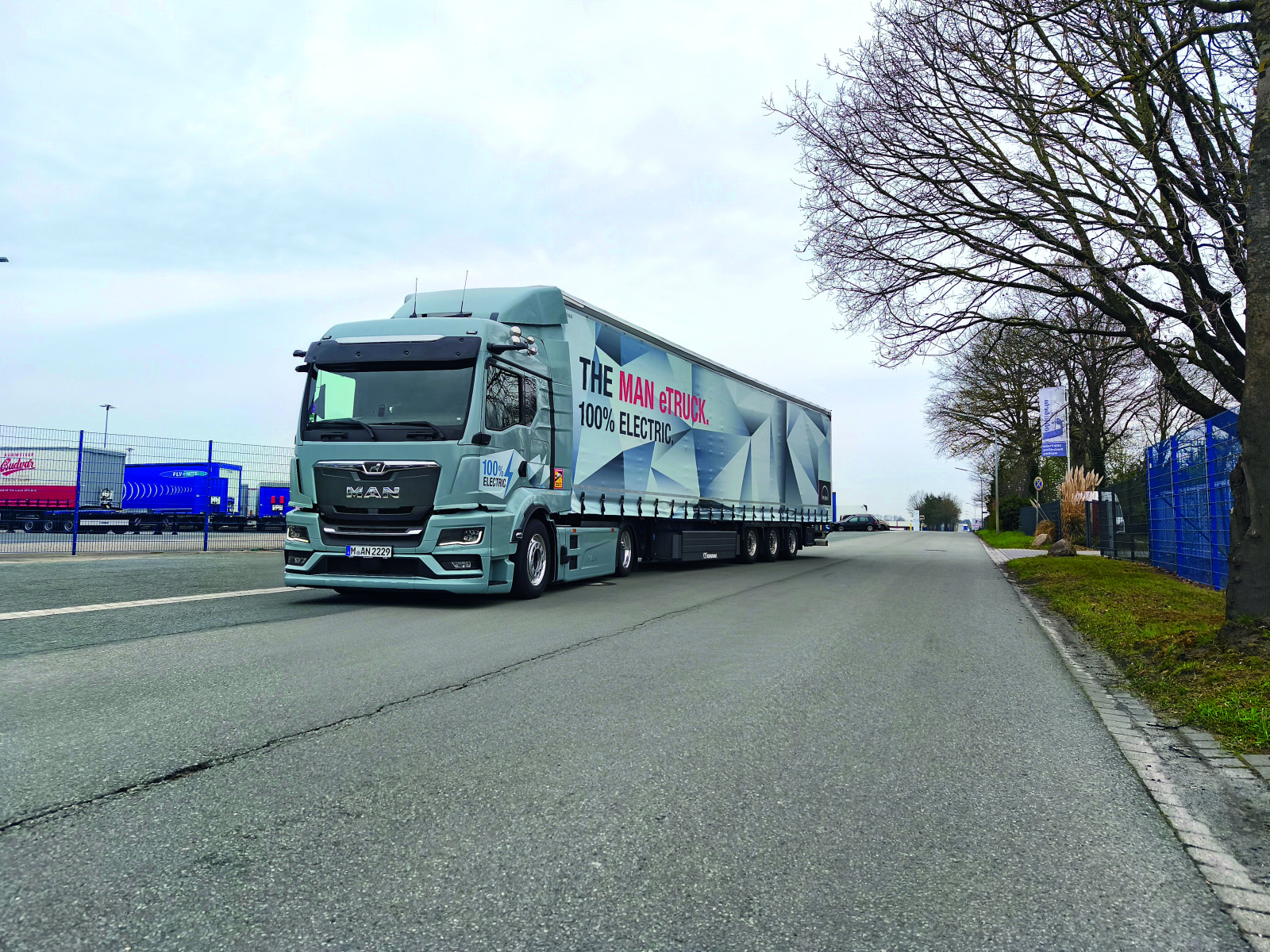
MAN Truck & Bus has started a 1,000km electric truck run from Paris to Berlin, putting one of its lowliner eTrucks onto a public charging corridor that crosses France, Belgium, the Netherlands, and Germany. The vehicle is taking part in Milence’s “Power to Go Further” tour and is charging exclusively at public Milence hubs along the route, making the journey a live test of whether long-haul battery-electric freight can operate against a real cross-border charging network rather than a closed demonstration environment.
MAN is using its eTGS Ultra semi-trailer tractor on the run, positioning the vehicle as a market-ready option for high-volume applications that need a lower trailer height. The truck is built with a maximum battery capacity of 534kWh, and MAN says the platform can cover up to 570km in long-distance work without intermediate charging, depending on configuration and duty cycle. The route itself is as important as the truck. Stops are being made at hubs including Saint-Witz, Ghent, Maasmechelen, Zwolle, Mogendorf, Kassel-Lohfelden, and Vockerode before the run reaches Berlin.
The significance of the journey lies in its refusal to hide behind ideal conditions. Heavy-duty electric trucking has produced no shortage of concept visuals and controlled depot trials, but public-corridor performance is where the argument now has to be won. Freight operators need to know whether chargers can be reached by truck, whether dwell time can be planned into commercial schedules, and whether route design still works once borders, driver hours, and payload realities are included. A Paris–Berlin corridor is not proof that every lane is ready, but it is a far better test than a short circuit between private chargers.
That is why infrastructure providers are moving centre stage. Milence says it already has more than 33 hubs operational across Europe, and the corridor framing is deliberate. Electric trucks do not scale through isolated charging islands; they scale when fleets can trust repeatable access along major freight routes. The remaining gaps are obvious enough — grid connection speed, site density, charging power, and consistent interoperability among them — but the market is moving into a phase where public infrastructure has to carry some of the load that early adopters previously absorbed through private investment.
For road freight, the next question is not whether battery-electric trucks can move goods. They can. The harder question is where they can do so without undermining network efficiency. Demonstration runs like Paris to Berlin are useful because they force that question into the open. If corridor reliability continues to improve, the conversation will shift from possibility to lane selection, and from symbolic decarbonisation to operational deployment.