IN Brief:
- PEZA has launched e-SuRGE to digitalise sustainability reporting for exporters.
- The platform has been developed with Japan’s Zeroboard and TechShake.
- The system is designed to support enterprises at different levels of ESG reporting maturity.
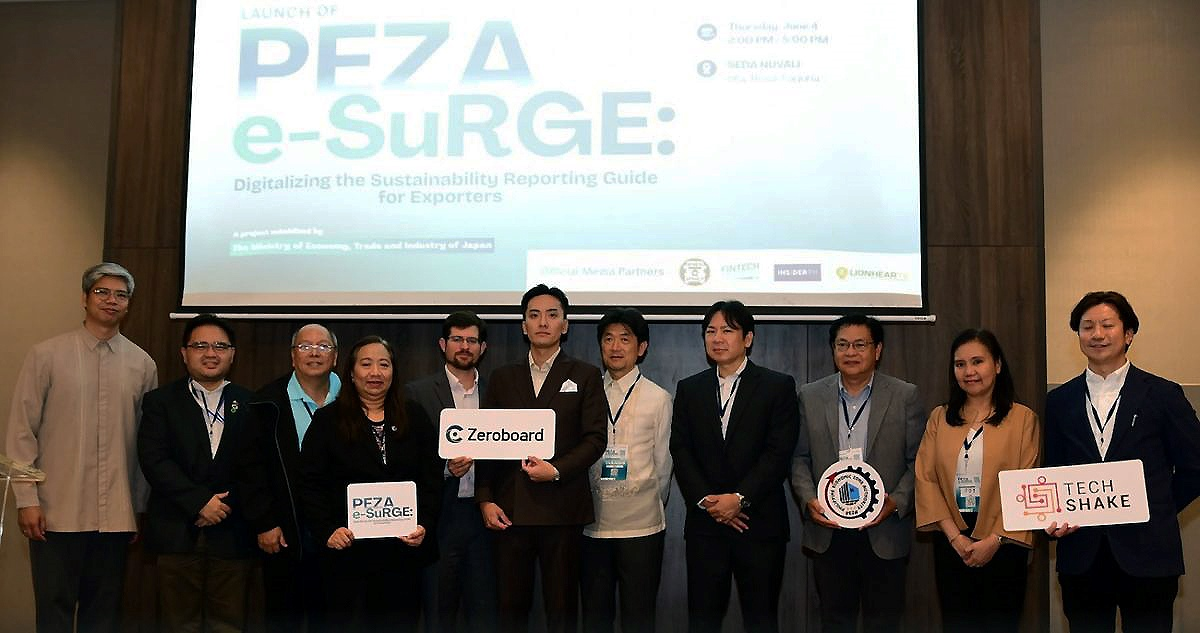
PEZA, the Philippine Economic Zone Authority, has launched e-SuRGE, a digital platform designed to strengthen environmental, social, and governance reporting among PEZA-registered enterprises.
The platform was unveiled on 4 June 2026 at Seda Nuvali in Santa Rosa, Laguna, in partnership with Japan’s Zeroboard and TechShake. e-SuRGE digitalises PEZA’s Sustainability Reporting Guide for Exporters, turning the existing framework into a more accessible and scalable system for companies operating in Philippine economic zones.
Different levels of ESG readiness across exporters make standardisation difficult. Large multinational suppliers may already have reporting teams, carbon data, customer-driven disclosure processes, and established audit routines, while smaller manufacturers and logistics-linked businesses often face similar questions from customers and investors without the same internal resources.
e-SuRGE is designed to support that uneven starting point by giving enterprises a structured digital route into reporting. The platform is intended to simplify submission, improve consistency, and allow companies to develop their reporting capabilities over time, rather than treating sustainability disclosure as a one-off compliance exercise.
Export-led supply chains are carrying a growing documentation burden as sustainability data moves closer to the commercial flow of goods. A shipment may still be judged on cost, lead time, quality, and service, but the supplier behind it is increasingly assessed on energy use, emissions reporting, water risk, waste management, labour standards, and governance controls.
Economic zones concentrate that pressure. They are designed to connect industrial activity, infrastructure, labour, and export channels, yet they also concentrate ESG exposure through energy demand, waste systems, transport movements, water use, and the environmental footprint of manufacturing clusters. Stronger reporting tools can help zone operators and enterprises understand where operational performance is improving and where gaps remain.
The Philippines is also investing in physical logistics capacity that supports export activity and domestic supply chain resilience. Modular and large-scale cold storage projects planned for agricultural zones are strengthening the country’s ability to handle perishable goods, while e-SuRGE addresses the parallel data layer that increasingly travels with exported products.
Fragmented ESG reporting creates cost without necessarily improving operational performance. When every customer asks for similar information in a different format, suppliers can spend time reworking the same data into multiple templates. A structured digital platform gives authorities and businesses a clearer route to comparable information, while reducing administrative friction for companies that have to report repeatedly.
Zeroboard’s involvement reflects the growing role of carbon accounting and sustainability software in trade infrastructure. Digital reporting tools are becoming part of procurement machinery, allowing companies to collect data more consistently, identify missing information, and respond faster when buyers ask for evidence rather than broad statements of intent.
Operational data remains the harder part of the process. Warehouses, transport fleets, energy systems, packaging flows, supplier choices, and production processes all feed into ESG reporting, but those figures can become unreliable when captured retrospectively through manual spreadsheets and disconnected systems. Bringing reporting closer to operations gives companies a better chance of improving data quality before disclosure deadlines arrive.
The platform’s value will depend on adoption, training, data integrity, and whether outputs are recognised by buyers, financiers, and regulators. A digital channel cannot make operations sustainable on its own, but it can create a common structure for measuring progress, identifying weak points, and making sustainability performance more visible across export supply chains.
As global value chains become more selective, exporters with reliable sustainability data will have an advantage over those relying on incomplete records or ad hoc declarations. PEZA’s e-SuRGE launch moves that requirement into a formal digital channel for Philippine economic-zone enterprises, placing ESG reporting closer to core export infrastructure.