IN Brief:
- The Bolesławiec AutoStore covers 4,500m² within Rhenus’s 57,000m² logistics centre.
- More than 100 robots handle a grid containing almost 140,000 storage bins.
- Rhenus reports capacity exceeding 38,000 bin presentations daily, rather than 38,000 completed customer orders.
Rhenus has formally opened a large AutoStore installation at its logistics centre in Bolesławiec, Poland, adding a high-density robotic storage system to an existing 57,000m² warehousing operation. The installation occupies 4,500m², holds nearly 140,000 bins and has more than 100 autonomous robots moving goods between the storage grid and picking stations. Rhenus says the system is its second-largest AutoStore installation worldwide and one of the largest of its type in Poland.
The 22 October ceremony marked the culmination of a project planned and tested from late 2025, with physical installation carried out between March and July 2026. Rhenus says the grid can hold approximately 1.8 million individual product units and deliver more than 38,000 bin presentations each day. These are separate measures: a bin presentation brings a storage container to an access port, whereas a completed customer order may require several presentations, picking operations and packing steps. The company has not supplied a comparable daily order-dispatch figure.
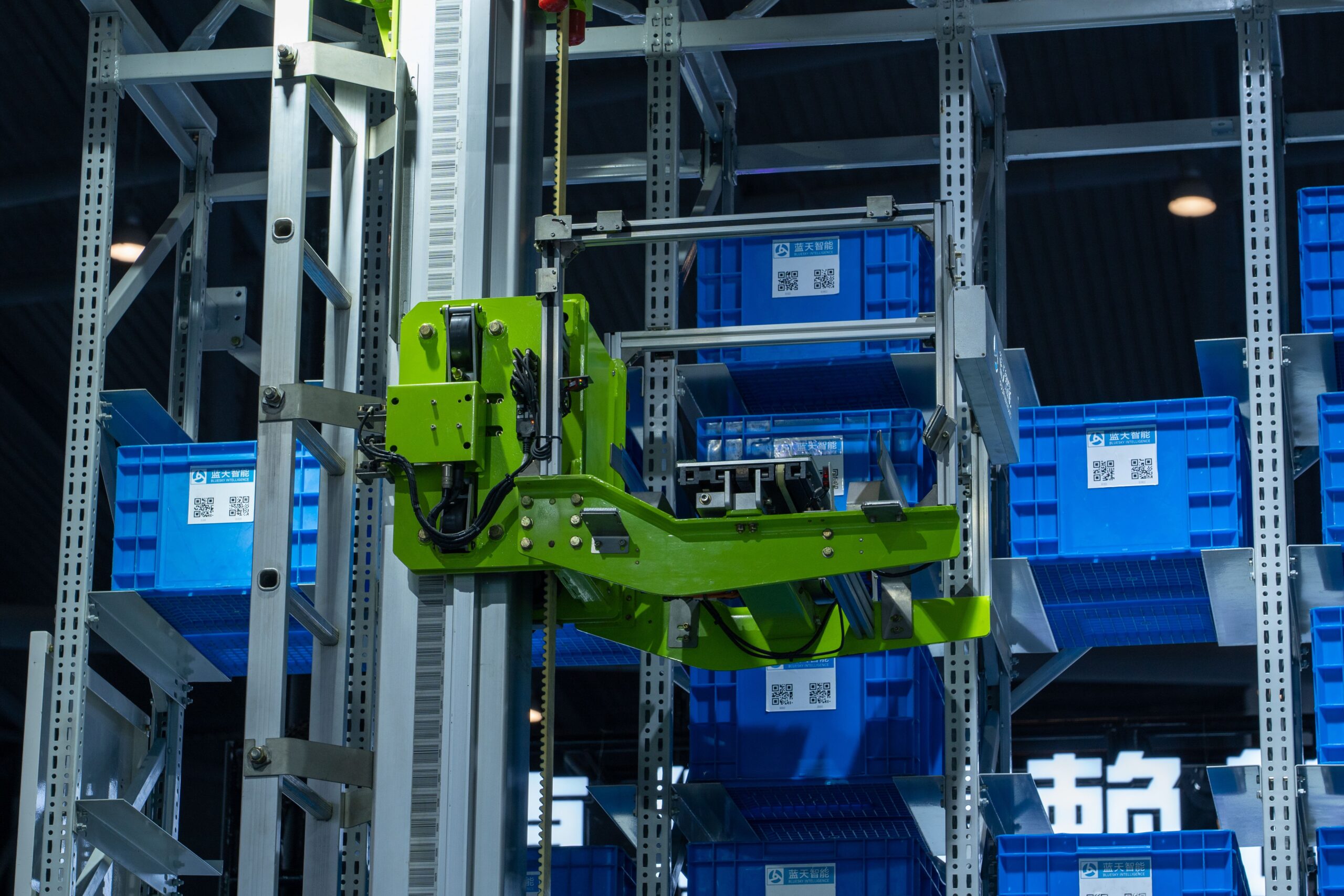
AutoStore differs from a conventional racked warehouse in the way stock is held and retrieved. Products sit in bins stacked inside a tightly packed grid, while robots travel across rails above it. When a particular bin is required, the control system directs a robot to retrieve it and present it at an access port where picking or replenishment can take place. Eliminating the need for personnel or trucks to enter aisles between every storage location produces a denser storage arrangement than traditional shelving.
Retrieving stock from a tightly packed grid requires the control software to coordinate bin access as well as robot travel. If the requested bin is below other containers, robots must temporarily move the bins above it. The location of fast-moving stock, number of available ports and balance between replenishment and picking can therefore change the effective rate of retrieval. Even with more than 100 robots, finished order throughput also depends on how many order lines can be picked and packed downstream.
Element Logic integrated the AutoStore installation with the wider warehouse operation. The eight-month implementation included manufacture, installation, testing and adjustments to Rhenus’s warehouse management system. That interface is needed to translate customer orders into bin-retrieval tasks, confirm inventory movements and return completed picks to the subsequent fulfilment stages. Rhenus has not published details of the specific software architecture or how its existing picking and packing lines have been reconfigured.
Bolesławiec serves ecommerce customers whose orders often contain small quantities drawn from a broad assortment. Rhenus says that the efficiency of processes handled by the new system has tripled, although it has not disclosed the original baseline, calculation method or measurement period. The claim cannot be interpreted as a threefold increase in the throughput of the entire 57,000m² building. The installation’s substantial bin capacity gives the operator a new storage and retrieval resource, but the number of dispatched orders remains dependent on subsequent handling.
The system uses what Rhenus describes as the largest available AutoStore bin size. Larger containers can accommodate a broader range of stock units, although the final suitability of each item still depends on its physical dimensions, weight, packaging and handling requirements. Businesses using high-density storage must also decide which products remain better suited to pallet racking, flow shelving or conventional handling, especially where goods are bulky, slow-moving or unsuitable for bin storage.
The installation follows earlier Rhenus AutoStore deployments in Europe, including the company’s first system in the Netherlands in 2018. Experience with earlier sites offers an established operating model, but the Polish warehouse has its own stock profiles, order patterns and layout constraints. Integrating the system with existing inbound and outbound movements is a significant part of realising the theoretical storage density without shifting congestion into picking, packing or goods dispatch.
Robotic retrieval also changes the work carried out by warehouse employees. Goods are presented at designated stations instead of requiring staff to travel repeatedly between shelving locations. Picking stations still need correct item identification, ergonomic handling, reliable replenishment and controls for inventory discrepancies. Maintenance procedures must account for a large quantity of stock being held inside one grid, including how orders are handled while equipment or software is unavailable.
The installation’s 4,500m² footprint represents less than a tenth of the overall 57,000m² logistics centre, leaving other building areas for inbound receipts, bulky inventory, packing, staging and despatch. It is not clear what share of customer stock has moved into AutoStore or whether those conventional areas have been reconfigured. Combining automated bins with remaining warehouse processes will determine whether faster retrieval translates into shorter order lead times rather than queues at downstream workstations.
Rhenus has not stated the project’s capital cost or supplied a site-wide before-and-after productivity measure. The completed installation nevertheless adds a high-density storage and goods-to-person picking capability at Bolesławiec. Further operational figures, particularly fulfilled order lines per hour, exception rates and despatch volumes, would allow the claimed process improvements to be assessed against the performance of the full distribution operation.