IN Brief:
- RWE has confirmed unloading ten Nordseecluster B foundations at Buss Ports’ heavy-lift terminal in Eemshaven.
- The project requires 60 monopiles averaging around 81 metres long and 1,350 tonnes, with handling scheduled across 2026 and 2027.
- Foundation installation is planned for 2027, turbine installation for 2028, and Nordseecluster B operations for early 2029.
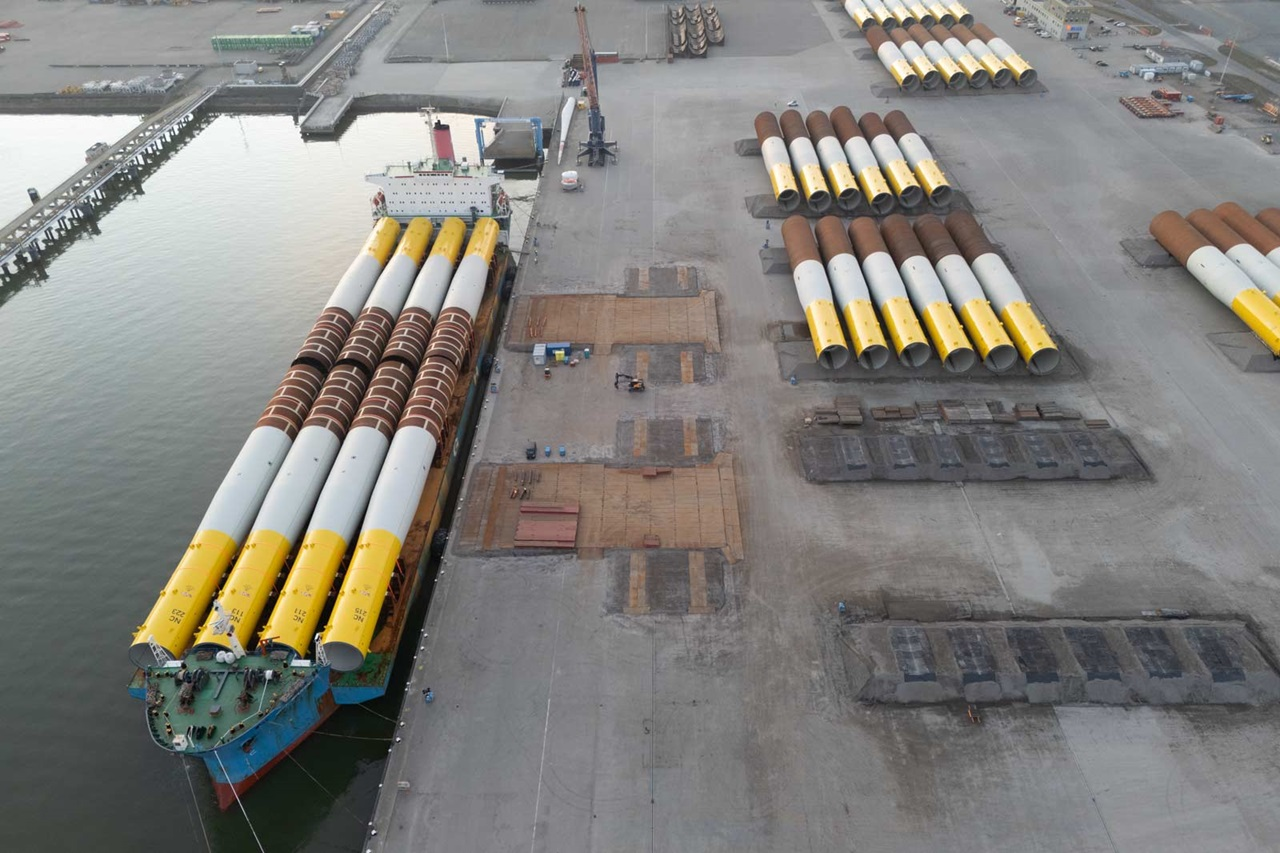
RWE has received and unloaded the first ten monopile foundations for Nordseecluster B at Eemshaven in the Netherlands. The arrival starts a port handling programme covering 60 foundations for the second phase of the offshore wind development in the German North Sea. Dajin Heavy Industry is manufacturing the structures, while Buss Ports’ heavy-lift terminal is providing the receiving and staging infrastructure. RWE expects the 60 foundations to pass through Eemshaven during 2026 and 2027.
The foundations are approximately 81 metres long on average and weigh around 1,350 tonnes each. A monopile is a large tubular steel structure that is installed in the seabed to carry a wind turbine. Its dimensions impose constraints on ship selection, lifting arrangements, quayside access, and storage positioning. Unlike conventional unitised freight, the foundation cannot be moved through a container terminal’s standard handling sequence, and both the available deck area and the lifting configuration have to accommodate the individual structure.
Unloading ten units is a defined delivery milestone, but none of those foundations has thereby been installed offshore. The structures must be stored, prepared, and dispatched for a separate marine installation campaign. RWE plans to start installing Nordseecluster B’s foundations during 2027 and has not specified the dates of individual offshore lifts in this update. The port operation therefore precedes another transport and handling stage rather than completing the component’s journey.
Dajin has separately documented the overseas delivery programme from its Tangshan manufacturing base in China. On 2 October, the manufacturer reported dispatching ten monopiles and ten main access platforms. It also described a subsequent shipment of ten monopiles aboard the 40,000-deadweight-tonne special deck carrier KING THREE, which departed on its maiden voyage in October. Those manufacturing reports demonstrate successive outbound shipments; the available updates do not establish which vessel delivered the ten foundations that RWE has now confirmed unloading.
Deadweight tonnage measures the total weight a ship is designed to carry, including cargo and other loads, rather than the weight of the monopiles on a particular voyage. Cargo dimensions, deck strength, securing arrangements, and stability are separate limitations. The movements between China and the Netherlands involve production, loading, ocean transport, discharge, and storage, with each stage needing to be aligned before an offshore installation vessel can collect the next structures. No voyage duration or consignment-specific transport cost has been disclosed.
Eemshaven’s role extends beyond transshipment. Long foundations need enough clear space for receiving operations and storage without preventing the next vessel from reaching the quay. Available ground-bearing capacity, suitable supports, lifting zones, and access routes all influence how a heavy-lift terminal can handle successive arrivals. RWE has identified the terminal’s storage areas and port infrastructure as reasons for using it, but has not published the specific cranes, unloading duration, or number of remaining vessel calls for Nordseecluster B.
The two-year handling window allows foundations to be staged before the offshore work is carried out. Production deliveries and installation dates need not coincide, provided the terminal can hold components safely and release the right units when vessels and weather windows permit. Staging can protect the installation sequence from some variations in overseas transport, although it also requires substantial space and careful stock positioning. The ten structures already unloaded are only a portion of the 60 that must reach the port under the current programme.
Nordseecluster is being developed about 50 kilometres north of the German island of Juist. Its first phase, Nordseecluster A, has planned capacity of 660 megawatts and is due to be fully operational in early 2027. Nordseecluster B will add 900 megawatts from 60 turbines, taking combined capacity to approximately 1.6 gigawatts. After foundations are installed in 2027, RWE plans to install B’s turbines in 2028 and begin commercial operation in early 2029.
The programme links three distinct construction schedules: the manufacturing and arrival of foundations, installation of seabed structures, and delivery and erection of turbines. Each phase depends on the preceding equipment being available and on offshore access. Changes in vessel availability or marine conditions could require adjustments to the order in which port stock is released, though RWE has not reported a delay to its current timetable. The 2027 and 2028 dates remain planned installation windows rather than evidence of work already completed.
Buss Terminal Eemshaven is also intended to support installation activity for RWE’s OranjeWind offshore project in the Netherlands. The company expects the shared port to create operational synergies by making specialist space and infrastructure available to both projects. No quantified cost saving has been provided, and the project update does not identify common vessels or lifting equipment assigned to both programmes. Access must still be coordinated within the port’s practical capacity.
RWE is responsible for developing and operating Nordseecluster, in which it holds 51% alongside Norges Bank Investment Management’s 49%. RWE forecasts that the completed two-phase project will produce roughly 6.5 terawatt hours of electricity annually. It has also signed a power purchase agreement with Amazon associated with 110 megawatts of Nordseecluster B capacity. Both figures concern future operation, not output from the B foundations now in storage. The next physical milestones are further foundation arrivals at Eemshaven and the start of the 2027 offshore installation campaign.