IN Brief:
- Global Port Tracker forecasts June US import volumes at 2.25m TEU, up 14.3% year-on-year.
- Imports are expected to fall below 2025 levels from July through September.
- The pattern points to early cargo movement ahead of tariff, fuel, and peak-season uncertainty.
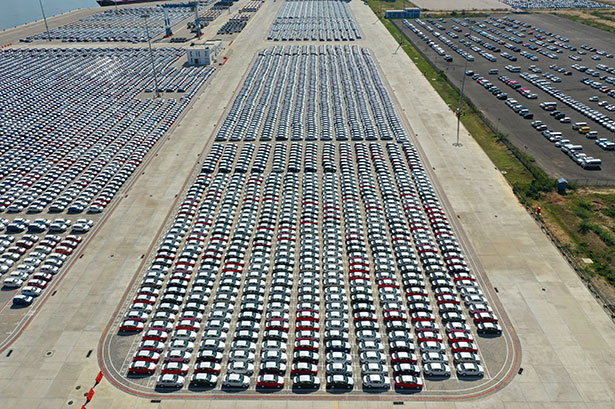
National Retail Federation and Hackett Associates expect US import cargo volumes to rise again in June before falling below 2025 levels into the autumn, signalling another period of frontloaded freight movement.
Ports covered by Global Port Tracker handled 2.05m TEU in April, down 5.1% from March and 7.3% year-on-year. May was projected at 2.14m TEU, up 9.7% from a year earlier, while June is forecast at 2.25m TEU, up 14.3%. The year-on-year increase is partly linked to the weaker import base created by tariff disruption last year.
The forecast then turns negative. July is expected to reach 2.19m TEU, down 8.4% year-on-year. August is forecast at 2.12m TEU, down 8.6%, and September at 2.06m TEU, down 2.2%. October is expected to edge up 0.1% to 2.08m TEU.
The first half of 2026 is forecast at 12.6m TEU, up 0.6% from the same period in 2025, helped by the May and June gains. Imports totalled 25.4m TEU in 2025, down 0.3% from 25.5m TEU in 2024.
The profile suggests that importers are bringing forward cargo rather than entering a straightforward demand upswing. Tariff uncertainty, fuel-cost exposure, and peak-season risk are encouraging earlier movement, especially where retailers and distributors want stock landed before potential cost increases take effect. That approach can protect near-term availability, but it shifts pressure into warehousing, cash flow, and inventory management.
For logistics teams, frontloading creates a different operational problem from sustained growth. Ports, drayage providers, rail ramps, distribution centres, and warehouses face a surge that may not continue. Labour schedules, yard space, appointment windows, container returns, and onward transport capacity all need to absorb higher volumes without assuming those volumes will remain at the same level later in the season.
IN Supply recently covered Transpacific spot rate surge exposes freight volatility, where sharp increases on Asia-US routes showed how quickly freight costs can move when demand, carrier pricing, and capacity management align. The latest import forecast points to the cargo-side effect of that volatility: buyers move earlier because waiting can mean paying more, missing allocation, or losing schedule control.
Another recent IN Supply story, China e-commerce sellers shift stock into overseas warehouses, showed how higher airfreight costs and customs changes are already pushing some sellers away from direct parcel models and toward bulk shipping and overseas fulfilment. That shift adds another layer to import planning because inventory is increasingly positioned before demand is finalised.
Frontloading can protect service levels, but it also carries commercial risk. Earlier cargo movement ties up working capital, increases storage requirements, and can leave companies holding stock in the wrong location if demand changes. For retailers, that risk is especially sharp in seasonal and promotional categories. For industrial importers, the risk is more often tied to project timing, customer schedules, spare-parts availability, or production programmes.
Warehousing pressure is one of the most immediate effects. When cargo arrives early, it needs space before it is sold, used, assembled, or redistributed. That can push more stock into overflow facilities, temporary storage, third-party networks, or port-adjacent space. If frontloaded cargo is not matched by accurate demand planning, the cost saving from avoiding a tariff or freight increase can be offset by storage, handling, obsolescence, and rework.
The forecast also complicates transport planning. A June import rise followed by weaker July, August, and September volumes can create a short spike in drayage, rail, and trucking demand. Providers may be reluctant to add permanent capacity for a temporary surge, which can leave shippers exposed to higher spot costs or reduced appointment availability. Inland congestion can then appear even if total annual demand is not especially strong.
The wider market is also shaped by uncertainty around China-origin flows and sourcing diversification. Importers continue to adjust exposure to China, Southeast Asia, India, Mexico, and other production markets, but diversification does not remove freight volatility. It changes where capacity is needed, which ports are used, and how much buffer stock is required.
The June forecast therefore gives a mixed signal. US import volumes are set to rise, but the increase does not necessarily indicate a healthier or more stable freight market. It reflects companies protecting themselves against policy and cost uncertainty by moving cargo earlier. That strategy can work, but only when inventory, warehousing, and inland transport are planned with the same discipline as the ocean booking.