IN Brief:
- Ning Yuan Dian Kun has entered commercial service on the Ningbo–Jiaxing coastal route with a pure-electric propulsion system.
- The 742 TEU vessel uses containerised battery packs, dual-mode charging, and intelligent navigation and control systems.
- The launch gives short-sea operators a live reference point for how electrification could reshape port calls, energy planning, and vessel design.
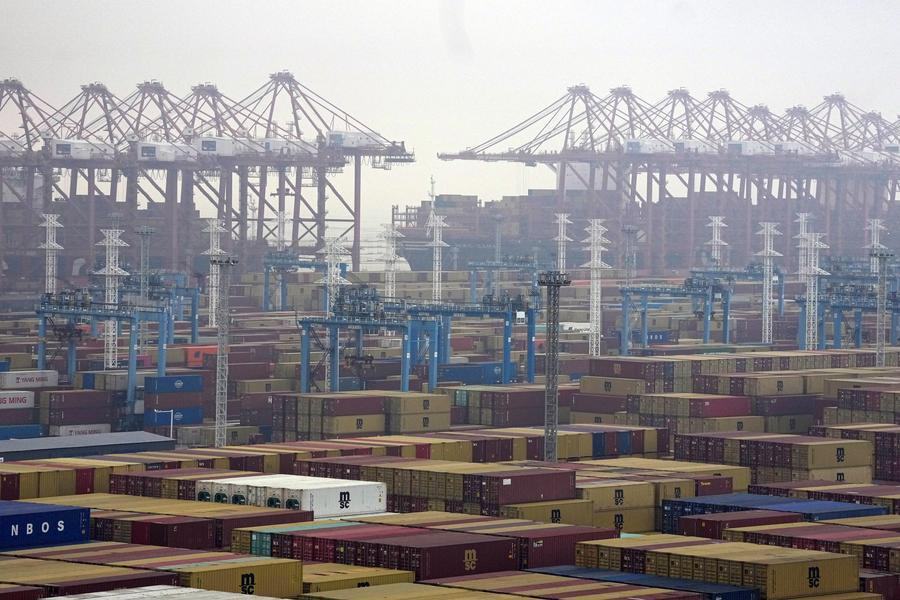
Ningbo Ocean Shipping has started commercial operations with Ning Yuan Dian Kun, a 10,000-tonne-class pure-electric intelligent container ship that is now running between Ningbo-Zhoushan Port and Jiaxing in Zhejiang province. The launch places a live coastal container service behind one of the most closely watched decarbonisation stories in regional shipping, moving the discussion from demonstration craft and harbour vessels into regular freight operations.
The vessel is 127.8 metres long, 21.6 metres wide, and designed to carry 742 TEU. It is fitted with 10 containerised battery packs with total capacity of about 20,000 kWh and powered by two permanent-magnet synchronous propulsion motors. The ship also uses smart navigation and engine systems, with autonomous collision-avoidance functions, high-precision tracking, and integrated ship-shore-cloud control intended to support safer and more efficient passage on a high-frequency coastal route.
Its energy system is built around two replenishment models rather than one. Shore power charging is combined with rapid battery-container swapping, giving the operator more flexibility on turnaround planning and making the vessel less dependent on a single charging sequence at berth. The open-deck design is also intended to improve cargo handling speed, while a revised bow profile reduces air resistance, tightening the ship’s operating efficiency beyond the propulsion system alone.
The commercial significance sits well beyond one hull. Short-sea container services are among the more plausible proving grounds for electric propulsion because routes are fixed, voyage lengths are predictable, and charging or swapping infrastructure can be concentrated at a limited number of ports. That does not make the economics easy, but it does narrow the operational problem. The closer a network is to repetitive, clockwork movement, the more viable battery planning becomes.
That is where this launch starts to matter. Ports on coastal feeder networks are already under pressure to cut berth time, improve equipment utilisation, and lower emissions without sacrificing schedule discipline. A pure-electric container vessel changes more than the fuel line. It changes how energy is procured, how turnaround windows are structured, and how operators think about redundancy when a ship’s power system is effectively part of the cargo-handling equation.
The next question is scale. One vessel can prove a concept, but a service pattern begins to test whether ports, grid support, maintenance capability, and operational planning are ready for repeat deployment. Ning Yuan Dian Kun will not decarbonise China’s coastal container sector on its own. What it does offer is a working model for short-sea electrification at a moment when shipping’s broader fuel transition still remains expensive, fragmented, and uneven across vessel classes.