IN Brief:
- Port of Sagunto is heightening STS cranes to serve larger ships.
- Sarens lifted two 620-tonne cranes by 11 metres using CS350.
- Higher crane clearance supports faster vessel turnaround and berth competitiveness.
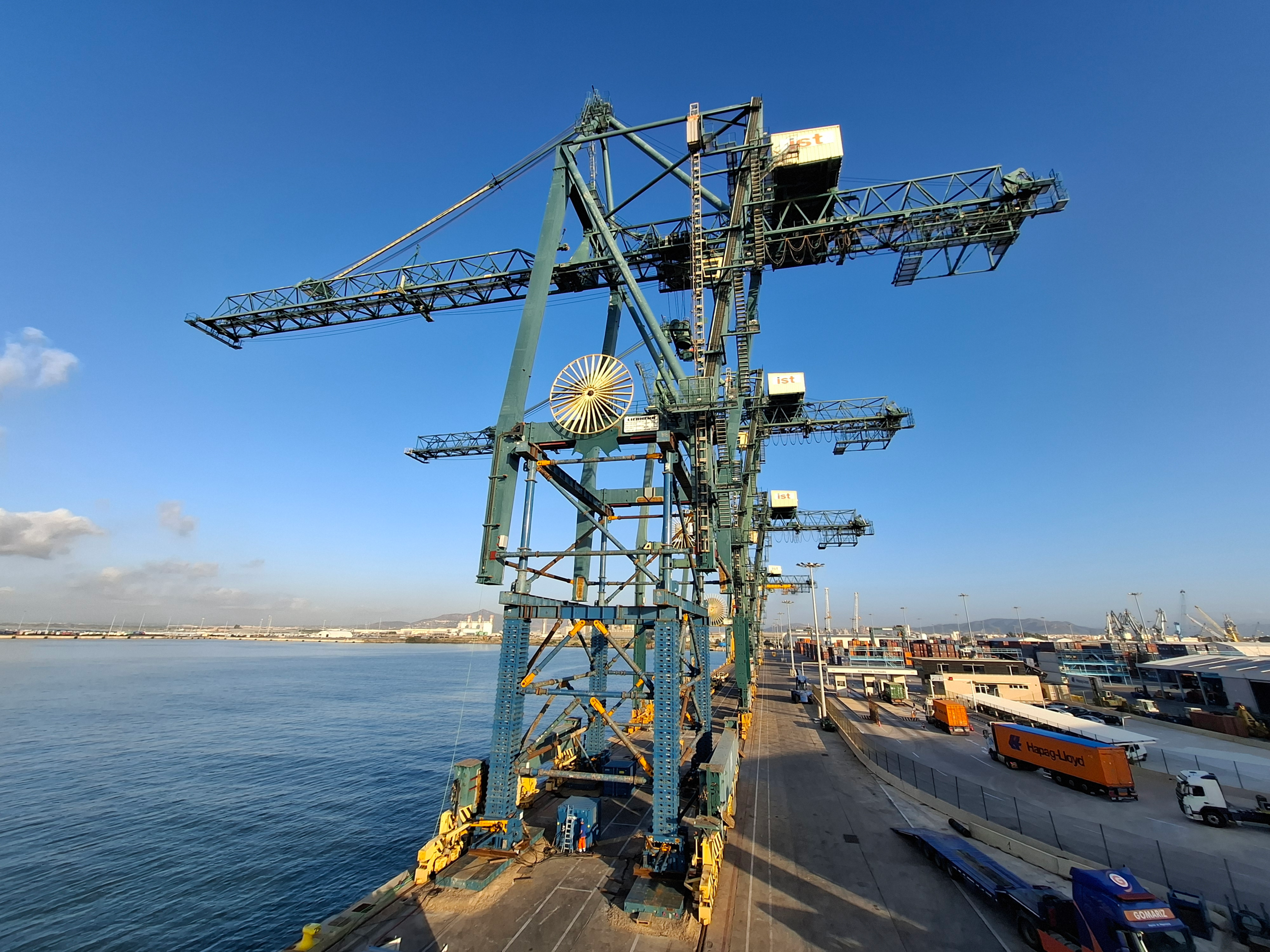
Sarens has completed a jacking operation at the Port of Sagunto in Valencia, lifting two 620-tonne ship-to-shore (STS) container cranes by 11 metres to increase working clearance and enable the terminal to handle larger, taller vessels.
The work was carried out for Quality Futura at Intersagunto Terminales, described as the main container operator at the port, with around 640 metres of berthing line and annual capacity of approximately 190,000 TEU. The port functions as a complementary option to the nearby Port of Valencia for container, general cargo, and bulk flows, with road and inland connections serving the industrial corridor around Sagunto and the Valencia–Teruel axis.
The technical scope centred on lifting each crane structure in a controlled sequence using synchronised hydraulic jacks positioned at structural support points. Sarens said the project required detailed stability checks because the cranes’ centre of gravity sits around 42 metres above ground level, directly affecting how load is distributed between jacks during each lift increment.
Sarens selected four CS350 system bases for the job, citing capacity and stability, and highlighting the system’s bottom-feed design. That approach avoids repeated work at height associated with top-feed systems, because lifting elements are inserted from below rather than installed and removed at the top of the stack. Sarens also noted that the CS350 can lift loads up to six metres without shoring, but that lifting above a six-metre stack requires a shoring system to stabilise the towers — a practical constraint when the target lift is 11 metres.
Beyond the jacking towers themselves, Sarens said the installation included a metal structure at the top of the lifting towers weighing around 100 tonnes, built from modular beams and support equipment. Logistics for the mobilisation were material: Sarens transported machinery and materials using 16 trucks from its yard to Sagunto, assembled the system on site in five days, and kept the equipment at the terminal for five weeks.
Operational conditions were not trivial. Sarens said wind speeds were monitored to remain within permitted limits, while periods of intense heat above 30°C and heavy rain interrupted planned procedures. It took about two days to jack each crane to final height, including the fitting of bracings, with six Sarens operators involved.
Larger vessels mean higher container stacks above deck, and terminals without sufficient crane clearance lose optionality on the services they can support. Sarens said the extra 11 metres increases clearance height enough for the terminal to work ships carrying up to 9 or 10 container levels above deck, allowing extensions to be integrated into the crane legs and improving suitability for modern trade routes.
José María Martínez, Technical Solutions KAM at Sarens, said: “Thanks to the lifting capacity of the STS cranes, the port now has renovated facilities that allow it to compete for ships that were previously forced to go to larger facilities.” He added that taller cranes can reduce manoeuvring time for large ships, lowering costs for shipping lines through faster handling.
For ports competing on schedule reliability and berth productivity, crane height upgrades are a blunt, expensive tool, but they are often cheaper than rebuilding quay infrastructure — and they directly affect what vessel classes can be served without operational workarounds.