IN Brief:
- Addverb has introduced Elixis-W as a wheeled humanoid aimed at industrial intralogistics use cases.
- The platform combines wheeled mobility, dual-arm manipulation, and a “physical AI” software stack for unstructured environments.
- Addverb says rollout will start with limited, closely supervised deployments, prioritising safety and repeatability.
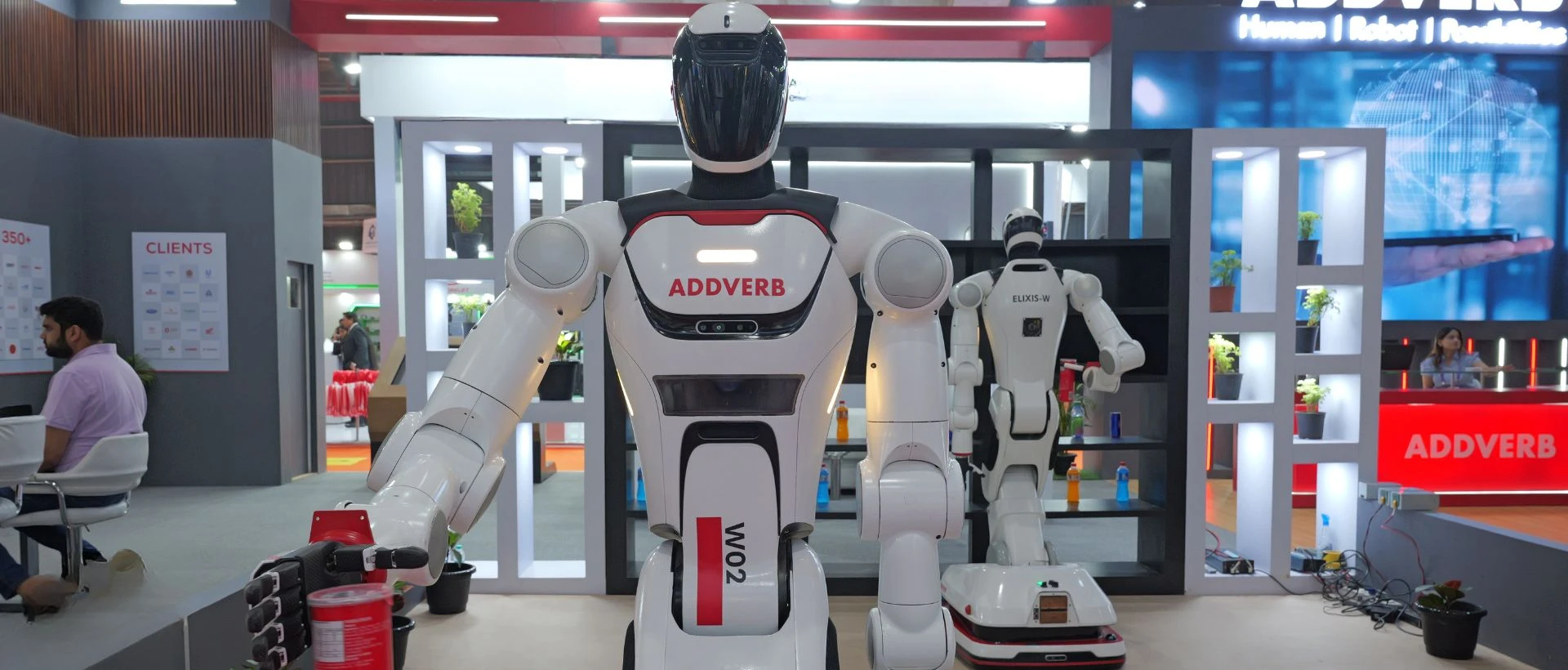
Addverb has unveiled Elixis-W, its first wheeled humanoid robot, positioning the system as a practical step toward deploying general-purpose robotics inside warehouses and factories where layouts, aisles, and workstations were designed around human movement rather than automation-first infrastructure.
On its Elixis product page, Addverb describes Elixis-W as a wheeled humanoid intended for longer routes, listing a 10 kg payload and speeds up to 1.5 m/s, with an estimated ~2-hour battery duration. The same reference material sets out a broader platform specification that includes 41 degrees of freedom, a five-finger dexterous end-effector option (or a parallel-jaw gripper), and a sensor suite built around stereo depth cameras and 3D LiDAR for perception-led navigation and manipulation.
The company’s framing is clear: wheels first, legs later. In its LogiMAT India 2026 blog post, Addverb argues that most industrial sites remain flat-floor environments where wheeled mobility reduces integration friction, while still enabling teams to validate the harder part of the humanoid proposition — reliable, safe task execution around people, racks, cages, pallets, and mixed inventory.
Technically, Addverb points to a stack combining 3D SLAM and navigation with controllers that “combine RL, imitation & MPC”, as well as “VLA enabled” multimodal sensor fusion. The intention, as described, is not a robot that simply follows mapped routes, but one that can interpret scenes, plan movement, and manipulate objects without forcing operations into rigidly structured workflows. That is a meaningful shift from conventional AMRs that are excellent at moving totes and pallets, but typically hand off the harder “last metre” work — grasping, placing, turning, sorting, and exception-handling — back to humans.
Addverb has also emphasised a cautious deployment approach. The company says Elixis-W will be introduced through limited proof-of-concept deployments in controlled industrial environments, with close supervision to validate safety, reliability, and consistency before any wider roll-out. That matters in practical terms because the value case for a humanoid in a warehouse is unlikely to be won on novelty; it will be won on uptime, safe behaviour in mixed-traffic aisles, maintainability, and integration with site systems that already struggle with exception rates and inventory ambiguity.
For operators, Elixis-W sits in an interesting middle ground: potentially more flexible than fixed automation, but more operationally demanding than single-purpose robotics. If the platform can execute repeatable manipulation tasks across multiple workflows — without turning every shift into a tuning exercise — it offers a route to automation that does not require rebuilding facilities around conveyors, high-density ASRS, or fully segregated robotic zones. If it cannot, it risks becoming an expensive demonstrator that is difficult to industrialise at scale.