IN Brief:
- The first rollout under the agreement will use 100+ robots to support high-volume processing.
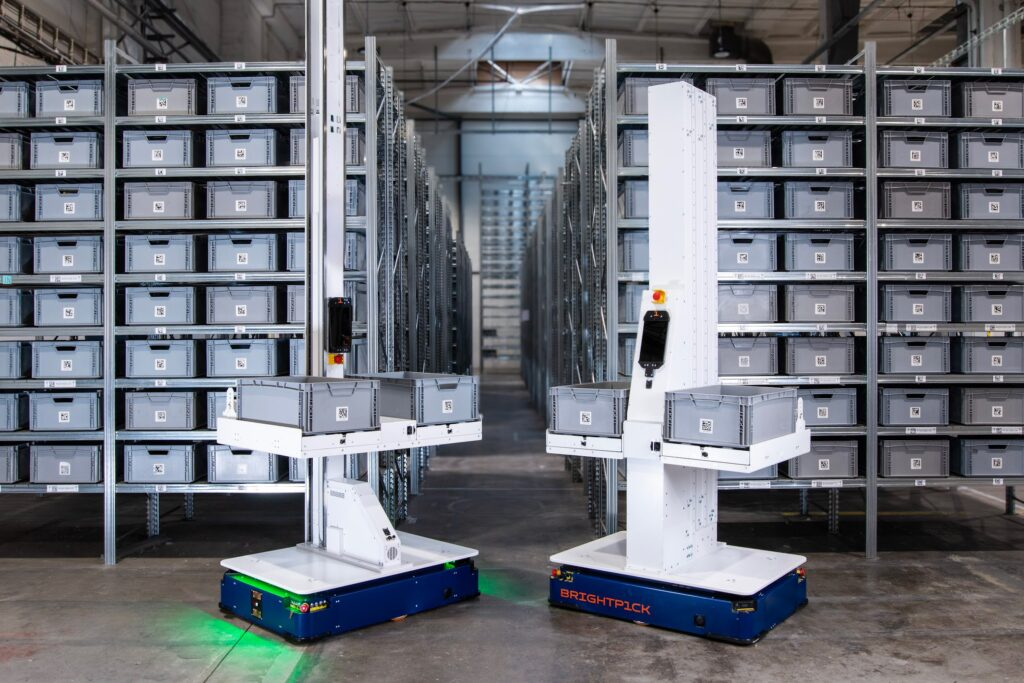
- Brightpick’s mobile picking robots are designed to pick and consolidate orders directly in warehouse aisles.
- The partnership is structured for multi-site expansion as NAPA standardises automation across its network.
Brightpick has signed a strategic partnership with NAPA to deploy AI-powered robotic automation across NAPA’s distribution centres, starting with a project that will use more than 100 Brightpick robots. The agreement follows a pilot collaboration in 2025 and an additional-site deal signed in early 2026, with further installations under consideration as NAPA scales the model.
For NAPA, the driver is consistency at the sharp end of automotive parts replenishment. Its store network spans nearly 6,000 locations in the US, supported by a nationwide distribution footprint, and it lists more than 560,000 parts, accessories, and supplies. That mix tends to produce high line counts, a long tail of slower-moving SKUs, and a steady stream of small-item picks where travel time, batch build, and order consolidation dictate performance as much as pick speed.
Brightpick’s approach is built around autonomous mobile robots that move through storage aisles, retrieve totes from shelving, and pick items into order containers without the back-and-forth to fixed goods-to-person stations. In practice, that configuration targets two bottlenecks at once: the walking and travel time that dominates manual piece-pick operations, and the downstream consolidation workload created by multi-zone picking.
Brightpick co-founder and CEO Jan Zizka framed the NAPA agreement as an inflection point for the company’s sector coverage, saying it “marks our first customer in the automotive sector.” NAPA’s Justin Ducharme, EVP, Distribution and Logistics, said the expanded deployment “supports our goal of continuously improving how we serve our customers,” positioning the automation work as a way to sharpen handling and replenishment performance as expectations for fast parts availability harden.
The partnership also pushes mobile manipulation deeper into industrial distribution, where automation has often focused on conveyance, sortation, and shuttle-based storage rather than in-aisle robotic picking. Brightpick has been public about recent performance improvements in its newer-generation platform, citing throughput gains per robot and pick rates that are intended to match typical warehouse associate productivity, while extending operation into longer shifts and overnight windows.
Operationally, the integration challenge is less about whether robots can pick, and more about how cleanly they slot into existing warehouse control, inventory systems, and labour models without forcing a DC into a multi-year rebuild. Brightpick’s pitch is that its systems deploy in weeks rather than quarters, and that automation can be layered into live facilities, with robots orchestrated as a fleet and dispatched to tasks in real time.
The initial 100+ robot deployment will be watched closely by the aftermarket supply base for a simpler reason: automotive parts DCs are unforgiving environments, with dense SKU counts, variability in item geometry, and service levels that do not tolerate drift. If NAPA can lift throughput while stabilising accuracy and cut-off times, it is the type of rollout that tends to replicate across a network.