IN Brief:
- DSV has launched a direct Luxembourg–Indianapolis air freight connection for pharmaceuticals.
- The route forms part of the company’s Air ThermoDirect cold-chain solution.
- The service is designed to reduce uncontrolled-environment exposure, cost, emissions, and operational risk.
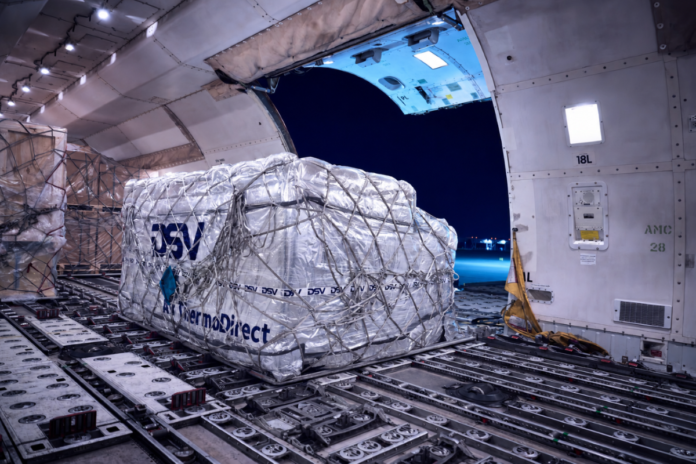
DSV has launched a direct Luxembourg–Indianapolis pharma air route as part of the latest expansion of its Air ThermoDirect solution, strengthening temperature-controlled connectivity between Europe and the United States.
The route operates through Indianapolis International Airport, one of the fastest-growing life sciences and healthcare logistics hubs in the US. It links two important pharmaceutical gateways and is designed to provide a more predictable cold-chain option for temperature-sensitive products moving between manufacturing and distribution regions.
Air ThermoDirect is built around temperature-controlled air freight movement without the complexity of active containers. The service is designed to reduce the time pharmaceutical products spend in uncontrolled environments while lowering handling complexity, cost, emissions, and operational uncertainty.
Pharmaceutical logistics is among the most demanding segments of the air cargo market. Products may require controlled ambient, chilled, frozen, or specialist temperature conditions, while the tolerance for delay is low because product integrity can be affected by a missed handover, unplanned dwell time, packaging failure, documentation error, or exposure on the tarmac.
The Luxembourg–Indianapolis lane gives DSV a direct corridor between two regions with strong life sciences activity. Luxembourg provides access to European pharma manufacturing and distribution networks, while Indianapolis has developed into a major US healthcare logistics node, supported by airport infrastructure, express parcel capability, and surrounding pharmaceutical operations.
Cold-chain logistics is moving beyond basic refrigerated transport into more controlled lane design. The strongest pharma routes now combine visibility, validated handling, reduced handoffs, and disciplined temperature control from origin to destination. Every transfer between warehouse, truck, terminal, aircraft, and receiving facility creates a point where time and temperature control can be weakened.
Reducing exposure to uncontrolled environments therefore becomes an operating principle rather than a service add-on. A direct route can remove some of the uncertainty created by multi-stop routings and fragmented ground handling, while giving manufacturers and distributors a clearer basis for planning release times, packaging choices, contingency procedures, and arrival windows.
European cargo infrastructure is being upgraded in parallel, with airport logistics estates adding specialist capacity for pharma and general cargo. Brussels Airport’s cargo estate expansion reflects the investment now being directed into buildings, energy performance, handling environments, and landside capacity for more regulated freight flows.
Product complexity is reinforcing that investment cycle. Biologics, vaccines, cell and gene therapies, clinical trial materials, and specialty medicines often carry higher value and stricter handling requirements than traditional pharmaceutical freight. Even where products are not ultra-cold, the cost of failure can be high because replacement stock may be limited, patient timelines may be affected, and regulatory obligations require evidence of control.
Sustainability is becoming part of the cold-chain equation as well. Temperature-controlled logistics has historically depended on energy-intensive storage, specialist packaging, active containers, and conservative routing. Operators now have to protect product integrity while reducing emissions, packaging waste, and avoidable transport complexity. A route that removes handling stages and unnecessary container dependency can support that balance if service reliability is maintained.
Airfreight will remain expensive compared with slower modes, but pharma shippers do not judge transport on freight cost alone. Product value, shelf life, regulatory exposure, patient need, and the cost of a failed shipment all shape the transport decision. Direct pharma corridors make that premium spend more controlled, especially where validated handling and predictable transit are worth more than broad network coverage.
DSV’s expansion of Air ThermoDirect on the Luxembourg–Indianapolis route adds another structured lane to a healthcare logistics market becoming more corridor-based. The future of pharma airfreight is likely to rest on fewer weak handoffs, better lane validation, and tighter integration between airports, forwarders, manufacturers, and final distribution networks.