IN Brief:
- Nomagic’s Shoebox Picker won the 2026 IFOY Award in the Robot Warehouse System category.
- The system handles fragile, two-piece shoeboxes using AI-driven perception and specialised gripping hardware.
- Physical AI is moving warehouse robotics toward variable, labour-intensive workflows that conventional automation has struggled to address.
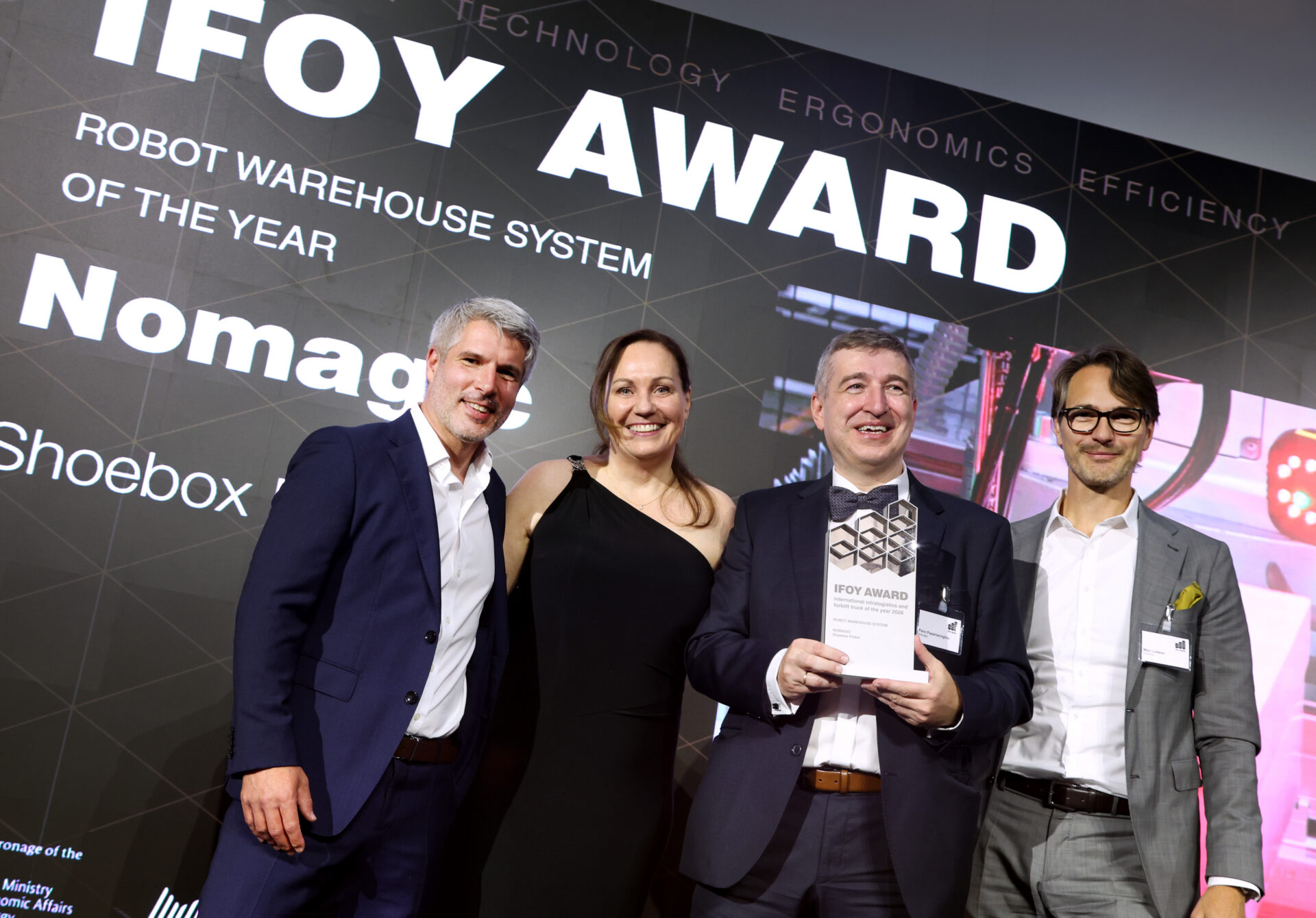
Nomagic has won a 2026 IFOY Award for its Shoebox Picker, a Physical AI warehouse robotics system built to automate one of fashion and footwear fulfilment’s most awkward manual tasks.
The Warsaw and Atlanta-based company won in the Robot Warehouse System category. Its Shoebox Picker is designed to handle two-piece shoeboxes at commercial scale, addressing a product format that creates problems for conventional robots because boxes can be fragile, variable in size, inconsistent in orientation, and often unsealed.
The system combines AI-driven perception with specialised gripping hardware, allowing it to pick, pack, and sort shoeboxes in live warehouse conditions, including mixed-bin scenarios. Nomagic says the solution can automate up to 98% of shoebox SKUs and is already deployed in a customer environment.
The award follows a period of investment and product development for the company. Nomagic announced a $10m Series B extension earlier this year, bringing total funding to more than $84m, with plans to expand commercial activity in the US and continue developing Visual-Language-Action models for warehouse robotics.
Shoeboxes present a deceptively difficult automation case. Standard cartons are generally rigid, sealed, and predictable; shoeboxes often behave differently. Lids shift, edges deform, boxes arrive at odd angles, and packaging variation makes simple gripping unreliable. In a high-volume fashion warehouse, even a modest exception rate can push work back to manual teams and weaken the commercial case for automation.
The industry’s robotics frontier is moving steadily into these difficult zones. At pallet level, J-Elephant and Geek+ have been working on automation for heavy, repetitive pallet movement, another workflow that sits between traditional mechanisation and fully automated handling. Nomagic operates at item level, but the pattern is related: automation suppliers are pushing into jobs that were previously left to human adaptability because the product, environment, or process was too variable.
Fashion fulfilment creates that variability every day. Product sizes change by season, packaging quality is inconsistent, returns are common, and demand patterns can swing quickly around promotions or launches. The operational burden often falls on manual teams working around automated storage, conveyors, or sorters that still depend on people to manage irregular picking and packing tasks.
Physical AI is intended to narrow that gap. Rather than depending only on fixed rules and tightly controlled presentation, systems combine perception, learning, and motion control to respond to a wider range of real-world product states. The promise is not that robots become universally capable overnight, but that they begin to handle categories of work that previously broke conventional automation assumptions.
Commercial deployment will depend on more than technical capability. Robotics systems must fit into existing warehouse layouts, integrate with warehouse management and control systems, maintain pick quality through peaks, and avoid creating new bottlenecks around exception handling. Fashion and footwear fulfilment centres often operate under tight labour and service pressure, leaving little room for long, disruptive integration projects.
The Shoebox Picker’s live deployment is therefore important because it moves the technology from demonstration into operational use. Warehouse robotics has seen many impressive prototypes over the past decade, but the market is increasingly selective about systems that cannot withstand real product mix, real shift patterns, and real maintenance conditions.
Nomagic’s award gives the shoebox workflow unusual prominence, but the wider point is larger than footwear. The next stage of warehouse automation will be shaped by systems that can handle the messy, variable, high-touch tasks left behind after storage, conveying, and sortation have been mechanised. Shoeboxes are one example; the competitive field is much broader.