IN Brief:
- FastMove travels at up to 2m per second and exceeds 600 pallets per hour.
- Standard vehicles carry 1,500kg, with twin-load configurations supporting 3,000kg.
- The system operates between -30°C and 50°C across frozen, ambient, and industrial environments.
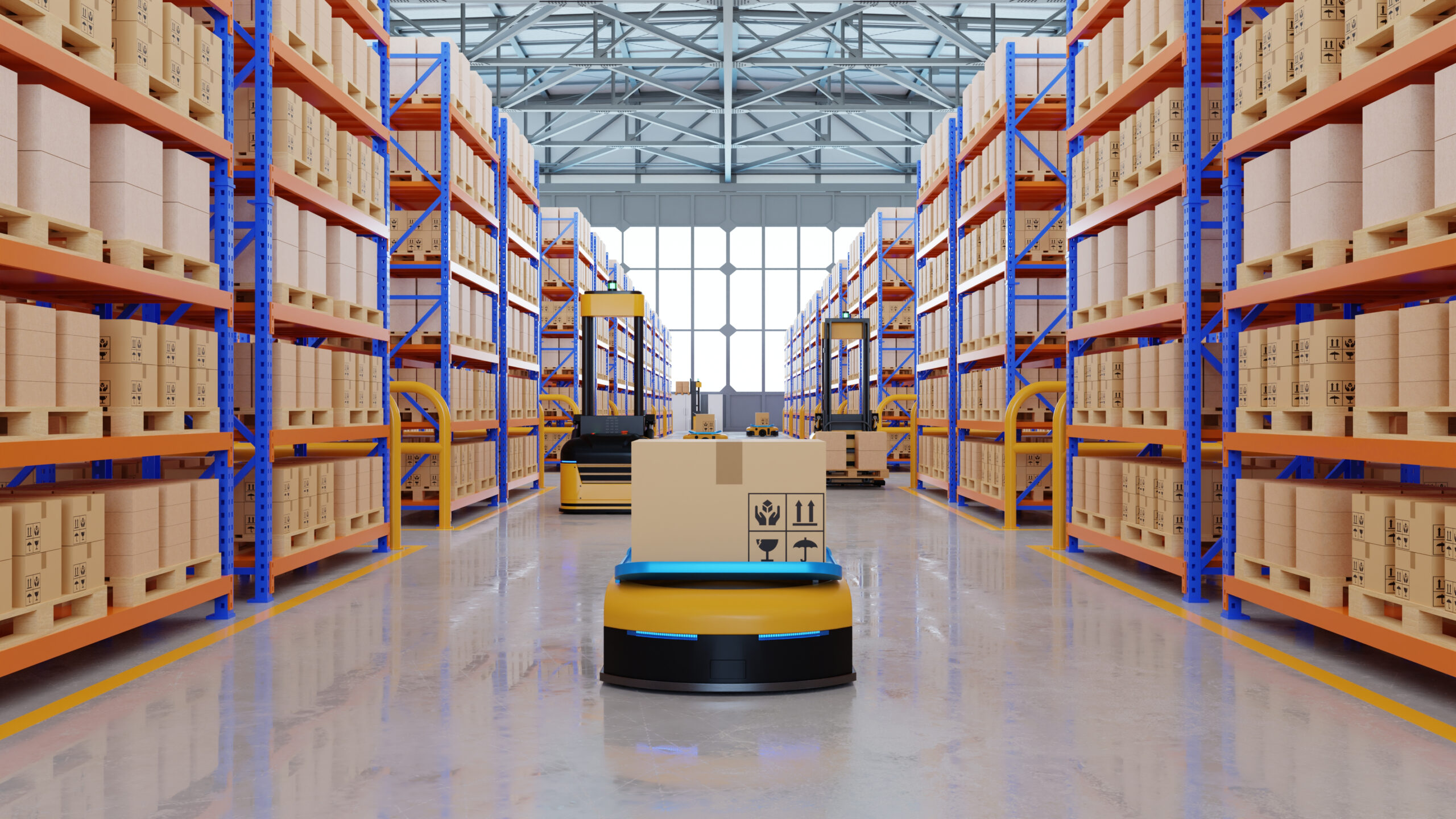
Swisslog has introduced FastMove, a modular electrified monorail designed to carry pallets across long distances and complex routes within automated warehouses, production sites, and distribution centres.
The system travels at speeds of up to two metres per second and can handle more than 600 pallets per hour. Standard vehicles carry loads of up to 1,500kg, while a twin-load configuration increases capacity to 3,000kg.
FastMove is aimed at food and beverage, consumer-goods, retail, and industrial operations where high pallet volumes need to move between receiving, storage, production, picking, consolidation, and despatch.
Its track can be arranged around structural columns, equipment, working areas, and irregular building geometry, allowing the system to cross routes that would be difficult to serve with floor-level conveyors. Vehicles operate independently along the electrified rail and can be added as throughput grows.
Swisslog is presenting FastMove as an alternative to conventional pallet conveyors over longer or more complicated connections. Roller and chain conveyors remain effective for predictable point-to-point flows, although extensive installations require motors, sensors, supports, guarding, transfers, and control equipment along the complete route.
A monorail concentrates propulsion within the individual vehicles and track system. Fewer powered components may be required across a long connection, although switches, lifts, control systems, safety devices, and maintenance areas remain integral to the installation.
Capacity can be increased by adding carriers rather than extending every section of conveyor. That modularity supports phased investment where anticipated volume growth does not justify the final fleet size on the first day of operation.
The system can work between -30°C and 50°C, bringing frozen-food storage and other temperature-controlled environments within its operating range. Cold conditions place particular demands on lubrication, sensors, cabling, materials, tolerances, and battery or electrical performance.
Automation inside a freezer can reduce the amount of manual travel through difficult working conditions while limiting the time that doors and temperature zones remain open. Faster, repeatable pallet transfers also support more stable replenishment between frozen storage, picking, and production areas.
Food and beverage plants may use the monorail to connect production with storage while reducing forklift activity around processing lines. A dedicated transport path creates clearer separation between pedestrians, hygiene-controlled zones, production equipment, and logistics traffic.
Raised or segregated routes remove some of the conflicts created when forklifts, pallet trucks, pedestrians, and autonomous mobile robots share the same floor. Transfer points still require guarding and controlled access, although much of the routine travel can occur outside occupied aisles.
Warehouse layout is increasingly shaped by the cost and scarcity of suitable space. A transport system capable of following the building rather than demanding a wide ground-level aisle can improve the use of irregular areas and preserve floor space for storage, production, maintenance, or picking.
FastMove also supports modernisation projects where existing automated equipment remains serviceable. Many warehouses contain storage cranes, conveyors, controls, and software installed over several investment cycles, making complete replacement costly and operationally disruptive.
A new monorail layer can connect older storage systems with recently added production, picking, or despatch areas. Integration will still depend on common pallet identification, routing logic, load status, and warehouse-control software capable of coordinating equipment from different generations.
The product enters a market where fixed and mobile automation are converging. HelloFresh has pushed autonomous mobile robots further into chilled fulfilment, using flexible vehicles close to production and order assembly where flows can change rapidly.
Other facilities continue to favour highly structured pallet storage, including the automated rice-handling system installed for Herba Ingredients. Fixed equipment remains attractive where product volumes, load formats, and storage profiles are stable.
FastMove occupies the space between those approaches. Its route is fixed, although individual vehicles can receive different missions and the fleet can grow incrementally, providing more flexibility than a continuously driven conveyor while retaining a dedicated transport path.
The commercial case will depend on pallet volume, travel distance, layout complexity, and service requirements. A short, high-volume route may still favour conveyor, while low-throughput movements may be handled more economically by forklifts or mobile robots.
Maintenance planning will be central because several warehouse processes may depend on the same track network. Vehicle redundancy can preserve some capacity during servicing, although switches, controls, and transfer stations require contingency procedures to prevent a local fault from isolating an entire storage or production area.
FastMove gives Swisslog another method of connecting automated storage with the wider facility. Its performance will be judged through availability, whole-life cost, throughput, and the ease with which the system can expand around changing production and distribution requirements.