IN Brief:
- Reid Stockfeeds has moved to a six-truck rental fleet supplied by Linde Material Handling.
- Three Linde H25 internal-combustion forklifts and three Baoli KBE25 electric trucks were selected for different operating environments.
- FleetFOCUS telematics will manage inspections, authorised access, impacts, equipment isolation, and operator accountability.
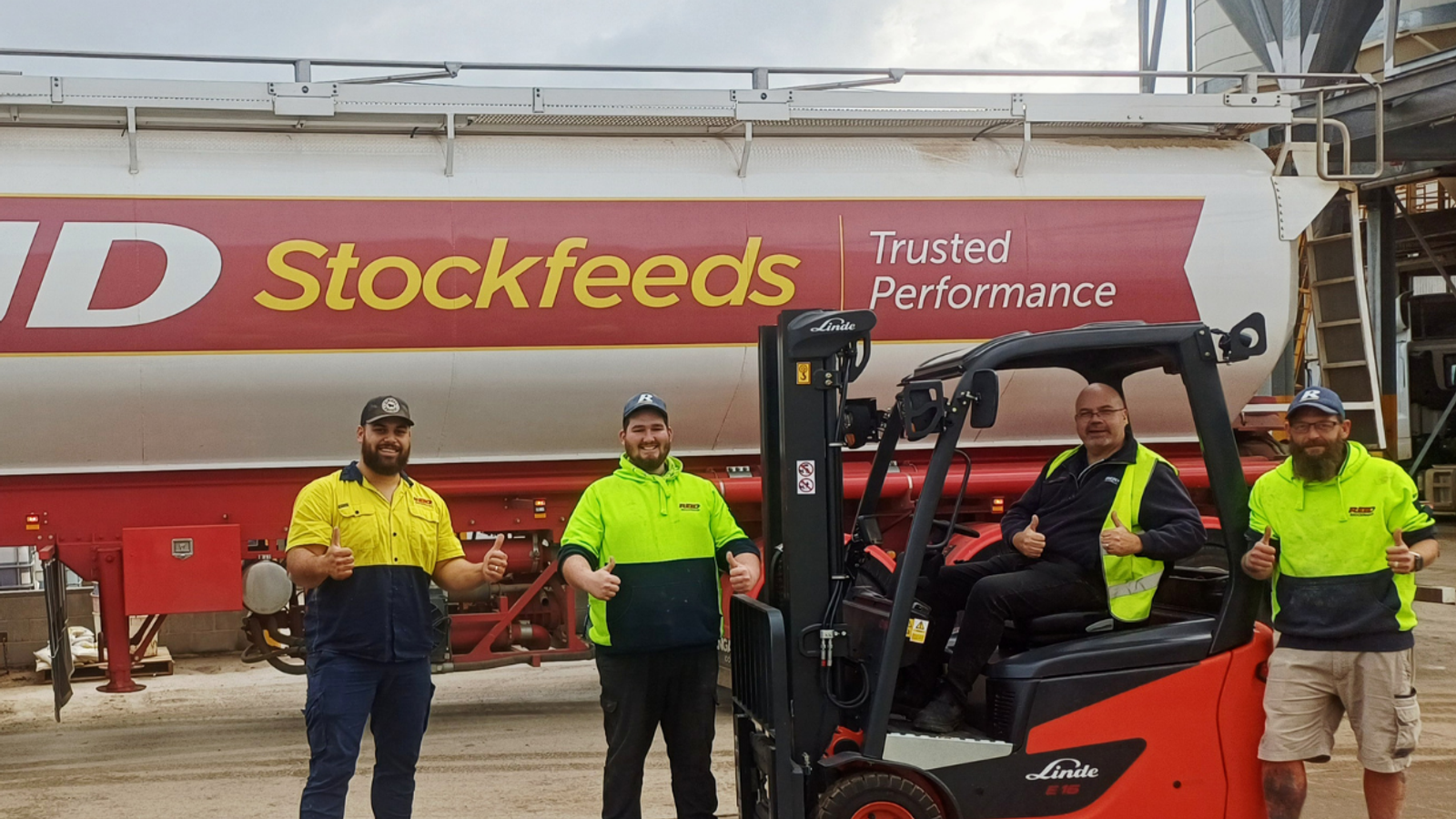
Reid Stockfeeds has introduced a mixed fleet of electric and internal-combustion forklifts across its Australian feed-manufacturing network under a long-term rental agreement with Linde Material Handling.
The six-truck fleet comprises three Linde H25 hydrostatic internal-combustion forklifts and three Baoli KBE25 electric machines. Its specification was developed around the surfaces, traffic patterns, indoor conditions, shift structures, and handling duties found across Reid Stockfeeds’ five sites.
A major manufacturing plant at Trafalgar and a high-output bagging operation at Cobden sit within a network serving livestock producers across Victoria, South Australia, Tasmania, and New South Wales. Forklifts move ingredients, bulk bags, finished feed, packaging, and palletised goods between intake, production, storage, and dispatch.
Most locations operate two shifts each day, leaving little tolerance for equipment failure during live production. Cobden handles hundreds of completed pallets daily, while mineral additives including salt and sugar create further inbound and internal movements around its processing operation.
Jason Shelley, transport manager at Reid Stockfeeds, said: “Our forklifts are critical to running our mills. If one goes down, the whole site feels it.”
An initial preference for a fully electric fleet was revised after detailed site surveys, since Cobden’s concreted indoor routes suited battery machines while gravel, uneven outdoor surfaces, and a road crossing required the stability and endurance of hydrostatic internal-combustion trucks.
Powertrain follows the duty cycle
Battery-electric forklifts remove local exhaust emissions, reduce noise, and can lower routine maintenance demand, but their suitability depends on charging access, shift duration, floor condition, gradients, load weight, temperature, and the intensity of operation. A uniform fleet would have simplified procurement while leaving some duties poorly served.
The Baoli electric units will replace gas forklifts inside warehouse and production areas, improving air quality and providing tight turning circles around racking and process equipment. Overnight charging is expected to support a full working day under the current duty cycle.
Outdoor work will be handled by the Linde H25 trucks, whose hydrostatic drive enables controlled acceleration, braking, and direction changes. Smoother movement over uneven ground should reduce physical shocks transmitted to operators and provide more stable handling across rougher routes.
Comfort had become an operational concern under the previous fleet, with drivers reporting bruising after repeated travel across poor surfaces. Testing before the contract was awarded allowed Reid Stockfeeds to assess the machines against its actual routes rather than relying solely on specification sheets.
Fork positioners have been fitted throughout the fleet to accommodate varying pallet widths and bulk bags. Operators can change fork spacing from the cab instead of leaving the seat to adjust the tynes manually, reducing handling time and exposure around the front of the machine.
BlueSpot warning lights project a visible indication into the travel path, supplementing mirrors, pedestrian segregation, horns, and local traffic rules. Mills and warehouses contain doorways, columns, process equipment, stacked product, dust, and noise that can restrict visibility or mask an approaching vehicle.
Telematics becomes part of site control
Linde’s FleetFOCUS platform will provide digital pre-start checks, individual operator logins, impact monitoring, and electronic isolation. Unauthorised personnel can be prevented from starting a truck, while defects and incidents are attached to a specific machine, operator, and time.
Those records extend beyond fleet administration because feed-manufacturing operations need evidence that handling equipment has been inspected, maintained, cleaned where required, and used by trained personnel. Digital checks reduce reliance on paper forms that may be incomplete, damaged, or reviewed only after an incident.
Impact data can reveal repeated contact with racking, barriers, doors, equipment, or product, although a cluster of incidents may point to layout and process weaknesses as well as operator behaviour. Narrow routes, damaged floors, blind corners, unrealistic production flows, and unsuitable loads can all produce recurring events.
Utilisation records should also show whether the six machines remain distributed appropriately between sites. Persistently low hours may indicate that a truck can be redeployed, while excessive use may expose insufficient capacity or an imbalance between production and dispatch.
The rental arrangement combines equipment and servicing within a planned monthly cost, with regional support forming an important part of the contract. Typical service attendance within one or two days still requires local contingency, since a critical truck can stop loading or production while a technician is travelling.
Attachment compatibility, spare-machine availability, parts holdings, safe alternative methods, and the ability to transfer work between areas remain necessary alongside the service agreement. Reliability is strengthened by supplier support, but it is not outsourced entirely.
Reid Stockfeeds’ mixed specification reflects the physical work carried out at each mill rather than a single technology preference. Indoor air quality, rough ground, pallet dimensions, shift intensity, operator comfort, telematics, and service reach have shaped a fleet in which each machine has a defined operating role.