IN Brief:
- The Venlo installation uses 127 Skypod robots, 60,000 rack locations, and eight goods-to-person stations.
- Daily throughput ranges from 40,000 to 70,000 pieces, with peaks of 2,200 order lines per hour.
- GXO is using the automated operation for Guess distribution across EMEA and Asia alongside growing e-commerce volumes.
GXO Logistics and Exotec have completed an automated fulfilment deployment for Guess at GXO’s Venlo operation in the Netherlands, installing 127 Skypod robots, 60,000 rack locations, eight goods-to-person stations, and around 200 metres of conveyor.
The live system processes between 40,000 and 70,000 pieces per day according to seasonal demand and can reach 2,200 order lines per hour during peak periods. GXO manages inbound logistics, quality-control and garment-conditioning services, and outbound distribution for Guess across EMEA and Asia from the site.
Fashion distribution combines a large number of stock-keeping units with substantial seasonal variation. Sizes, colours, collections, promotions, and channel demand can alter the velocity of individual products rapidly, while fulfilment capacity still has to remain available for the wider range.
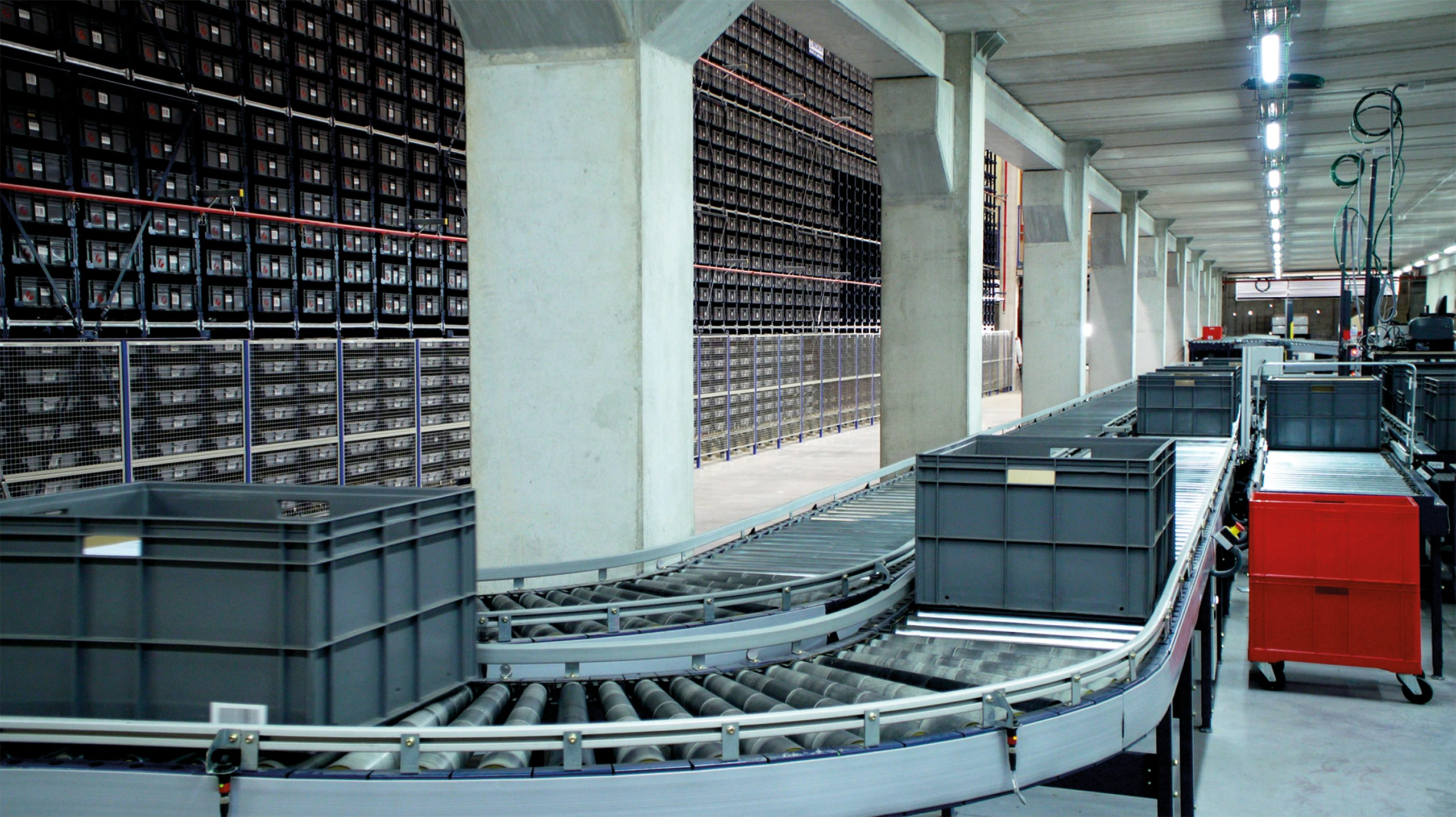
Exotec’s Skypod system stores inventory in a high-density rack and uses mobile robots to retrieve products for operators at fixed goods-to-person workstations. At Venlo, that storage and picking layer is connected to the wider operation through conveyors and supporting handling equipment rather than functioning as an isolated robotic cell.
The detailed system includes vertical movement, tote handling, and consolidation equipment around the robotic storage operation. Exotec acted as the integrator for the deployment, giving GXO one party responsible for coordinating several automation elements rather than leaving the warehouse operator to reconcile separate equipment suppliers.
That integration is particularly useful in contract logistics, where automation has to remain compatible with a customer’s changing order profile. GXO cannot design the site solely around one fixed retail pattern if Guess subsequently increases e-commerce volumes, changes regional distribution requirements, or alters the number of products held at Venlo.
Store replenishment and e-commerce also use warehouse capacity differently. Retail orders can involve larger consolidated quantities moving to known destinations, while consumer orders are usually smaller, more fragmented, and sensitive to late order cut-offs.
The same inventory pool therefore has to support both without creating competing processes that reduce throughput. Goods-to-person automation allows software to determine which stock is presented to operators while reducing the relationship between an individual SKU and a fixed manual pick face.
Exotec says end-to-end processing time at Venlo has been reduced to one day following deployment. That figure provides a broader measure than robot speed because orders can still lose time after picking if consolidation, value-added work, packing, or despatch cannot keep pace.
The site is also absorbing additional e-commerce volume for the Benelux market. New order profiles will use the same 127-robot installation, testing whether the capacity designed into the system provides enough headroom when several channels reach seasonal peaks simultaneously.
Inventory accuracy remains fundamental to the operation. Dense automated storage can reduce travel and improve presentation of stock to operators, but inaccurate product records, poorly timed replenishment, or inbound delays can still prevent a fast picking system from finding the right item when it is needed.
Fashion inventory also changes velocity quickly. A product can move from ordinary demand to a high-volume item during a successful launch or promotion, while seasonal stock can slow sharply as a collection nears its end.
Robotic storage gives the software more freedom to manage those shifts without physically rebuilding long rows of manual pick faces. The advantage is strongest when demand data, stock records, and the automation-control layer remain synchronised closely enough for the system to respond to the changed profile.
The 60,000 rack locations give Guess substantial storage capacity inside the automated operation, but cubic utilisation is only part of warehouse performance. Picking accuracy, workstation productivity, replenishment, downstream handling, labour planning, and carrier cut-offs determine whether that capacity turns into reliable customer orders.
GXO is already beyond the commissioning stage, so the installation can now be assessed through live operating figures rather than projected performance. Between 40,000 and 70,000 pieces are moving through the system each day, while peak processing reaches 2,200 order lines per hour.
The next pressure point will come as e-commerce and seasonal demand use more of that available capacity. If Venlo can absorb those additional volumes without major re-engineering, the deployment will have demonstrated the flexibility GXO needs from automation installed inside a long-term contract-logistics operation rather than a single-purpose warehouse.