IN Brief:
- Hyroad supplies hydrogen and maintenance from leased space within IMC Logistics' Fontana yard.
- The agreement supports IMC's Class 8 hydrogen fuel-cell trucks operating in Southern California drayage.
- Hyroad's nearby Santa Fe Springs station recorded 45 fuelling transactions during its first full week.
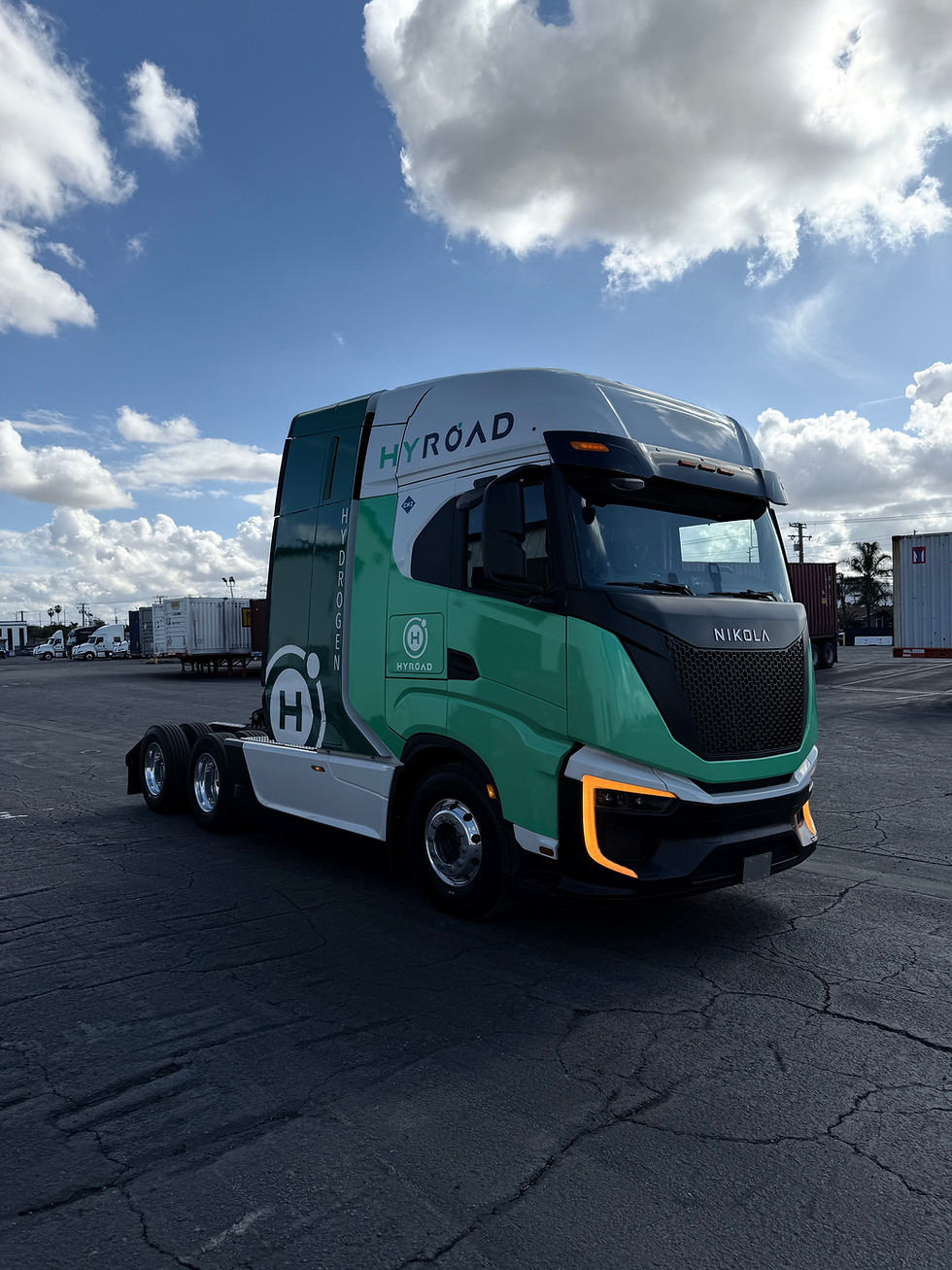
Hyroad Energy is supplying hydrogen fuel and vehicle maintenance for IMC Logistics’ Class 8 fuel-cell truck fleet at the carrier’s Fontana yard in California, placing both services inside a working drayage operation.
Hyroad leases space within the IMC facility and provides ongoing refuelling, maintenance, and repair services from the site. The arrangement gives the carrier one service point for two of the support functions required to keep its hydrogen trucks available for daily work.
IMC Logistics provides drayage and landside logistics across the United States, while its Pacific operation is using a mixture of battery-electric, hydrogen fuel-cell, and other emerging technologies as it expands lower-emission freight capacity.
The Fontana agreement moves hydrogen support closer to the fleet itself. Instead of sending trucks to a remote public station and then arranging specialist maintenance separately, the carrier can refuel at its operating yard while Hyroad remains responsible for the associated vehicle service.
That arrangement addresses one of the practical constraints around hydrogen heavy vehicles. A truck can be technically capable of completing its duty cycle but still deliver poor fleet utilisation if suitable fuel or qualified maintenance is unavailable close to the route.
Drayage makes availability particularly important because trucks typically work repeated movements between ports, rail terminals, warehouses, distribution centres, and customer facilities. A vehicle held out of service can remove capacity from a tightly scheduled flow even when the underlying journey is relatively short.
Hyroad’s Fontana work follows the launch of a mobile hydrogen station at Tom’s Truck Center in Santa Fe Springs in July. That installation uses Taylor-Wharton equipment combining a 1,000-kilogram liquid-hydrogen tank, pump, dispenser, controls, and safety systems in one mobile package.
Hyroad says the Santa Fe Springs station completed 45 fuelling transactions during its first full week, with individual fuelling times consistently below 25 minutes. Those figures provide an early indication of station use, although they do not establish the long-term utilisation, cost, or reliability of the wider network.
The Fontana model differs by placing fuel directly inside the customer’s yard. Depot-based infrastructure gives the fleet a known refuelling point linked to its operating schedule and reduces dependence on a public network whose coverage remains limited compared with conventional diesel supply.
Maintenance is the second half of the availability equation. Fuel-cell trucks combine hydrogen storage, high-voltage electrical equipment, batteries, fuel cells, and conventional heavy-vehicle systems, creating service requirements that ordinary diesel workshops may not yet be equipped to handle.
Hyroad has already concentrated support capability in Fontana, including warehouse space and parts inventory connected with hydrogen-truck maintenance. The IMC agreement allows that technical infrastructure to be used alongside fuel supply rather than leaving the carrier to manage separate specialist relationships.
Southern California provides a demanding environment in which to test the model. Port and inland freight volumes create dense Class 8 truck activity, while fleet operators face pressure to reduce emissions without sacrificing vehicle availability or delivery performance.
A proposed 70-port electric truck charging hub at National City near the Port of San Diego has recently advanced through environmental and coastal approvals, illustrating the parallel infrastructure build-out required for battery-electric heavy freight. Hydrogen removes the long charging event from the operating model but introduces its own production, delivery, storage, station, and maintenance requirements.
IMC’s mixed approach avoids relying on one propulsion technology for every route. Battery-electric trucks may suit predictable return-to-base work where charging can be planned around dwell time, while hydrogen offers different refuelling and range characteristics for other duty cycles.
The announcement does not disclose the size of IMC’s hydrogen fleet, expected fuel volumes, contract value, or agreement duration. Those omissions prevent the current deployment from being treated as evidence of large-scale hydrogen adoption across the carrier’s network.
The operational structure is nevertheless concrete. Hyroad is fuelling and maintaining Class 8 fuel-cell trucks from inside the logistics yard rather than demonstrating a vehicle or station in isolation, connecting the energy infrastructure directly with day-to-day freight activity.
That makes vehicle availability the useful measure from here. Fuelling time, station uptime, maintenance intervals, parts availability, truck utilisation, and the number of loads completed will determine whether the arrangement gives IMC a dependable alternative within its drayage fleet.
The same measures will determine whether Hyroad can repeat the model with other operators. A depot service becomes commercially interesting when trucks remain in revenue operation often enough to justify the additional fuel and maintenance infrastructure, rather than when a station merely proves that hydrogen can be dispensed.