IN Brief:
- AD Visi Way provides RTLS location tracking, while AD Visi Secure adds a tamper-evidence loop.
- Both labels are under 1mm thick, use printed non-lithium batteries, and offer read distances up to 100 metres.
- Initial products will be available to order in late 2026, with a broader suite planned for early 2027.
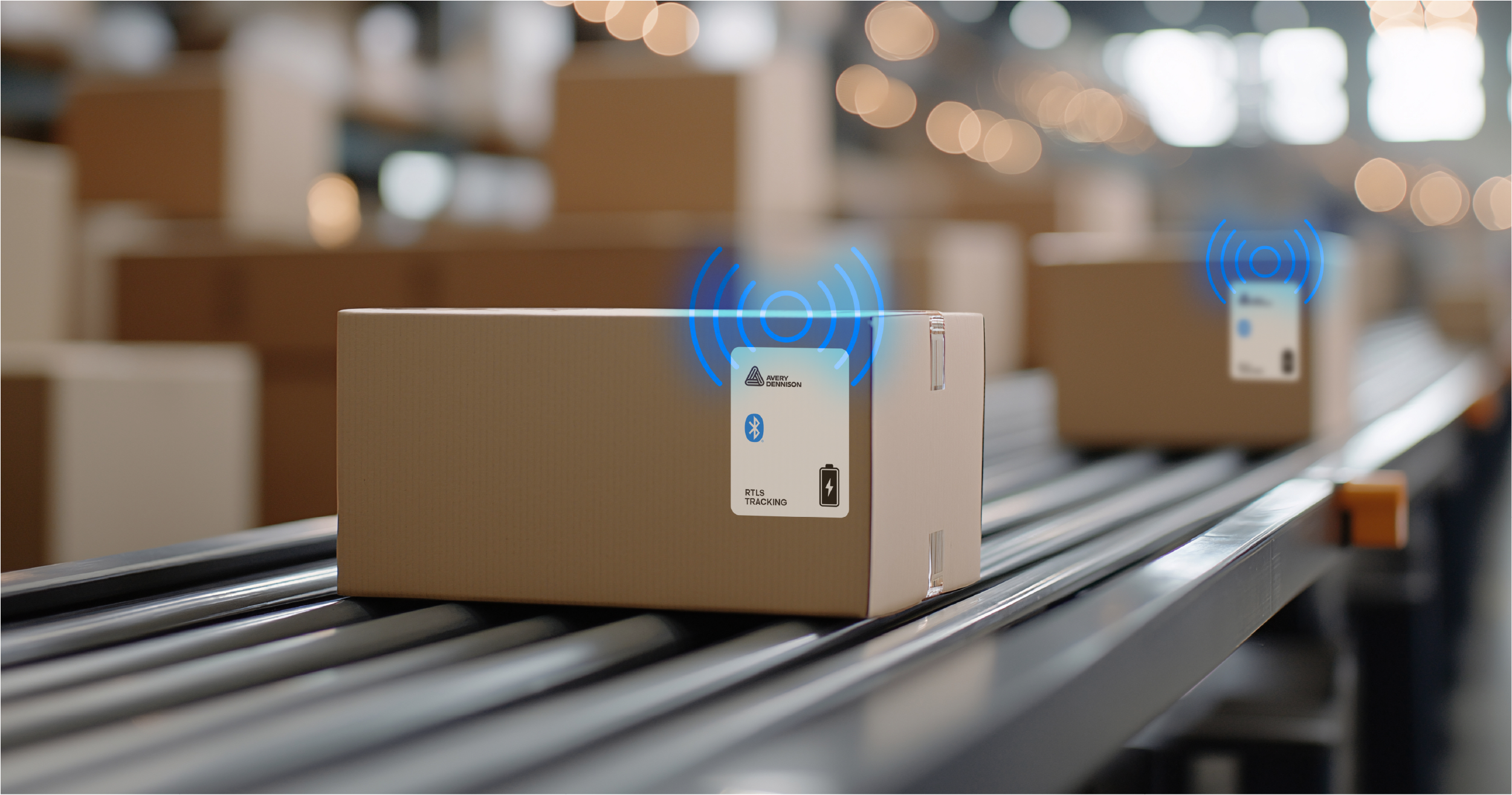
Avery Dennison has introduced AD Visi, a range of active Bluetooth Low Energy labels designed to provide continuous location and security information for time-critical and high-value goods moving through supply chains.
The initial range consists of AD Visi Way, which provides Real-Time Location System tracking, and AD Visi Secure, which adds an integrated tamper-evidence loop capable of associating a security event with time and location.
Both products use InPlay NanoBeacon chip technology and thin printed non-lithium batteries. Avery Dennison says the flexible labels are less than 1mm thick, operate between -30°C and +60°C, and provide a reading distance of up to 100 metres.
The first products will be available to order in late 2026, with a broader AD Visi range expected to follow in early 2027. They are designed for use on parcels, pallets, and returnable transport items rather than as separate tracker units requiring a rigid enclosure.
The physical format is an important part of the proposition. Conventional active trackers can provide detailed location and condition information, but they are commonly separate devices that have to be fitted to the shipment, recovered, recharged, or managed as reusable equipment.
Moving active electronics into a label less than a millimetre thick creates another deployment option for shipments where passive identification provides too little information but a conventional tracker is unnecessarily bulky or expensive.
Active Bluetooth Low Energy labels broadcast rather than waiting for energy from a reader before responding. Compatible infrastructure can therefore detect the item without a worker presenting each label directly to a scanner.
That can be useful in warehouses, yards, loading areas, and transport hand-off points where the operator wants to know that an item has entered, left, or remained within a defined zone without adding another manual scanning process.
AD Visi Way is focused on location. It broadcasts information for RTLS tracking through the journey, allowing suitable gateways or readers to generate location events that can be passed into a supply-chain visibility platform.
AD Visi Secure adds the tamper loop. High-value shipments may require evidence not only of where the item travelled but whether the package was opened or interfered with between custody points.
Combining the tamper event with time and location can narrow the point at which an exception occurred. That does not determine responsibility automatically, but it gives the investigation a more precise event record than discovering damage or interference only when the shipment reaches its destination.
Healthcare products, electronics, critical industrial components, and other sensitive goods are obvious potential applications, although Avery Dennison is positioning the technology for wider logistics use rather than limiting it to one sector.
The 100-metre nominal read distance also changes how labels can be detected compared with many passive technologies. Items do not necessarily need to pass close to a fixed scan point, giving warehouse and logistics operators more freedom in positioning receiving infrastructure.
Real-world range will still depend on the environment. Racking, metal freight, vehicle bodies, building structures, radio interference, and label orientation can all affect wireless performance, so deployment design remains part of the tracking system rather than something the label specification removes.
Power management is another constraint. Continuous broadcasting requires an energy source, and Avery Dennison is using printed non-lithium batteries alongside low-power NanoBeacon chips to keep the format thin while supporting active operation.
The announcement does not provide one universal battery-life figure, which reflects the fact that broadcast settings, environmental conditions, and the required journey can alter power consumption. Operators will have to match configuration with the length and detail of the tracking requirement.
Avery Dennison is also keeping active Bluetooth alongside other identification technologies rather than presenting it as their replacement. Its portfolio includes passive Bluetooth Low Energy and UHF RFID, allowing users to choose according to cost, data granularity, infrastructure, and supply-chain maturity.
That approach reflects the economics of item visibility. A low-value product moving through a controlled warehouse may require only passive identification, while a sensitive component travelling through several custody changes may justify continuous broadcasting and tamper information.
Returnable transport items create another use case because the tracking cost can be spread across repeated journeys. Pallets, totes, and specialist containers can disappear from circulation or accumulate at the wrong location, making persistent location information valuable even when the goods inside them change.
Avery Dennison’s manufacturing scale could also influence adoption. Active tracking is not new, but incorporating the electronics into a printable-label format produced through a large established intelligent-label operation gives the technology a different route towards higher-volume use.
The launch now has to move from specification to operating evidence. Tracking accuracy, battery life, wireless coverage, label durability, tamper performance, and integration with existing logistics systems will determine whether AD Visi can occupy the space between inexpensive passive tags and larger dedicated tracking devices.
If those requirements are met, the labels give supply-chain operators another level of visibility without attaching a conventional tracker to every shipment. The technology becomes useful when the location and security events improve decisions around the goods, not merely when a Bluetooth signal can be detected from 100 metres away.