IN Brief:
- YMX and Outrider have signed a five-year agreement covering commercial deployment of autonomous electric yard trucks.
- YMX will finance and operate fleets while Outrider provides autonomous technology, remote monitoring, and technical support.
- Initial deployments will target food and beverage, retail, consumer goods, and automotive customers during 2026.
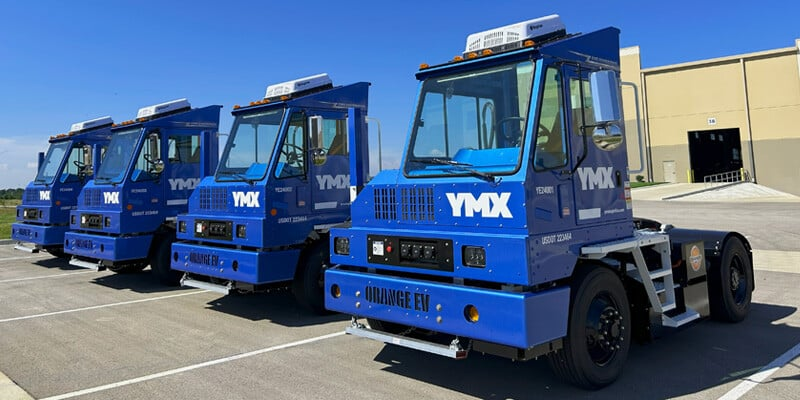
YMX Logistics and Outrider have signed a five-year commercial agreement to deploy autonomous electric yard trucks at enterprise customer sites, pairing Outrider’s self-driving system with a managed operating model in which YMX will finance fleets, lead implementations, operate the vehicles, and provide on-site support. Initial deployments are aimed at food and beverage, retail, consumer packaged goods, and automotive operations, moving the technology beyond isolated trials towards a repeatable service proposition for large distribution and manufacturing yards.
Outrider’s system automates trailer spotting inside private logistics sites, where vehicles move semi-trailers between parking positions and dock doors, hitch and unhitch loads, and use a robotic system to connect and disconnect trailer brake lines. The platform also provides real-time trailer inventory data, monitors electric vehicle charge status, and integrates with yard, warehouse, and transportation management systems, allowing autonomous moves to sit inside existing task allocation rather than operating as a separate fleet.
YMX is incorporating those vehicles into its Autonomous Yard Operating System, which combines yard management technology, fleet operations, performance management, and operating data across customer sites. Under the non-exclusive agreement, Outrider will support deployments, remote monitoring, and technical support while both companies work on site planning and operating processes, leaving YMX responsible for much of the implementation burden that an enterprise customer would otherwise have to coordinate across technology, equipment, finance, and day-to-day operations.
The commercial structure addresses one of the less visible barriers to yard autonomy, because purchasing a self-driving truck does not by itself create an autonomous yard. Site mapping, traffic rules, charging, system interfaces, trailer inventory accuracy, dock priorities, maintenance, staff procedures, and exception handling all have to be organised around the vehicle before it can replace routine manual moves. Financing and operating the fleet as part of a logistics service shifts more of that work onto the provider and can lower the capital threshold for customers testing the technology across several facilities.
Distribution yards are attractive automation environments because movements are repetitive and geographically bounded, yet they remain difficult enough to expose weaknesses quickly. Autonomous trucks have to work alongside over-the-road drivers, pedestrians, service vehicles, and manually driven equipment while coping with blocked lanes, misplaced trailers, changing dock priorities, and weather, all at sites that were designed around human drivers rather than robotic fleets. Outrider says its system has completed more than 100,000 autonomous trailer moves, while its functional safety approach has been assessed by TÜV SÜD against the organisation’s Autonomous Vehicle Conformity Framework.
Physical automation also has to handle the tasks that force a human driver out of the cab, which is why Outrider developed a robotic mechanism for trailer brake and electrical connections rather than limiting autonomy to vehicle steering. Trailer connections vary across fleets, and damaged or unusual equipment can still create exceptions, so remote or on-site human intervention remains part of a practical operating model even when the majority of movements are autonomous. Removing the driver from routine spotting changes the labour requirement without removing the need for operational supervision.
Yard management software is already being extended across large distribution networks, including a YardFlow programme expanding from 26 facilities to more than 200 sites, but autonomous vehicles introduce a physical execution layer that software-only systems do not have to control. Dispatch decisions now affect battery state, vehicle positioning, collision risk, trailer coupling, and dock interaction as well as task sequencing, making data quality and exception management directly relevant to the movement of heavy equipment.
Electrification adds another dependency because Outrider designed the system around electric yard truck platforms, and YMX uses capacity-based pricing rather than hourly charging for its service. Vehicle utilisation, battery state, charger availability, and planned trailer moves therefore have to be scheduled together if the provider is to increase throughput without creating charging bottlenecks during busy periods. Private yards can exploit predictable dwell and site-controlled charging more easily than long-haul fleets, although high utilisation leaves less idle time available for energy recovery.
The five-year term gives the partners enough runway to establish whether those operating assumptions survive across customers with different layouts, traffic volumes, trailer fleets, and service requirements. A deployment model that needs extensive bespoke engineering at every site will be difficult to scale economically, whereas repeatable planning, integration, and support processes could turn autonomous yard trucks into another managed logistics service rather than a specialist automation project. Commercial adoption will depend less on whether the vehicle can perform a trailer move — that capability is already established — than on whether fleets can repeat those moves safely and productively across ordinary yards without transferring complexity elsewhere in the operation.