IN Brief:
- Prime Air plans to expand from 11 US sites to coverage reaching nearly 500 cities and towns by year-end.
- Nearly all items weighing five pounds or less and fitting inside a large shoebox can qualify for the service.
- Network scale will test drone utilisation, inventory positioning, maintenance, weather resilience, and integration with other delivery methods.
Amazon plans to expand Prime Air drone delivery to nearly 500 US cities and towns by the end of 2026, increasing the service’s geographic footprint around sixfold.
Prime Air currently operates from 11 sites across ten US metropolitan areas, with locations in Arizona, Florida, Kansas, Louisiana, Michigan, Nebraska, and Texas. Further launches are planned around Chicago, Syracuse, Cleveland, Atlanta, and Boise before the network expands into additional communities.
Each current Prime Air site serves an area of approximately 175 square miles. Amazon says its drone operations are already making thousands of deliveries daily and have completed hundreds of thousands of deliveries during 2026.
The proposed expansion moves the programme into a different operational phase. Drone delivery has spent years being assessed through individual trials and tightly defined service areas; operating across hundreds of cities will require repeatable processes for aircraft utilisation, maintenance, inventory, weather disruption, and local launch-site capacity.
The eligible product range has also widened. Amazon says nearly all items weighing five pounds or less and fitting inside a large shoebox can be delivered by drone, covering more than 60% of the products its customers purchase most frequently.
That includes groceries, electronics, cosmetics, medicines, and household products. Orders can arrive in as little as 30 minutes, although Amazon says most are delivered at around the one-hour mark.
The five-pound limit makes Prime Air a specialised part of the last-mile network rather than a replacement for conventional parcel vans. A delivery vehicle can carry hundreds of packages with widely varying dimensions, while a drone is best suited to a narrower group of lightweight orders where speed has sufficient value to justify a dedicated flight.
At larger scale, the important measure will be how those modes work together. Amazon already uses Same-Day facilities, conventional delivery stations, one- and three-hour services, Amazon Now, lockers, vans, and other fulfilment options. Prime Air adds another decision to the process that selects how an individual order should move.
Inventory positioning is central to that decision. A 30-minute flight provides little benefit if the requested item is stored several hours away, so eligible products have to be positioned within reach of a Prime Air operation before the customer places the order.
That creates the same inventory trade-off faced by other rapid fulfilment models. Holding more products closer to customers improves response time but fragments stock across more locations, increasing the risk of excess inventory in one market and shortages in another.
A network serving nearly 500 cities will therefore depend as heavily on demand forecasting and replenishment as on aircraft technology. The system needs enough locally available products to generate productive drone flights without filling every site with slow-moving stock.
Aircraft utilisation presents another constraint. Dedicated infrastructure is easier to justify when drones spend a high proportion of their available operating time carrying orders rather than waiting for demand, charging, undergoing maintenance, or remaining grounded by weather.
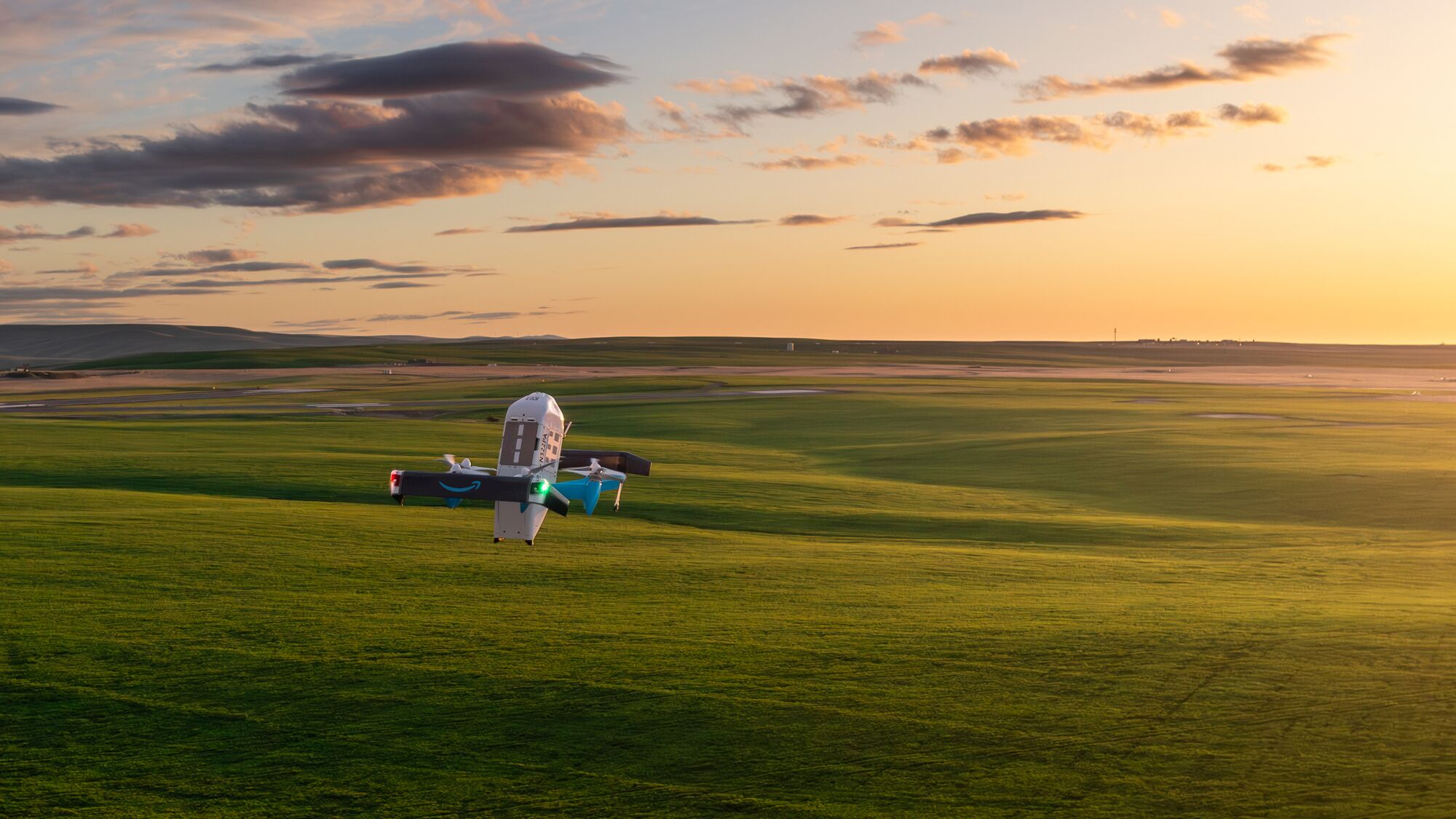
Prime Air’s MK30 aircraft are designed to operate in light rain and a range of temperatures, but severe weather will continue to reduce usable flying time. A larger geographic footprint will expose the network to different local conditions, making fallback delivery capacity important when aircraft cannot operate.
Amazon also has to scale the aviation control environment alongside the logistics operation. Prime Air holds US Federal Aviation Administration Part 135 certification and uses onboard sensors and Detect-and-Avoid technology to monitor airspace and obstacles during highly autonomous flights.
Those systems reduce the amount of direct piloting required for each movement, but network expansion still creates maintenance, site-management, regulatory, and operational requirements that increase with the number of locations.
The commercial test is not whether a drone can carry a package. Prime Air has demonstrated that repeatedly. The harder question is whether hundreds of local operations can deliver enough eligible orders with high aircraft utilisation and predictable service to become a durable part of a much larger fulfilment network.
Amazon’s planned footprint will provide a substantially better test of that economics. Eleven sites can still be managed as a relatively specialised programme; coverage approaching 500 cities and towns requires standardisation, inventory discipline, and exception management closer to those expected from conventional parcel operations.
Drones are unlikely to remove delivery vans from that network. Their more plausible role is narrower: extracting lightweight and time-sensitive orders where direct flight can provide a faster route than adding another stop to a ground delivery round.
If Prime Air reaches the planned scale by year-end, the significance will lie less in the aircraft themselves than in whether Amazon can make that specialised transport mode operate reliably inside the same inventory and delivery system already handling millions of conventional orders.