IN Brief:
- GNIDA has reopened the race to develop a 174-acre multimodal logistics park near Dadri.
- The scheme combines warehousing, cargo yards, cold storage, and optional rail-linked handling systems.
- Its location near freight corridors and Noida International Airport points to a longer-term push for integrated North India distribution capacity.
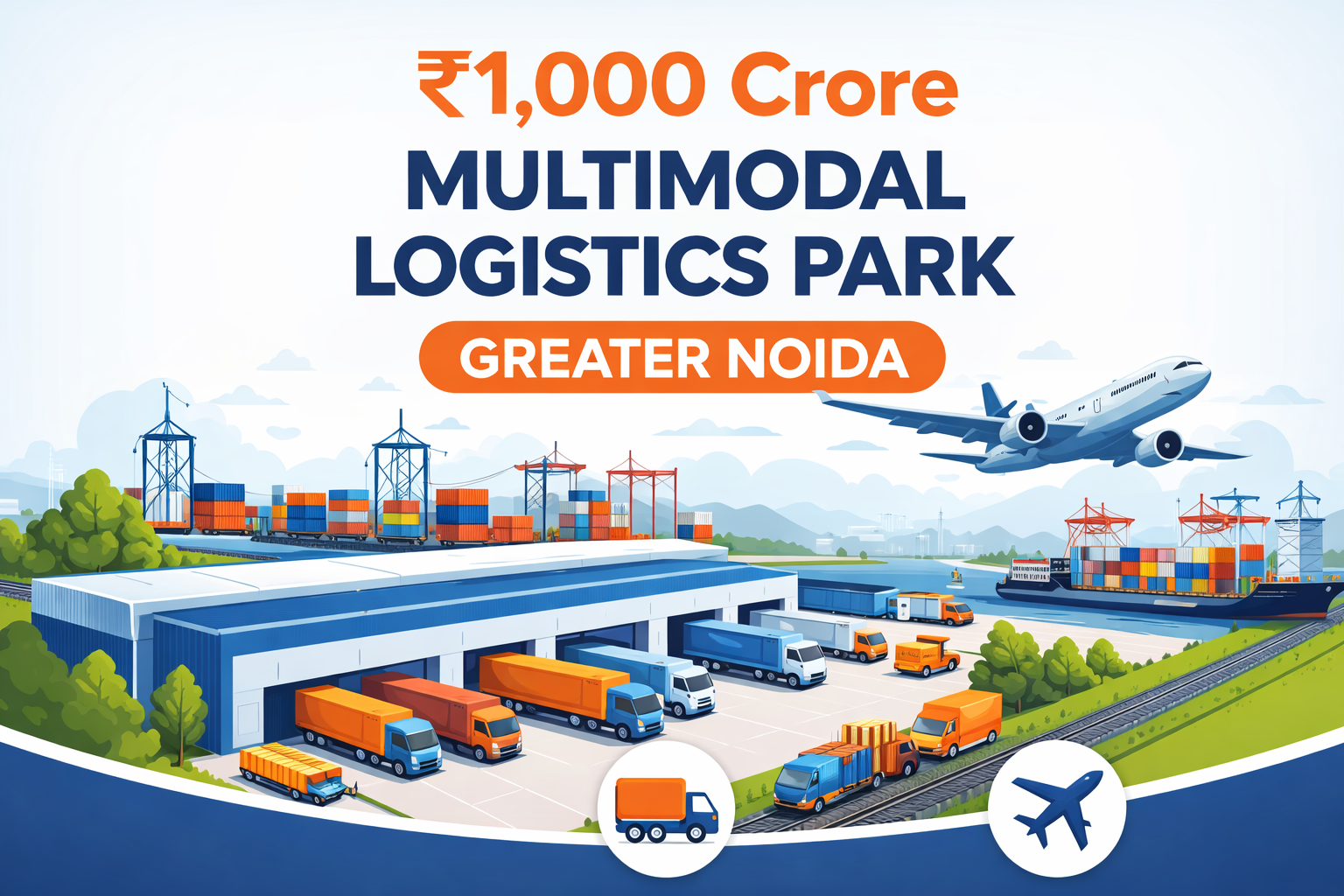
Greater Noida Industrial Development Authority has moved into the next phase of its proposed multimodal logistics park near Dadri, reopening competition for a 174-acre site at Kappa-II beside the Inland Container Depot. The authority has floated a fresh tender to appoint a developer through an e-auction process, bringing back into play a project that has been on the radar of major logistics and infrastructure groups since last year.
The scheme is pitched as a large-format freight and warehousing node rather than a conventional industrial estate. Around 7 lakh square metres have been earmarked for core logistics and warehousing uses, with plans for container terminals, cargo yards, cold storage, and facilities for bulk and break-bulk handling. Tender terms also allow for rail-linked multimodal systems, mechanised cargo handling yards, and advanced warehousing infrastructure, along with supporting trucking and first- and last-mile connectivity services.
The commercial terms underline the scale GNIDA is seeking. The reserve price has been set at ₹11,000 per square metre, the land is to be allotted on a 90-year leasehold basis, and the selected developer is expected to commit at least ₹1,000 crore to the project. Registration opened in late March, with the submission window running to late June. The authority is also seeking developers with at least a decade of logistics-sector experience, which narrows the field to operators with both capital depth and an existing delivery track record.
The site’s location is the central part of the proposition. Dadri already sits within one of North India’s most strategically watched freight zones, and the park is being marketed on proximity to the Eastern and Western Dedicated Freight Corridors, the Inland Container Depot, and Noida International Airport. That combination creates a stronger multimodal case than many inland warehousing schemes can offer. It also gives occupiers a route into a broader mix of domestic distribution, import handling, export consolidation, and temperature-controlled movement without relying on one transport mode.
The project also arrives as distribution planning in the National Capital Region keeps shifting outward from older, road-led clusters towards larger sites with scope for automation, rail access, and higher throughput. Developers are no longer selling floor area alone. They are selling connectivity, dwell-time reduction, truck turnaround performance, and the ability to handle more varied cargo streams under one roof. Cold-chain space and mechanised yards are especially notable here, because they widen the park’s relevance beyond general merchandise into industrial, food, and healthcare flows.
Dadri’s wider appeal is that it sits inside a corridor where policy ambition, industrial land strategy, and freight infrastructure are beginning to line up more convincingly than before. The park is also intended to complement the Bodaki logistics hub under the Delhi-Mumbai Industrial Corridor framework, which suggests the Greater Noida area is being positioned as a more substantial inland logistics platform rather than a single isolated project. The harder test will come later, when land strategy has to convert into occupier take-up, transport integration, and reliable operating economics. For now, the tender marks a more serious attempt to turn a well-located plot into a functioning multimodal asset.