IN Brief:
- EcoFlex XS provides a three-litre-class payload for small temperature-sensitive healthcare shipments.
- Refrigerated, controlled-room-temperature, and frozen configurations have been tested against ISTA physical and thermal profiles.
- The shipper is around 25% smaller and lighter than the existing EcoFlex Small model.
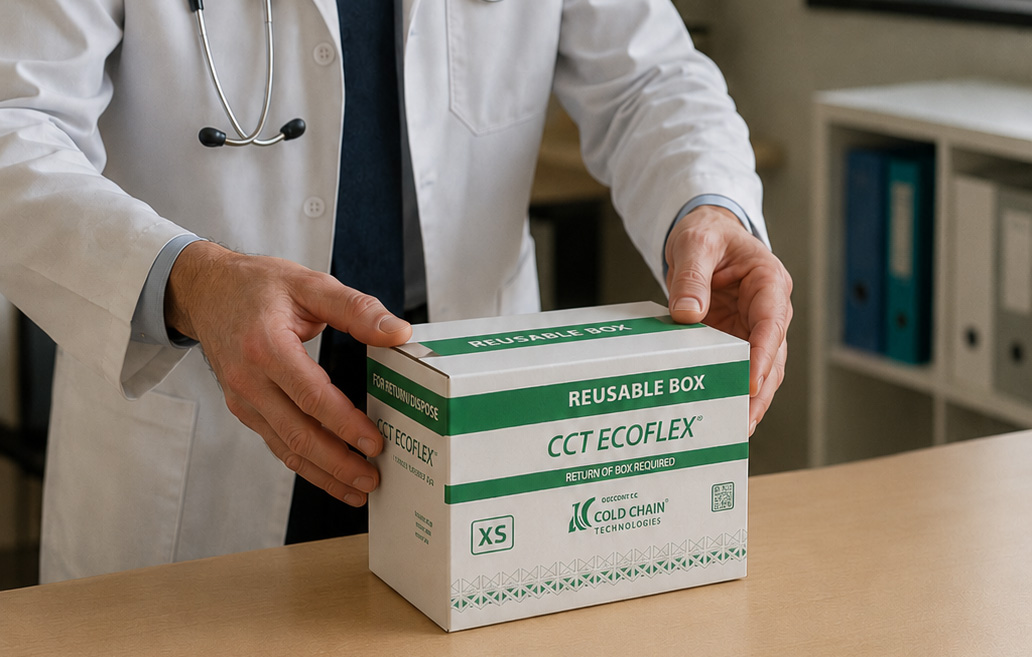
Cold Chain Technologies has launched EcoFlex XS, a compact reusable shipping system developed for clinical-trial samples, pharmaceutical product samples, blood and diagnostic materials, and other small temperature-sensitive consignments.
The shipper extends the EcoFlex portfolio with a three-litre-class payload and is available in refrigerated, controlled-room-temperature, and frozen configurations. Its format is intended to retain the thermal and reuse model of the wider range while reducing unused internal capacity around small products.
EcoFlex XS has been engineered to meet ISTA 3A physical-testing requirements. Under ISTA 7D thermal qualification, it achieved durations of up to 96 hours in refrigerated winter conditions, 89.7 hours in controlled-room-temperature summer conditions, and 66.2 hours in frozen winter conditions.
The payload box measures 178mm by 178mm by 89mm, with a thermal bag positioned inside the payload area to act as a heat deflector. The design extends thermal duration while preserving the space available for the product.
Compared with the existing EcoFlex Small shipper, the XS version reduces volume by 25.64% and weight by 25.4%. Smaller external dimensions can lower dimensional freight charges, reduce storage requirements, and increase the number of units carried within vehicles and aircraft.
David Webber, senior global marketing manager at Cold Chain Technologies, said: “The EcoFlex XS is a natural extension of the EcoFlex family and addresses a very specific need in the market for smaller-volume temperature-controlled shipments.”
He said interest had been particularly strong around sample distribution and clinical-trial applications, where payloads may be small but the required thermal protection remains substantial.
Small consignments present an awkward packaging ratio. A vial, sample, or diagnostic product may occupy only a fraction of the container, while insulation, conditioned components, monitoring equipment, paperwork, and physical protection create a package many times larger than the product itself.
Oversized systems preserve temperature but increase volumetric weight, transport cost, conditioning demand, and reverse-logistics requirements. Those inefficiencies accumulate when a clinical programme sends hundreds or thousands of individual shipments to hospitals, laboratories, investigators, or trial participants.
A more closely matched shipper reduces the amount of packaging and coolant carried around each payload. The resulting saving varies by carrier, route, and charging model because some services bill against physical weight while others use dimensional calculations.
Published thermal duration must still provide sufficient margin for the complete lane. Customs delays, missed connections, weekend holds, failed delivery attempts, and disruption at courier hubs or airports can all extend the journey beyond its planned transit time.
The qualification figures differ by temperature configuration and seasonal test profile, so the longest duration cannot be applied indiscriminately to every shipment. Refrigerated, frozen, and controlled-room-temperature products face different heat flows, coolant requirements, and failure modes.
Physical resistance is equally important because a temperature-controlled parcel can pass through automated sortation, depots, aircraft loading, vans, and several manual handovers. A shipper that performs well in a thermal chamber must also withstand drops, vibration, compression, and changes in orientation.
The reusable format creates a further operating cycle after delivery. Units must be recovered, inspected, cleaned, refurbished where necessary, reconditioned, and returned to an available inventory position before they can be dispatched again.
Commercial and environmental performance depend on completing enough cycles without excessive loss or damage. A durable shipper produces limited benefit when return instructions are unclear, collection is expensive, or units accumulate at hospitals and laboratories.
EcoFlex XS carries artwork identifying it as reusable and is supported by the company’s ReNew refurbishment and renewal programme. Clear labelling assists recovery, although the parcel network must still provide a defined route for the empty packaging.
The company has also expanded the infrastructure surrounding its reusable portfolio, including additional manufacturing and refurbishment capacity in Pennsylvania. Reuse requires those service operations as much as it requires a durable container.
Pharmaceutical companies are examining reusable packaging as they seek to reduce single-use materials and report distribution emissions more accurately. Environmental performance depends on transport distance, return rate, cleaning, refurbishment, material composition, and the number of completed cycles rather than reuse status alone.
Smaller units can improve that calculation by reducing material and transport demand per shipment. They also align with decentralised clinical trials, personalised medicine, diagnostics, and product-sampling programmes, where individual consignments are limited in size but high in value.
Ease of preparation remains critical because shipments can originate from specialist logistics centres, hospitals, clinics, laboratories, or research sites with different levels of packaging experience. Qualified performance must be supported by straightforward conditioning, assembly, closure, and return procedures.
EcoFlex XS is available across all three temperature configurations. Its launch extends a packaging market that is becoming increasingly segmented by payload, lane, duration, and therapy type rather than relying on a small number of broadly sized containers.
For small healthcare consignments, the operational gain comes from reducing unused cube without narrowing the safety margin around the product. A shipper matched more closely to its payload can lower freight and packaging demand while preserving qualified protection throughout the journey.