IN Brief:
- KfW IPEX-Bank is providing an €82 million loan for automation development and testing at Wilhelmshaven.
- The proposed system links autonomous terminal trucks with automated stacking cranes and terminal-management software.
- Pilot results will inform any future roll-out, initially to Hamburg and subsequently to other German sites.
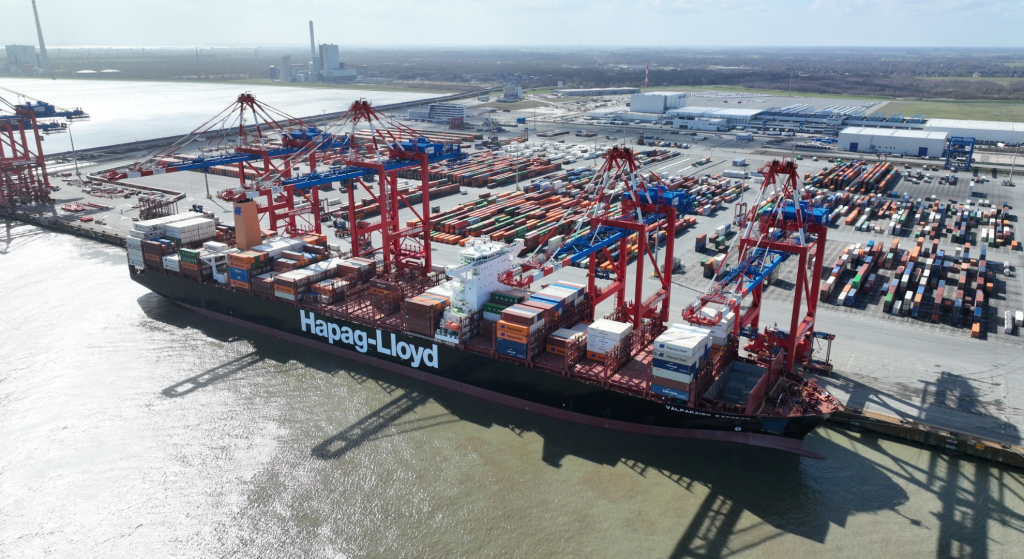
EUROGATE has secured an €82 million loan from KfW IPEX-Bank to develop and test automation at its Wilhelmshaven container terminal in Germany. The pilot will combine autonomous terminal vehicles, automated stacking cranes and software intended to coordinate cargo movements between quay and storage areas. The loan finances a development and verification programme; the bank has not reported a commissioned automated handling system or demonstrated commercial operating results.
The proposed operating model combines autonomous terminal trucks, known as ATTs, with automated stacking cranes, or ASCs. The trucks are intended to carry containers between the quay and the storage blocks, while the stacking cranes manage transfers within the yard. EUROGATE will also develop its own software for automated container terminal operations, aiming to move that system towards practical readiness under working terminal conditions.
A container arriving at a conventional terminal passes through several separate handling stages. A quay crane removes it from the ship, transport equipment moves it to a stacking area, and yard equipment positions it for storage or onward collection. Automating the connection between those stages requires vehicles and cranes to carry out coordinated tasks. A terminal may possess automated cranes without having a fully autonomous transport and control system linking the whole sequence.
The planned integration requires vehicle movement instructions, container destinations and transfer sequences to remain consistent with the availability of receiving cranes. EUROGATE will further develop its own terminal software to coordinate those functions. Reliable operation would depend on the exchange of current instructions and equipment-status data, with the pilot intended to verify whether those interfaces work under terminal conditions rather than merely in a software test environment.
EUROGATE has separately ordered four automated stacking cranes for Wilhelmshaven, with delivery scheduled for 2028. That equipment order is not the same transaction as the €82 million loan for the wider pilot. KfW IPEX-Bank has not divided the loan between individual contracts or said whether it finances the entire crane purchase. The announcement also provides no evidence that the ordered cranes are installed or that the autonomous trucks and terminal software are already operating together.
The lender describes flexibility, efficiency and measurable operating improvements as project objectives. Expected gains include reducing fossil fuel use by electrifying elements of container handling, and lowering production costs through automated operations. Neither a percentage emissions reduction nor a verified cost saving has been supplied. The overall investment budget, testing timetable, loan term and operating performance thresholds were also not disclosed in the announcement.
Electric equipment can reduce combustion at the point of use, but an assessment of actual energy and emissions performance must consider the equipment duty cycle and electricity supply. Likewise, automation does not by itself demonstrate higher throughput. Container demand, vessel arrival patterns, yard occupancy, service requirements and interruptions influence how many moves can be completed. A pilot has to establish whether the integrated system improves relevant measures under the conditions at Wilhelmshaven.
Safety and operational exceptions will also affect the practicality of the design. Autonomous vehicles and automated cranes operate in a terminal environment that still includes equipment maintenance, inspections and changing container priorities. Reliable control depends on identifying when equipment should stop, how tasks are reassigned and how a safe operating state is maintained if one component becomes unavailable. The announcement does not specify which detection, communications or supervision architecture EUROGATE will use, so those elements remain matters for the test programme.
The €82 million facility is a loan supporting a defined programme of development and verification, not a public grant or evidence that the deployment has proved commercially successful. Its financial terms, loan maturity, overall investment budget and start and completion dates for individual trial phases have not been disclosed. KfW IPEX-Bank characterises the funding as support for German and European export infrastructure, while operational readiness will depend on the results generated at Wilhelmshaven.
EUROGATE envisages Hamburg as the first subsequent location if the pilot supports expansion, potentially followed by other German terminals. That sequence makes Wilhelmshaven a reference installation for decisions about a wider network, but does not establish that equipment, operating conditions and terminal layouts will be identical at each site. A process demonstrated at one port may need additional interfaces, operating rules and commissioning work elsewhere before it can be transferred.
EUROGATE’s decision on wider use of the handling system will follow assessment of the Wilhelmshaven pilot, according to the lender. The remaining tests must establish whether automated trucks, stacking cranes and control software can perform reliably together under the terminal’s operating conditions. No measured savings, operating-capacity increase or confirmed deployment date has yet been reported, and expansion to Hamburg and other German terminals remains conditional.