IN Brief:
- Logic is applying its autonomous pallet system specifically to rail-to-road and road-to-rail freight transfers.
- Digital Twin OS is intended to coordinate pallet location, inventory, weight, traffic, and task allocation in real time.
- The development extends an existing Logic Pallet platform, with no named customer deployment or independent throughput result disclosed.
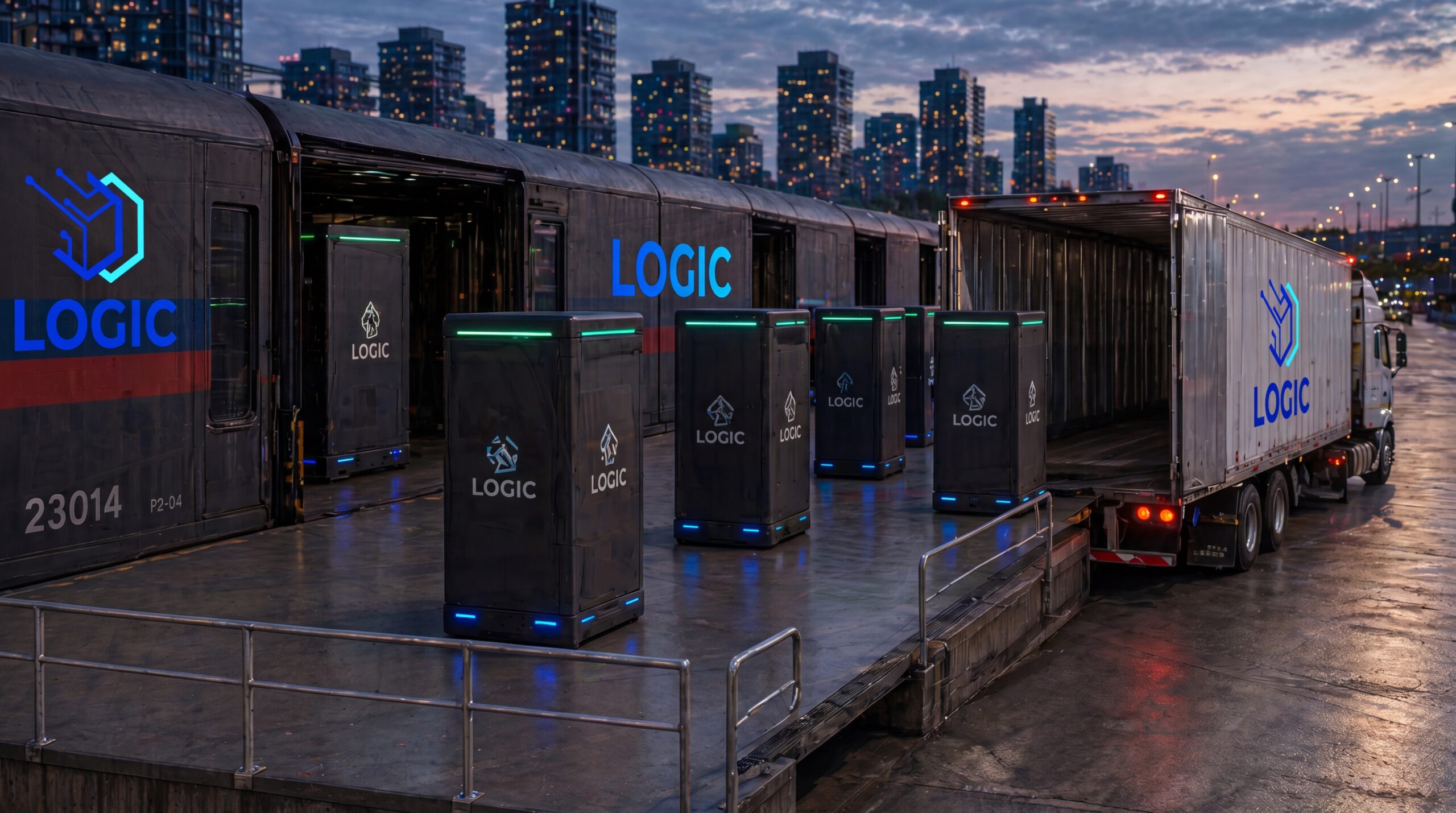
Logic is extending its autonomous pallet platform into rail-road transloading, combining self-propelled load carriers with a Digital Twin Operating System intended to coordinate transfers between railcars, road vehicles, and terminal operating areas.
The development is a new application of the existing Logic Pallet rather than a completely new robot. The core platform was already designed to move goods within and between facilities, self-load onto vehicles, track load weight, and continue autonomous operation after the cargo reaches another connected site.
The transloading configuration concentrates those capabilities on one of the more labour-intensive interfaces in freight transport: the point at which goods leave one mode and enter another.
Conventional rail-road transfer can involve repeated forklift handling. Cargo is unloaded from a railcar, staged, identified, allocated to an outbound truck, picked up again, and loaded in a sequence that must match vehicle availability and onward delivery plans.
Logic’s proposal is for the powered pallet carrying the load to perform more of those movements itself. The same asset can move from a storage or staging position towards the vehicle and carry the shipment through the transfer rather than requiring a conventional pallet to be lifted repeatedly by separate handling equipment.
Digital Twin OS provides the coordination layer around those physical movements. Logic describes the system as maintaining a live representation of the operating environment while synchronising information from the pallets working within it.
That includes pallet position, weight, inventory status, and progress against assigned tasks. The system is also intended to model traffic patterns and identify potential bottlenecks so workloads can be rebalanced when cargo volumes, vehicle arrival times, or equipment availability change.
The physical Logic Pallet is based around a powered 48-by-40-inch platform with a stated payload of 2,000lb, equivalent to about 907kg. Logic lists a maximum speed around one metre per second and battery endurance of up to 160 hours under its specified operating conditions.
Those figures position the equipment closer to a mobile robot than a disposable load carrier. That creates the central economic question around the concept: the asset travelling with the goods is considerably more complex and valuable than a conventional pallet, so it has to complete enough useful work to justify its capital cost, charging, maintenance, tracking, and recovery.
Transloading may provide an environment where that higher utilisation is possible. Intermodal terminals process concentrated waves of cargo around scheduled trains and truck arrivals, with a large proportion of activity devoted to moving standardised loads between staging positions and vehicles.
Removing forklift moves can reduce one part of the handling requirement, but autonomous equipment introduces different dependencies. Surface condition, gradients, vehicle interfaces, loading heights, railcar geometry, communications coverage, and safe interaction with people and other machines all have to remain predictable enough for the system to operate.
The digital twin is intended to manage some of that variation at fleet level. If one vehicle arrives late or a loading position becomes congested, software can reassign tasks instead of allowing a queue of autonomous pallets to accumulate behind the same unavailable destination.
Weight and inventory data can also remain attached to the movement. A pallet able to measure its load and report its position provides another source of information for shipment tracking, exception handling, and capacity planning as cargo moves between transport modes.
That does not remove the need for reliable item and transport data. An autonomous pallet can report accurately where it is and what weight it is carrying while still acting on an incorrect destination or shipment instruction supplied by an upstream system.
The August announcement also stops short of identifying a named rail operator, terminal, 3PL deployment, or measured live-trial result. The development should therefore be treated as a defined commercial application of the platform rather than evidence that autonomous rail-road transloading has already reached operating scale.
That distinction is particularly important because much of the underlying hardware capability has been public since the earlier Logic Pallet launch. The new element is the way Logic is packaging its robot and digital-twin software around the rail-road interface and the operating problems associated with that handoff.
The next useful evidence will come from a real deployment. Throughput per hour, equipment utilisation, intervention rates, charging demand, safety performance, and the amount of forklift handling genuinely removed will determine whether a powered pallet creates enough value at the modal boundary to justify travelling with the cargo.