IN Brief:
- Third-quarter revenue reached $18.1bn, with EBITDA of $4.7bn and EBIT of $3.3bn.
- Asian port congestion and weather disruption restricted effective vessel capacity while Ocean utilisation remained at 96%.
- Full-year underlying EBITDA guidance has increased to $14bn–$14.5bn, based on approximately 4% global container market growth.
A.P. Moller – Maersk has increased its full-year earnings guidance following a third quarter in which revenue rose 27% to $18.1bn, supported by higher ocean freight rates and disruption to global shipping capacity. The Danish logistics group reported earnings before interest, tax, depreciation, and amortisation (EBITDA) of $4.7bn, compared with $2.7bn a year earlier, while earnings before interest and tax (EBIT) increased from $1.3bn to $3.3bn.
The improvement lifted the group’s EBIT margin to 18.1%, against 9% in the corresponding quarter of 2025. Free cash flow reached $2.4bn as earnings strengthened across its three principal operating businesses: Ocean, Logistics & Services, and Terminals. The largest contribution to the increase came from container shipping, where freight rates rose substantially despite relatively limited growth in underlying volumes.
Maersk now expects underlying EBITDA of $14bn–$14.5bn for 2026, compared with its previous guidance of $10.5bn–$12.5bn. The underlying EBIT forecast has increased to $8bn–$8.5bn from $4.5bn–$6.5bn, while expected free cash flow has moved from greater than zero to more than $3bn. The revised outlook assumes global container market volume growth of approximately 4% for the full year.
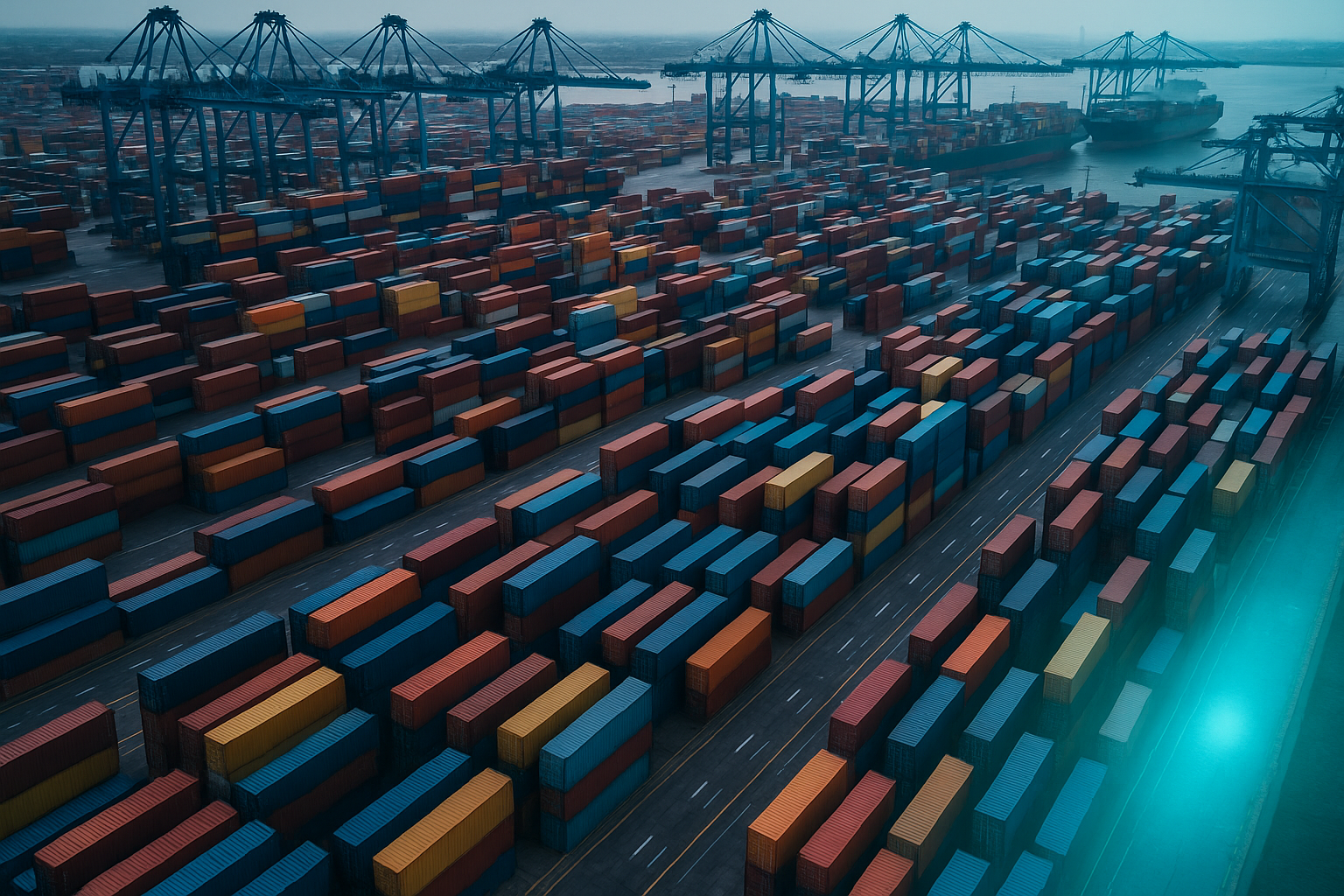
A severe typhoon season across Asia contributed to vessel delays and congestion at major container gateways during the third quarter. Maersk reported that average global port waiting times reached 16.6 hours at their peak, the highest level since January 2023. The resulting restrictions on effective transport capacity helped sustain freight rates even as demand growth remained comparatively moderate.
Port waiting time directly affects the number of journeys a vessel can complete within a given period. A ship delayed before berthing remains part of the available fleet, but it cannot load, discharge, or continue to its next scheduled port while waiting. Delays can accumulate across a service rotation, particularly where vessels must make several consecutive calls before completing a round trip.
Carriers can respond by adjusting schedules, omitting selected calls, or allocating additional vessels to maintain departure frequency. Each option changes the capacity and resources required to operate a network. Additional ships may preserve weekly sailings, but their deployment increases operating costs and can reduce the number of vessels available for other services.
Spot freight rates reflected these capacity pressures. The Shanghai Containerised Freight Index increased by 46% during the third quarter compared with the preceding three months, according to Maersk. The index measures spot market prices across specified container shipping routes and should not be confused with the average revenue achieved under every long-term freight contract.
The Ocean division generated EBIT of $2.6bn, compared with $567m a year earlier. Vessel utilisation remained at 96% despite the weather disruption, indicating that available container space continued to be heavily used. Loaded volumes were broadly steady, making the change in freight rates and operating costs more important to the division’s earnings performance than an expansion in cargo throughput.
Maersk also faced higher bunker, network, and container handling costs. The continued closure of the Strait of Hormuz and congestion elsewhere in the network affected routing arrangements and schedule reliability. Longer or more complicated journeys can increase fuel consumption, handling expenditure, and the number of vessel days required to transport the same quantity of freight.
The company’s Logistics & Services business recorded revenue growth of 13%, while its EBIT margin improved from 5.5% to 5.8%. Land-based transport solutions in the Gulf region contributed to performance, alongside air freight, project logistics, and other forwarding activities. These operations provide alternatives and supporting services where conventional maritime routes or transport arrangements are constrained.
Alternative land transport can maintain some cargo movements during maritime disruption, but the available capacity depends on road and rail infrastructure, border procedures, equipment availability, and the distances involved. The transfer of goods between transport modes also creates additional handling requirements. Such arrangements are therefore operational alternatives for selected cargo movements rather than direct replacements for the capacity of major container shipping routes.
Maersk identified investment in artificial intelligence infrastructure, semiconductors, electrification, and energy projects as contributors to freight demand. These activities generate movements of industrial machinery, electrical components, computing equipment, and other materials across international supply chains. The company has not disclosed the proportion of quarterly freight revenue attributable to those individual sectors.
Its Terminals business achieved record revenue, supported by improved commercial returns and container handling activity. Volumes increased by 2.6%, with growth particularly strong in Africa and Europe. Terminal utilisation was 85%, compared with 90% a year earlier, demonstrating that higher revenue and throughput do not necessarily require a corresponding increase in reported capacity utilisation.
Investment in port infrastructure continued alongside the stronger quarterly performance. APM Terminals began construction of the Laldia terminal in Chattogram, Bangladesh, in August, with the project expected to add 900,000 TEU of annual handling capacity. In September, its new Suape terminal in Brazil received its first commercial vessel, introducing initial capacity of up to 400,000 TEU annually.
Maersk also ordered 26 dual-fuel container vessels with a nominal capacity of 18,600 TEU each, scheduled for delivery in 2029 and 2030. These orders form part of a longer-term fleet renewal programme, but their eventual contribution to available capacity will depend on the deployment of new ships alongside the retirement, transfer, or continued operation of existing vessels.
The group’s improved outlook reflects strong earnings under current freight market conditions. It does not establish that elevated rates will persist indefinitely. Changes in congestion, vessel supply, trade demand, and maritime routing could alter the balance between available transport capacity and customer requirements during 2027. Maersk’s revised full-year guidance is based on the conditions visible after the third quarter, with the final result still dependent on trading and operational performance during the remaining months of 2026.