IN Brief:
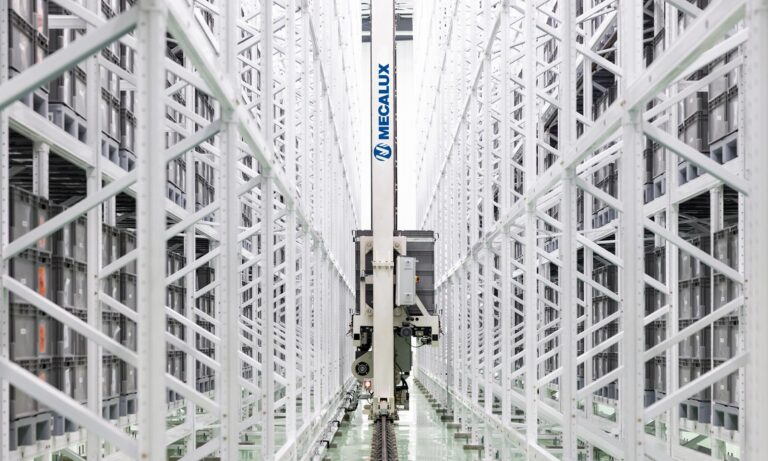
- Mecalux has installed two automated warehouse systems for Gerresheimer in Georgia.
- The warehouses support components used in inhalers, autoinjectors, and infusion systems.
- Easy WMS supervises the facilities and supports real-time inventory control.
Mecalux has delivered two automated warehouse systems for Gerresheimer at Peachtree City, Georgia, strengthening logistics support for the company’s US medical device production.
The automated facilities store semi-finished components arriving directly from injection moulding production. The components are used in medical devices including inhalers, autoinjectors, and infusion systems, placing the warehouses at a critical point between production, inventory control, and downstream assembly.
Both warehouses are supervised by Mecalux’s Easy WMS warehouse management system, which manages inventory visibility, stock movement, and operational control. The system supports real-time monitoring of products and helps components move efficiently from manufacturing into controlled storage.
Gerresheimer’s Peachtree City site has expanded to support growing demand in medical device markets. Automated storage gives the operation a more controlled interface between production lines and logistics, reducing manual handling, improving stock accuracy, and supporting higher throughput in a sector where quality control and traceability are central operating requirements.
Healthcare manufacturing is adopting warehouse automation beyond finished goods distribution. In medical device production, logistics begins inside the plant. Components must be stored, located, staged, and issued to production with tight process control, because errors can affect quality, compliance, and delivery schedules.
Automated pallet handling reduces dependency on manual movement in areas where production cadence and inventory accuracy are closely linked. When components leave injection moulding and enter storage, the warehouse system becomes part of manufacturing execution rather than a separate logistics activity.
Medical device supply chains have become more sensitive to capacity, resilience, and visibility since the pandemic exposed weaknesses in global healthcare production networks. Manufacturers are adding regional capacity, tightening inventory control, and investing in systems that can support both scale and compliance.
Automation helps reduce variability in the movement of components, especially where labour availability, training requirements, and quality assurance place pressure on manual operations. For life sciences manufacturers, the operating value is found in fewer exceptions, better inventory accuracy, and a cleaner connection between production and storage.
Large-scale warehouse automation investment is no longer confined to retail fulfilment, as demonstrated by Amazon sets out €10bn European robotics plan. Gerresheimer’s project applies the same automation discipline inside healthcare manufacturing, where automated storage is tied directly to production flow, traceability, and quality assurance.
Mecalux’s role also underlines the convergence of physical automation and software control. Storage hardware can increase density and handling efficiency, but the operational value depends on the WMS layer that allocates stock, records movement, manages locations, and integrates with production or enterprise systems. In regulated healthcare environments, digital control is essential to auditability and process discipline.
Warehouses are becoming controlled operational nodes inside manufacturing systems rather than buffers between production and distribution. That is particularly true for life sciences, food, electronics, and automotive production, where component availability, batch visibility, and handling accuracy directly affect output.
Gerresheimer’s automated warehouses give the Peachtree City operation a stronger platform for medical device growth. As healthcare products become more complex and demand becomes less predictable, the ability to combine production capacity with reliable internal logistics will increasingly define resilient manufacturing sites.