IN Brief:
- NAPA selected Hy-Tek Intralogistics and Hai Robotics for a multi-robot HaiPick storage and retrieval system.
- The planned configuration was evaluated at Hy-Tek’s Innovation Lab before deployment.
- The companies have not disclosed the installation date, robot count or measured performance at NAPA.
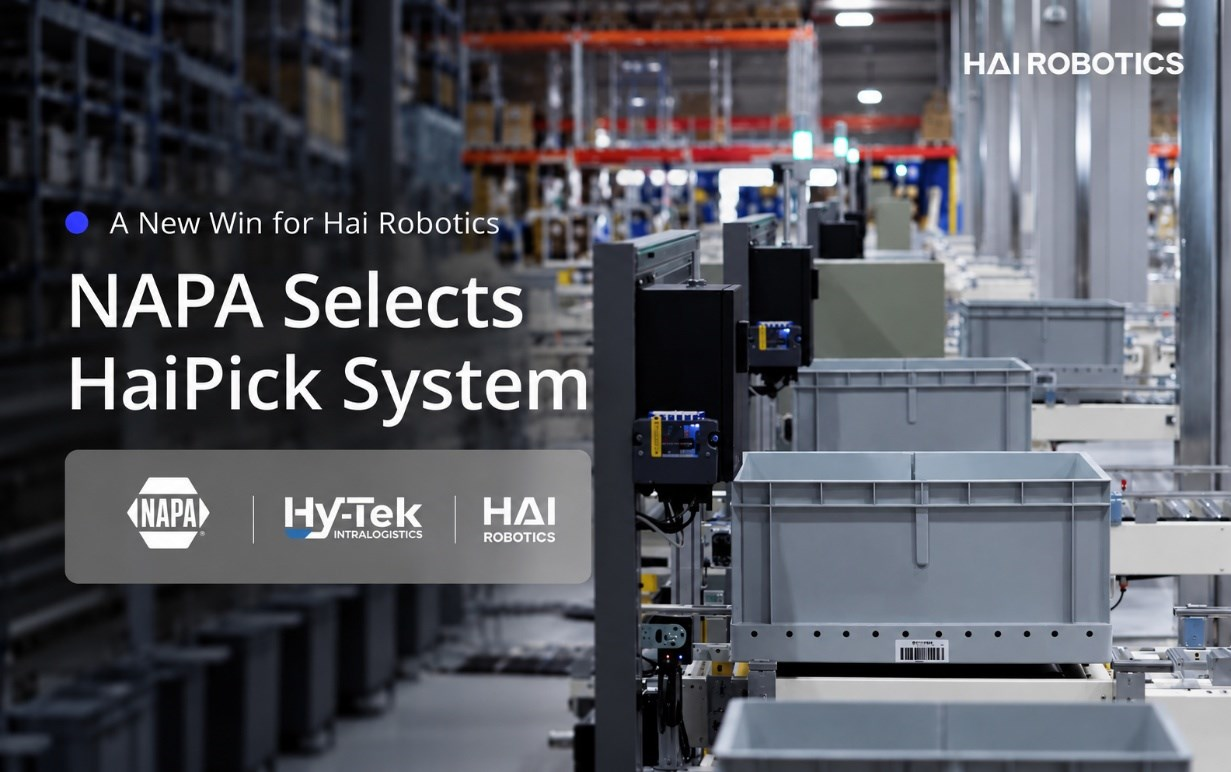
NAPA Auto Parts has selected Hy-Tek Intralogistics and Hai Robotics to develop a multi-robot automated storage and retrieval system for its flow centre operations. The 15 October announcement confirms the technology partnership and an earlier evaluation in a working warehouse environment, but not a completed installation. Hy-Tek is acting as systems integrator, using Hai Robotics’ HaiPick portfolio to design a denser and more flexible order fulfilment operation for the replacement-parts distributor.
Hy-Tek, Hai Robotics and NAPA tested the proposed configuration at Hy-Tek’s Innovation Lab during the design process. The suppliers say the live warehouse evaluation helped validate the design and refine it ahead of deployment. That test was conducted in the integrator’s facility, not presented as an operational installation at a NAPA distribution centre. Neither partner disclosed the receiving site, number of robots, capital expenditure, go-live timetable or comparative throughput data. The agreement therefore confirms a selected solution and pre-deployment evaluation, with results at a NAPA site still to come.
Automated storage and retrieval can reduce the distance warehouse employees travel to collect inventory, transferring movements between storage and pick stations to machinery. In a goods-to-person arrangement, retrieved containers are presented to staff for order assembly; other configurations may use robotic picking or different handling sequences. Vertical storage and a compact rack layout can raise inventory density, although total throughput also depends on how quickly goods enter, leave and are replenished. NAPA and its suppliers have not published the final storage layout or confirmed which tasks will remain manual.
Replacement-parts distribution presents a demanding inventory profile. A stock file may encompass high-volume service components alongside thousands of less frequently requested references with different dimensions, weights and handling requirements. The announcement specifically says the proposed design is intended to accommodate diverse stock-keeping-unit profiles, rather than treating the operation as a uniform stream of similarly sized products. Matching robot and storage capability to those characteristics is an engineering constraint: a storage system that works well with standard containers must still provide a practical route for exceptions, oversize items and products that need different treatment.
Hy-Tek is responsible for systems integration, with Hai Robotics providing the HaiPick storage and retrieval technology. Warehouse integration requires inventory records, storage locations, replenishment decisions and order priorities to match the physical movement of products. A retrieval robot can present a tote or case, but accurate fulfilment still depends on correctly identified stock and the systems that authorise each pick. The partners have not described the interfaces to NAPA’s existing warehouse management, stock control or dispatch platforms, so no particular software architecture can be assigned to this project.
The companies describe the design as a multi-robot HaiPick system, with the intention of combining higher storage density and better throughput within a single automated retrieval solution. They have not named the individual robot models, their respective tasks or the proportion of stock that would move through automation. It would therefore be premature to attribute case-handling functions, lift heights or retrieval rates from other HaiPick installations to this project. Those specifications will determine how much the machines can process, how often they need replenishment and where human intervention remains necessary.
The Innovation Lab trials gave the project team an opportunity to observe the proposed technology before committing to a final deployment approach. Congestion at picking stations, the mix of order sizes and the time needed to restart interrupted movements can all determine how well a storage system works beyond its nominal specification. The suppliers say they assessed performance and refined the solution, without publishing test conditions, load profiles or numerical results. Those undisclosed variables prevent a reliable comparison with NAPA’s existing operation or with the capabilities advertised for other HaiPick installations.
Commissioning will require the storage system to be populated, location records to be reconciled and downstream packing and dispatch to accept the material released by automated retrieval. A rapid retrieval cycle cannot by itself increase shipped orders if workstations or loading capacity become the limiting step. Those are common system-integration considerations, not reported shortcomings at NAPA. The completed deployment will need to sustain stock accuracy and fulfilment performance across different parts and order profiles before the announced design objectives can be assessed against operational evidence.
NAPA’s design-engineering team participated in the selection alongside Hy-Tek and Hai Robotics, after the partners evaluated the equipment in the Innovation Lab. The suppliers expect improvements in order accuracy, storage density and fulfilment speed, but have supplied no confirmed installation date, site capacity or measured productivity increase for NAPA. A commissioning announcement and subsequent live workload figures would establish whether the selected multi-robot arrangement delivers those intended improvements. The 15 October announcement establishes technology selection supported by pre-deployment testing; installation and live operating data have yet to follow.