IN Brief:
- Stora Enso will use Green Lane for seaborne movements of packaging board and wood-based products.
- Finnlines says its renewable biofuel option can reduce well-to-wake greenhouse gas emissions by up to 90% against conventional fossil fuel.
- The programme uses equivalent energy replacement within the fleet network and independently verified annual emissions accounting.
Finnlines has agreed an extension of its shipping cooperation with Stora Enso that will bring the forest-products group’s packaging board and wood-based cargo into the carrier’s Green Lane lower-carbon transport service. Announced on 15 October, the arrangement applies an existing marine energy and emissions-accounting programme to actual industrial freight movements. It is a new customer implementation rather than the launch of Green Lane itself, which Finnlines introduced in 2025.
The companies have not disclosed the annual tonnage to be covered, the precise contracted sailings or a quantified emissions saving specific to Stora Enso. Finnlines says the programme is designed for customers transporting goods on selected European routes who want alternatives to conventional fossil-fuel shipping. The agreement therefore establishes a commercial use of the service, while its eventual emissions results will depend on the movements included and the alternative energy accounted for.
The biofuel option operates through fleet-level energy substitution. Finnlines undertakes to use an amount of alternative fuel energy equivalent to the fossil fuel energy associated with a customer’s enrolled sea transport, even when the vessel carrying a particular consignment is not using that fuel on its voyage. The same distinction applies to the company’s new industrial-customer agreement: it does not identify every Stora Enso sailing as a voyage made with renewable fuel, nor does it eliminate the emissions from the ships carrying those goods.
Finnlines puts the potential reduction from the renewable biofuel option at up to 90% on a well-to-wake greenhouse gas basis, compared with conventional fossil fuel. This accounting boundary covers fuel production and use, rather than exhaust emissions alone. The percentage is the carrier’s upper-limit comparison for the fuel option, not a measured 90% reduction attributable to Stora Enso’s new agreement. The reported outcome for covered shipments will depend on the energy enrolled, the relevant transport activity and the methodology applied.
The carrier says its biofuel is ISCC certified and that reported Green Lane reductions are independently verified annually. Its accounting references include EU Monitoring, Reporting and Verification, FuelEU Maritime, ISO 14064 and EN 16258, with participating customers receiving certificates. Those checks concern the programme’s fuel or electricity use and emissions calculations; they do not amount to an independent life-cycle assessment of Stora Enso’s packaging products. The announcement provides neither a shipment-specific baseline nor a certificate showing achieved savings under the new arrangement.
Stora Enso supplies packaging board and other forest-based products that regularly move between mills, conversion sites, ports and industrial customers. In such chains, sea transport is one element of a larger logistics footprint alongside inland haulage and material handling. Using a defined shipping service may help the manufacturer account for maritime emissions in its wider supply chain, but it cannot on its own determine the carbon footprint of finished packaging or replace measurement of the other transport legs.
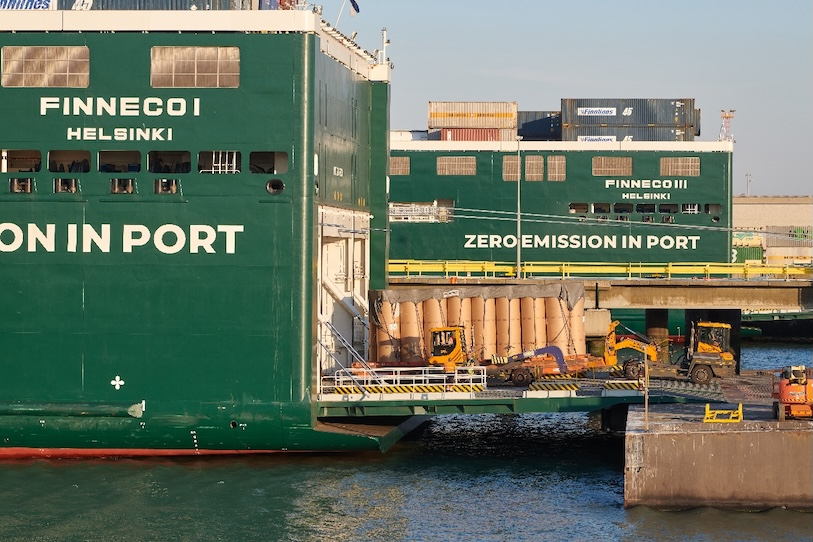
Finnlines operates industrial freight services across the Baltic Sea, North Sea and Bay of Biscay. Its North Sea and Biscay network includes routes connecting Finland with Poland, Belgium, Spain and the United Kingdom. Finneco-class ro-ro ships on Spanish services have air lubrication systems, battery capacity and solar panels, but the Stora Enso announcement does not identify the ships carrying its enrolled goods. The vessels’ physical energy-efficiency equipment and the Green Lane programme’s fleet-wide accounting are separate mechanisms, even where they form part of the same carrier’s environmental strategy.
Under the electricity-based Green Lane option introduced previously, Finnlines uses energy stored in batteries charged from shore power on certain services. That approach has a different operational boundary from replacing fleet fuel with certified renewable biofuel. Both options are subject to route selection and energy availability, which constrain where a lower-carbon product can be sold and how much covered freight can be accepted. No new vessel order or universal conversion of the shipping network was announced with this customer agreement.
Regular liner schedules still govern how packaging board and wood products move from industrial plants towards customers. Factory dispatches, road collection, terminal receiving windows and vessel departures must fit together, irrespective of how the voyage’s alternative energy is accounted for. Finnlines says the Green Lane option is designed to retain normal cargo flows, but it has published no Stora Enso-specific comparison of lead times, reliability or transport cost. The customer arrangement therefore adds a reporting mechanism without establishing a change to operational service performance.
The agreement extends an existing service into identifiable industrial freight rather than introducing a new fleet technology. Finnlines has not disclosed the number of Stora Enso shipments enrolled, their routes or the amount of certified alternative energy to be allocated to them. Future customer certificates may document reductions under the programme’s accounting rules; they would need to be read alongside the actual transport scope before any aggregate saving could be attributed to the new cooperation.