IN Brief:
- Water levels at Emmerich and Kaub have fallen well below thresholds for standard low water charges.
- Barge payloads are being reduced as operators assess whether individual movements remain commercially viable.
- Rail alternatives face limited equipment and major engineering work on the right bank Rhine corridor.
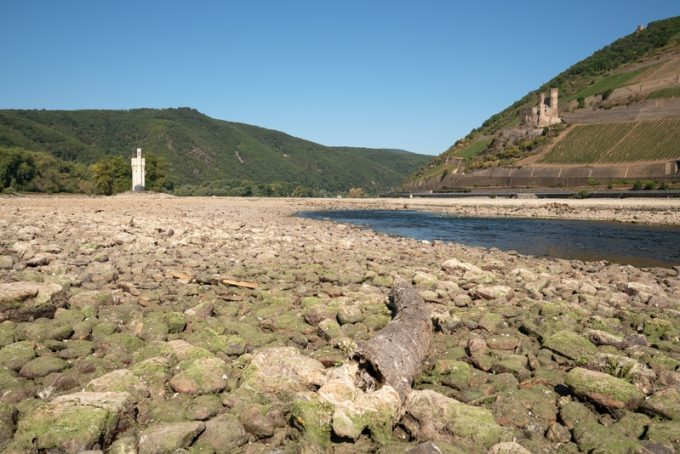
Contargo is preparing wider operational measures as exceptionally low water on the Rhine restricts barge payloads and threatens regular inland services between North Sea ports and the European hinterland.
Levels at the principal gauges have fallen beyond the thresholds covered by standard low water surcharges, leaving prices and available capacity to be agreed for individual movements. At such depths, vessels can use only a small part of their normal carrying capacity even where navigation remains technically possible.
The operator has warned that services to the Upper Rhine, Middle Rhine, and Rhine Main regions may need to be suspended if conditions continue to deteriorate. Containers would then move primarily by rail or road, either directly or through alternative transport and transhipment hubs.
Reduced draught changes the economics before it makes navigation impossible. A vessel carrying a fraction of its normal load still incurs crew, fuel, charter, terminal, and voyage costs, while more barge capacity is required to move the same number of containers.
Low water charges increase as the river falls because available vessel space becomes scarcer. Once gauges reach the lowest published bands, fixed surcharges are replaced by commercial agreement, leaving shippers exposed to changing prices and uncertain acceptance of individual bookings.
Bulk cargo faces similar constraints. Chemicals, fuels, metals, minerals, grain, and other industrial materials rely on the Rhine for high capacity movement between seaports, inland terminals, factories, storage sites, and energy infrastructure.
Rail offers the principal alternative for many container movements, although capacity is already restricted. A major refurbishment has closed the right bank Rhine railway between Troisdorf and Wiesbaden until December, forcing freight trains onto diversionary routes that require additional distance, equipment, crews, and operating time.
Contargo is examining increased rail frequencies and alternative routings between Rotterdam, Antwerp, and inland destinations. Those options depend on train paths, locomotives, wagons, terminal slots, and staff that cannot be added quickly across an already congested network.
Alternative modes cannot absorb the river overnight
Contingency planning often assumes that cargo can transfer between barge, rail, and road when one mode is disrupted. Each network has finite capacity, and the Rhine moves volumes that cannot be replaced immediately by trucks or trains without affecting freight already booked on those systems.
Additional road movements require drivers, vehicles, chassis, terminal appointments, and space around seaport and inland gates. A broad transfer from barge can increase congestion and rates while undermining the environmental advantage normally associated with inland waterway transport.
By the middle of July, falling levels were already reducing payloads and increasing the delivered cost of industrial freight. The latest conditions have moved the disruption closer to suspension territory, while the parallel railway closure has removed part of the normal safety valve.
Low water on the Danube has also disrupted regional grain logistics, showing how prolonged dry conditions can affect several European waterborne corridors simultaneously. Shippers with networks spanning both river systems may therefore find that alternative sourcing and routing options are under pressure at the same time.
Manufacturers can increase safety stock or arrange transport earlier in the season, although those measures add working capital, storage, and handling costs. Bulk commodities and heavy industrial cargo are particularly difficult to divert because road or rail alternatives may be considerably more expensive per tonne.
Container shippers also face storage, demurrage, and detention exposure when disruption separates the timing of a seaport discharge from the availability of inland transport. Contargo has warned that cargo may be routed through different hubs and that additional charges resulting from the low water measures may remain with the customer.
Forecast uncertainty complicates procurement because barge rates and acceptance can change with daily gauge readings. A transport plan agreed several days in advance may no longer be commercially workable when the vessel is due to depart, forcing rapid decisions about alternative modes or delayed production.
Climate resilience on inland waterways will require more than specialised low water vessels. Ports and industrial sites need stronger rail interfaces, flexible storage, better forecasting, and contracts that define how capacity is allocated during prolonged disruption.
The Rhine remains one of Europe’s most efficient freight corridors during normal conditions, but its capacity can fall much faster than the surrounding transport system can compensate. Until water levels recover, shippers will be competing for reduced barge space and the limited road and rail capacity available around an already constrained network.