IN Brief:
- C&C Fabrications is investing more than £1m in automation and manufacturing capacity.
- The programme includes CNC tube bending, laser cutting, robotic welding, powder coating, and a 3,000 sq ft extension.
- The investment targets demand from warehouse, logistics, food manufacturing, furniture, and automation customers.
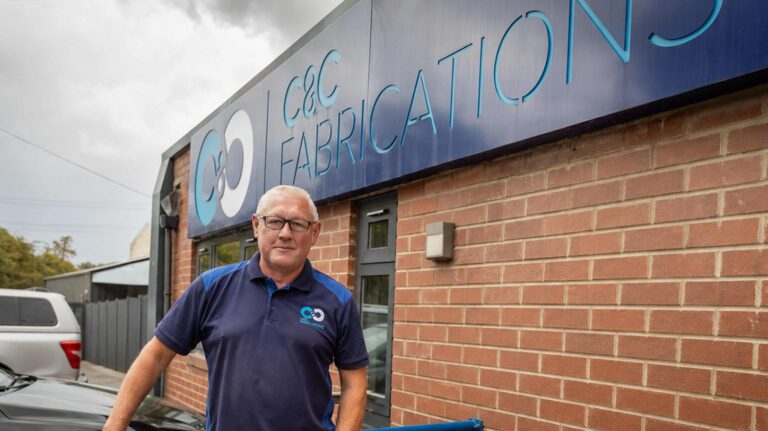
C&C Fabrications is investing more than £1m in automation, machinery, and additional factory space as the Yorkshire steel fabrication specialist expands its work for warehouse, logistics, automation, food manufacturing, and industrial customers.
The Ferrybridge-based business is marking its 30th anniversary with a programme that includes a £220,000 electric CNC tube bending and rolling machine, planned tube laser cutting capability, robotic welding, powder coating, and a 3,000 sq ft site extension. The investment is intended to increase capacity, improve consistency, and support faster turnaround on fabricated steel components.
The company supplies products including mezzanine floors, safety barriers, machine guards, suspended walkways, platforms, staircases, and bespoke fabrication. These assets sit inside the physical fabric of warehouses and factories, shaping safe access, machine integration, maintenance routes, storage density, and material movement.
Automated bending and rolling will give the business stronger control over repeatable, precision fabrication. Electrically driven CNC capability reduces the variability associated with manual forming and supports more complex tubular structures. In warehouse and industrial fit-out work, dimensional accuracy affects installation time as much as product quality.
The planned tube laser, robotic welding, and powder coating additions follow the same logic. Bringing more processes under one roof reduces handoffs, shortens production cycles, and gives customers clearer control over quality. Delays in fabricated components can hold back racking protection, mezzanine installation, machinery guarding, access platforms, and automation commissioning.
Fabrication suppliers are being pulled into the same productivity race as their customers. Warehouse operators are investing in robotics, conveyors, automated storage, AMRs, and high-density handling systems, while the engineering businesses that build the surrounding platforms, guards, barriers, and access structures must deliver faster, more consistent, and more integrated support.
Footasylum’s move to place its ecommerce range inside an AutoStore robot grid shows how retail logistics is changing the physical requirements of distribution centres. Dense automation still depends on correctly designed steelwork, safe maintenance access, impact protection, installation support, and mechanical integration around live operations.
A similar pattern can be seen in industrial service operations, where Trelleborg’s automated European service centre combines warehouse automation, value-added services, and component logistics within a single support model. C&C’s investment is smaller, but it belongs to the same shift: the supply base behind industrial logistics is upgrading its own manufacturing methods.
Labour pressure adds another driver. Skilled welders, fabricators, and metalworkers remain difficult to recruit, while customers expect shorter lead times and higher repeatability. Automation does not remove skilled labour from fabrication; it changes the work by moving routine cutting, bending, and welding toward controlled processes while experienced staff focus on setup, inspection, problem-solving, and bespoke work.
Food manufacturing customers bring additional requirements around safety, access, cleaning, and operational uptime. Steelwork in production and logistics environments must withstand repeated use, support segregation, protect equipment, and avoid creating unnecessary maintenance friction. Fabrication quality has a direct bearing on whether a site can keep moving without constant remedial work.
Warehouse fit-out has become more technical as buildings absorb automation, power upgrades, robotics, and greater throughput density. Barriers, platforms, stairs, guards, and walkways may look secondary beside a robot grid or conveyor line, but poor integration can restrict access, slow maintenance, and create safety exposure. Physical infrastructure is becoming less forgiving as logistics systems become more tightly engineered.
C&C’s expansion strengthens the company’s ability to support customers whose projects increasingly combine mechanical engineering, site safety, automation, and rapid fit-out. Fabrication remains a hands-on industrial trade, but competitive advantage is moving toward automated production, shorter internal process chains, and the ability to deliver repeatable components into complex operational environments.