IN Brief:
- Mars and REWE are operating 47 battery-electric trucks across a coordinated freight network.
- The vehicles have covered more than 2.4 million electric kilometres and replaced approximately 750,000 litres of diesel.
- The companies estimate that the programme has avoided almost 2,600 tonnes of CO₂e.
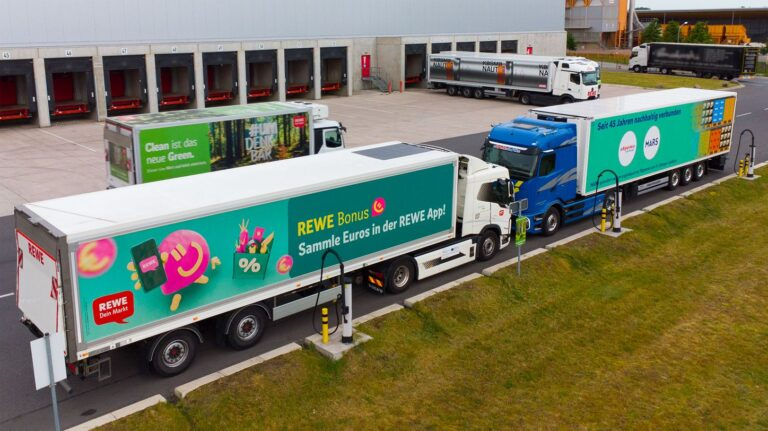
Mars and REWE are operating 47 battery-electric trucks across a coordinated German freight network linking food production and logistics sites with the retailer’s distribution operations.
Mars has introduced 23 electric trucks, while REWE operates another 24 within the shared network. The vehicles have travelled more than 2.4 million electric kilometres, replacing approximately 750,000 litres of diesel and avoiding almost 2,600 tonnes of carbon dioxide equivalent on a well-to-wheel basis.
The routes connect Mars facilities including Veghel in the Netherlands, Viersen in North Rhine-Westphalia, and the company’s pet-nutrition site at Verden. Loads move through its logistics centre at Minden before entering REWE’s network, including the retailer’s distribution operation at Oranienburg.
Concentrating the vehicles on known routes creates a more controlled operating environment than an unrestricted fleet conversion. Distance, payload, loading points, charging locations, dwell times, and delivery windows can be assessed repeatedly, allowing the trucks and infrastructure to be matched to a stable duty cycle.
That repeatability is central to heavy electric vehicle deployment. Battery-electric trucks can perform reliably where route length and charging access are predictable, but economics become more difficult when vehicles encounter unplanned detours, prolonged waiting, uncertain payloads, or limited access to high-capacity chargers.
The collaboration also joins decisions normally divided between manufacturer and retailer. Mars controls movements from factories and its logistics centre, while REWE manages distribution activity within its own network, allowing charging and vehicle deployment to be planned across a greater proportion of the product journey.
Food and grocery routes offer a strong base for corridor electrification because they frequently repeat between factories, regional warehouses, and retail distribution centres. Regular schedules create opportunities to charge during loading, unloading, and statutory driver breaks rather than introducing a separate unproductive stop.
Quiet electric operation can support deliveries during extended urban hours, particularly around Berlin, although the vehicle is only one source of noise. Refrigeration equipment, loading activity, reversing alarms, and yard movements must also be managed before a site can use night or early-morning windows without disturbing nearby residents.
Charging infrastructure now becomes part of the transport schedule. Depot power capacity, charger availability, parking geometry, dwell time, and energy procurement determine whether the vehicles can complete their routes without queuing or being removed from service.
The 47-truck deployment has moved beyond the scale of a demonstration. Similar expansion is underway elsewhere, including large electric delivery programmes within Australian grocery logistics, where fleet finance and charging strategy are being tested alongside daily transport performance.
Vehicle counts alone reveal little about operational success. Kilometres completed, diesel displaced, charger uptime, route availability, payload, maintenance response, and the proportion of work still assigned to backup diesel trucks provide a more reliable measure.
Payload remains a significant consideration in food and consumer-goods transport. Battery mass can reduce the weight available for cargo, depending on the vehicle and national allowances, and a truck that reaches its legal limit before filling its trailer may require additional journeys.
European equipment policy is already creating tension around that relationship, with trailer manufacturers warning that carbon rules must preserve payload and overall freight efficiency. Tractor, trailer, refrigeration, and load must be assessed as one transport system rather than as separate regulated products.
Electricity cost introduces another variable. Lower energy and maintenance costs may offset a higher vehicle purchase price on suitable routes, but depot connections, charging equipment, demand charges, and volatile power prices can alter the total operating case.
The emissions calculation similarly depends on the electricity used, vehicle utilisation, and the diesel journeys genuinely displaced. Mars and REWE have used a well-to-wheel measure, capturing energy production as well as operation rather than presenting only the absence of exhaust emissions.
Running dozens of vehicles through a shared network will expose failures that a single-truck pilot can conceal. Winter range, charger outages, route deviation, technician availability, and driver behaviour all become visible when the same model is used repeatedly across interdependent routes.
The programme treats electrification as a corridor design exercise rather than a vehicle purchase. Production, distribution, charging, energy, and transport planning have been aligned around the same flows, creating a structure that can be expanded where daily performance supports the investment.