IN Brief:
- CEOs from 30 European trailer manufacturers have signed a declaration calling for a review of Regulation (EU) 2024/1610.
- The sector argues that current VECTO-based trailer calculations do not reflect operational transport realities.
- The dispute links decarbonisation policy with payload, fleet efficiency, industrial competitiveness, and equipment cost.
European Commission CO₂ standards for heavy-duty vehicles and trailers are facing coordinated industry pressure after the chief executives of 30 European trailer manufacturers signed a joint declaration and petition calling for Regulation (EU) 2024/1610 to be reviewed and adjusted.
The signatories support the EU’s climate objectives, but argue that the current VECTO-based methodology for trailers could create unintended operational consequences. Their concern is that simulated emissions calculations may push manufacturers toward design changes that reduce usable load capacity, increase fleet costs, and require more journeys to move the same amount of freight.
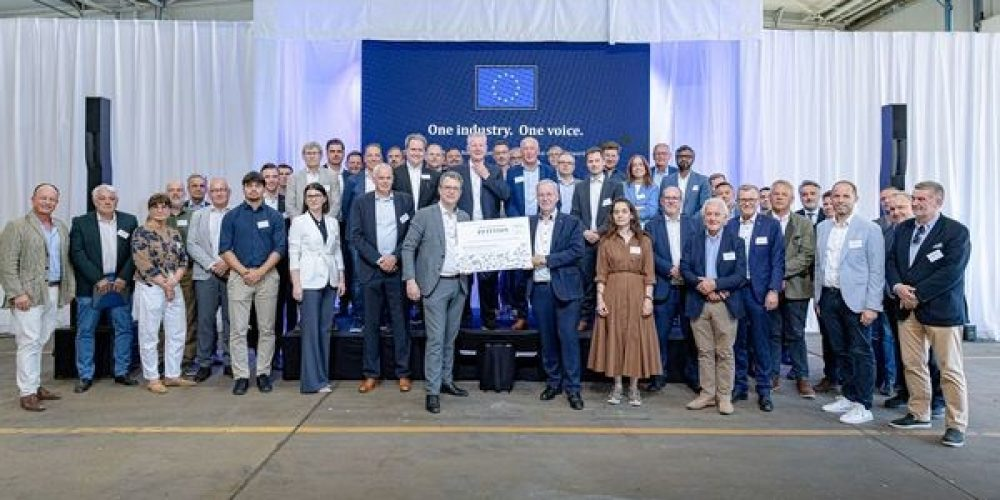
The declaration was signed in Koningshooikt, near Lier, in the presence of MEPs Kris Van Dijck of Belgium and Jens Gieseke of Germany. The group brings together companies that usually compete across the European trailer market, giving the petition weight beyond a narrow corporate complaint.
Regulation (EU) 2024/1610 extends CO₂ performance requirements to trailers, despite trailers producing no direct tailpipe emissions. The calculation is based on modelled effects on the tractor-trailer combination through the VECTO simulation tool, using reference loads and standardised duty cycles to estimate the trailer’s contribution to vehicle efficiency.
Trailer manufacturers argue that these assumptions do not adequately capture the operating reality of European freight. Payloads, load shapes, trip profiles, axle configurations, temperature control, loading height, side access, body strength, and dock compatibility can all shape whether a trailer is efficient in service. A model that rewards one design characteristic may penalise a configuration that performs better in real distribution work.
Fleet economics can change quickly when trailer design changes affect capacity. A trailer that performs well in a simulation but carries less usable cargo may reduce modelled emissions while increasing the number of trips needed. Additional trips mean more drivers, more road space, higher fuel or energy use, greater tyre wear, and more operating cost.
The road freight transition already depends on matching equipment to duty cycles. Masters Logistical’s electric trucks for British Sugar flows show how decarbonisation works best when vehicle capability, route predictability, depot access, and charging windows align. Trailer regulation faces the same discipline: emissions policy has to reward actual freight efficiency rather than abstract compliance.
European trailer manufacturers are also working through a difficult industrial environment shaped by high energy costs, skilled labour constraints, uneven demand, and international competition. If compliance requires expensive redesigns without a clear operational benefit, investment decisions become harder for both manufacturers and fleet buyers.
The sector is seeking an earlier Article 15 review, phased targets, and a more evidence-based approach that reflects real payloads, zero-emission tractor development, and the interaction between trailers and freight operations. The request does not reject decarbonisation; it challenges the mechanism being used to measure progress.
Road freight emissions cannot be reduced by one component alone. Tractor units, trailers, tyres, route planning, charging infrastructure, loading discipline, driver behaviour, warehouse turnround times, and network design all shape performance. A trailer is part of that system, but it cannot be treated as if it operates independently of cargo, powertrain, depot constraints, and customer delivery requirements.
Battery-electric and hydrogen truck deployment will make the calculation more complex. Zero-emission tractor units bring different weight, range, refuelling, and charging constraints, while trailers still need to serve mixed cargo categories across fragmented European markets. Efficiency gains will come from matching vehicle, trailer, route, and load rather than treating each asset as a sealed regulatory unit.
Brussels now faces a familiar regulatory problem: firm targets are needed to drive progress, but freight equipment is application-specific. Rules that are simple to administer can miss the operating detail that decides whether emissions fall on the road. A review that keeps climate ambition while correcting flawed incentives would strengthen the transition; a rigid approach risks making trailer compliance look cleaner in software than it performs in service.