IN Brief:
- RS Atlantico has entered service on the Atlantic Line following its arrival at Zeebrugge.
- The 190-metre car and truck carrier has capacity of approximately 5,500 CEU and LNG dual-fuel propulsion.
- The additional maritime capacity complements investment in road transport and SUARDIAZ’s Liverpool terminal.
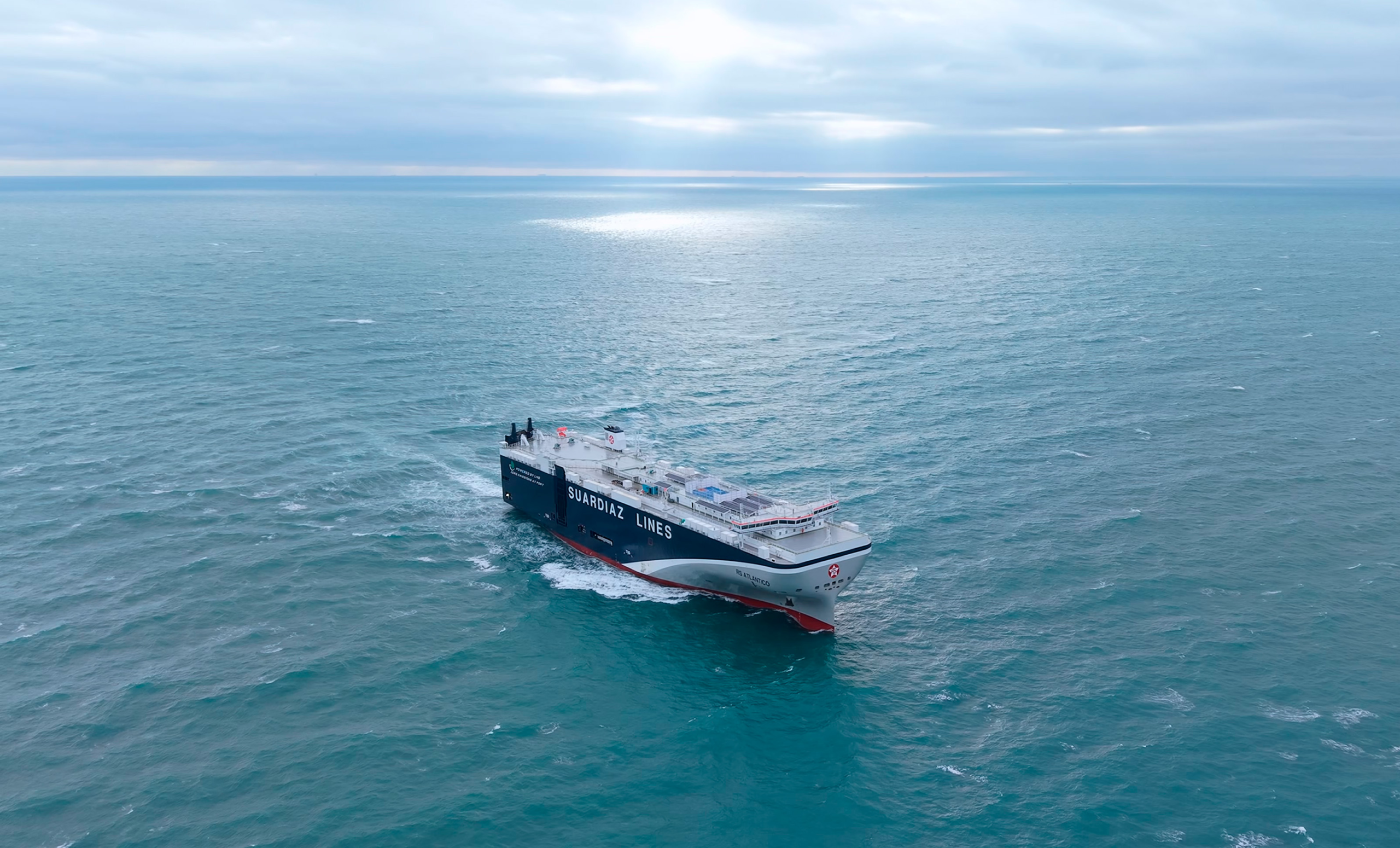
SUARDIAZ Group has brought RS Atlantico into service on its Atlantic Line, adding a fourth vessel to the route connecting automotive supply chains in Morocco, Spain, the UK, France, and Belgium. The Spanish shipping and logistics group marked the carrier’s arrival in Europe at Zeebrugge on 25 November.
The pure car and truck carrier (PCTC) is 190 metres long, with gross tonnage of approximately 55,000 GT and nominal capacity for around 5,500 car equivalent units (CEU). It can also carry machinery and larger rolling cargo. The vessel incorporates dual-fuel propulsion capable of operating on liquefied natural gas (LNG).
SUARDIAZ previously confirmed that RS Atlantico had departed China for Europe, with a second vessel in its procurement programme expected in 2027. The ship’s entry into service now increases the number of vessels allocated to an established commercial route, rather than representing a further shipbuilding commitment.
Juan Riva, chief executive of SUARDIAZ Group, said: “The addition of RS Atlantico to our Atlantic Line turns our ongoing investment strategy into operational capacity. For SUARDIAZ Group, growth is not simply about adding new assets, but about having greater capacity and better tools to support our customers in an increasingly global and demanding industry.”
Morocco’s vehicle manufacturing operations depend on maritime connections with European distribution networks. Vehicles produced for export must be moved from factories to port compounds, grouped into shipments, and allocated to vessel departures. The timing of these movements affects the amount of storage required at both ends of the shipping service, particularly when factory production continues between sailings.
Unlike containers, finished vehicles occupy deck space according to their individual dimensions. The car equivalent unit is a standardised measure of nominal carrying capacity; actual vehicle counts depend on the mix of passenger cars, commercial vehicles, and machinery being transported. Heavier cargo can also impose restrictions on its position within the ship because the load must remain within the structural capacity of the deck and the vessel’s stability requirements.
A PCTC allows cargo to be driven aboard through ramps and distributed across several enclosed decks. Vehicles scheduled for discharge at earlier ports must be accessible without requiring excessive repositioning of those destined for subsequent calls. Stowage planning therefore needs information about the cargo’s dimensions, destination, and weight before loading begins. A larger ship can accommodate more cargo, but the amount of usable capacity depends partly on how efficiently those requirements can be combined.
SUARDIAZ’s Atlantic Line serves several manufacturing and consumer markets within the same regional network. Allocating an additional vessel gives the operator more physical capacity from which to plan sailings and accommodate changing shipment volumes. The group has not published a revised sailing frequency, nor has it stated the net increase in annual route capacity. Those figures would depend on vessel assignments, turnaround times, maintenance periods, and utilisation across the service.
The maritime investment accompanies development of the company’s inbound logistics operations, including a fleet of more than 500 trucks and a new terminal in Liverpool. Road transport connects vehicle production and storage facilities with the maritime service, while the terminal provides an interface for handling and distributing finished vehicles in the British market.
Coordinating those operations becomes particularly important when a large ship discharges several thousand vehicles within a relatively short period. Terminal operators need sufficient compound capacity to receive the load, alongside vehicle identification records and condition checks before onward movements. Transport providers must then allocate road equipment and delivery appointments according to the destinations of the individual vehicles. A shortfall in collection capacity can occupy space needed for subsequent vessel arrivals.
Zeebrugge’s established vehicle handling infrastructure and connections with British and continental European ports make it an important part of the Atlantic Line. Its role within the Port of Antwerp-Bruges also places it close to automotive distribution networks serving several inland markets. The new ship can carry High & Heavy cargo alongside finished vehicles, creating potential opportunities to use available deck space where flows of passenger cars are uneven.
The dual-fuel propulsion system allows the vessel to use compatible conventional fuels or LNG, subject to operating and bunkering arrangements. Its greenhouse gas performance will depend on fuel selection, the engine’s methane emissions, and the upstream fuel production and distribution pathway. SUARDIAZ has not published measured emissions savings for the new ship on the Atlantic Line. Its confirmed operational change is the addition of the fourth carrier, with subsequent vehicle volumes and sailing schedules providing measures of the resulting increase in service capacity.