IN Brief:
- China Airlines, EVA Air, and STARLUX have reported handling pressure associated with increased import cargo volumes.
- Local forwarders report that uncollected freight is occupying warehouse space and restricting the circulation of cargo dollies.
- Selected China Airlines freighter flights have been cancelled, although their precise connection to the congestion remains unconfirmed.
Taiwan Taoyuan International Airport is experiencing cargo handling disruption as increased import volumes strain warehouse capacity, ground handling equipment, and available personnel. Airlines operating through the airport have warned of longer cargo processing times, while local freight forwarders report that uncollected imports are occupying space and restricting the availability of equipment needed to move shipments between aircraft and warehouse facilities.
SEKO Logistics issued a customer advisory on 4 November after China Airlines, EVA Air, and STARLUX Airlines reported handling pressures at Taoyuan. The three carriers had issued notices on 2 November identifying increased import cargo volumes as a cause of strain on staff, cargo dollies, and handling capacity. Potential consequences include slower cargo breakdown and build-up, longer export processing times, and changes to planned departures.
Congestion has developed around the movement of arriving freight through ground handling facilities. Imported cargo must be unloaded from aircraft, transferred from the apron, broken down from aircraft loading units where necessary, and processed before collection. These activities depend on the availability of handling equipment and sufficient warehouse space to accept cargo arriving from the aircraft.
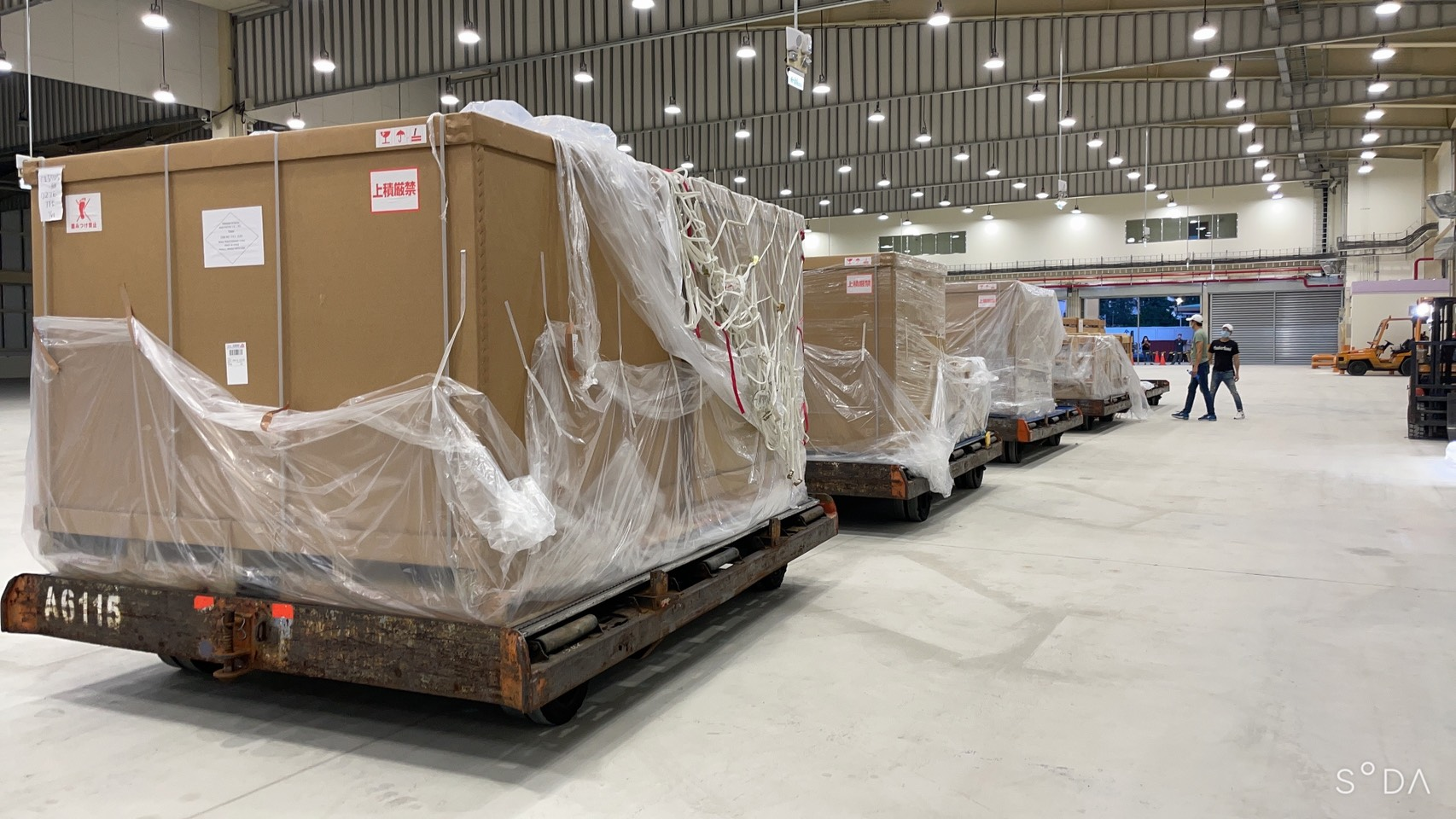
Local forwarders have reported that freight remaining uncollected is occupying substantial warehouse capacity. With storage areas congested, loaded cargo dollies are reportedly being retained outside the warehouses rather than returning promptly to aircraft handling operations. The resulting shortage restricts the equipment available to move newly arrived shipments away from aircraft stands.
A cargo dolly is a wheeled platform used to move air freight containers and pallets around the airport handling environment. Its availability is determined by how quickly each load can be transferred, unloaded, and released for another movement. When freight remains on the dolly because the receiving area cannot accept it, equipment that would normally circulate between the apron and warehouse becomes unavailable.
Forwarders have described delays affecting the movement of aircraft cargo and the routes connecting terminal facilities. One account identified a concentration of congestion around China Airlines’ warehouse, although that assessment has not been confirmed by the airport operator. The distribution of delays between individual handling facilities therefore remains uncertain.
Freight associated with Taiwan’s artificial intelligence and semiconductor industries has been identified by local forwarders as a contributor to the import backlog. The island receives equipment supporting technology manufacturing and computing infrastructure, including machinery and hardware that may require specialist transport arrangements. However, the proportion of the accumulated cargo attributable to these sectors has not been quantified.
Some forwarders believe consignments have remained uncollected because facilities intended to receive the imported equipment were not ready for delivery. That explanation remains unverified. The carriers’ notices establish increased import volumes and handling pressures, but they do not identify the commercial or operational reasons why individual customers have delayed collections.
The effect on outbound freight arises from shared ground handling resources. Cargo arriving for export requires acceptance, security processing, consolidation, preparation for aircraft loading, and movement to the departure stand. When equipment and warehouse space are occupied by imports, the same handling operation may have less capacity available to prepare departing consignments.
This creates a distinction between aircraft capacity and usable freight capacity. An airline may have space scheduled on an outbound service while a shipment remains unable to reach the aircraft within the required handling window. The availability of an aircraft therefore does not, by itself, confirm that cargo can be accepted, processed, and loaded in time for departure.
SEKO has also received notifications that selected China Airlines flights have been cancelled, including freighter services bound for the United States. The advisory does not identify the affected flight numbers or establish that the cancellations were caused by ground handling congestion. They must therefore be treated as a separate reported disruption rather than a confirmed consequence of the warehouse backlog.
Air freight capacity figures indicate that available lift has not contracted uniformly. Data from Rotate, cited in reporting on the situation, show that inbound widebody freighter capacity to Taiwan increased by approximately 20% during the week from 29 October to 4 November compared with the preceding seven days. That followed a 15% reduction in the previous period.
The increase in scheduled inbound lift does not establish a corresponding increase in cargo successfully processed through the airport. Flight capacity measures the space available to move goods by air, while terminal throughput depends on the rate at which shipments can pass through ground handling processes. The two measures can move in different directions when storage or equipment becomes constrained.
SEKO has advised customers to submit shipment forecasts, book space early, arrange advance cargo tender, and allow additional time for processing and flight connections. It has also recommended identifying urgent consignments so that possible alternatives can be considered. Actual uplift remains subject to confirmation by the operating airline and the handling conditions affecting individual shipments.
Early cargo tender may help manage particular bookings, but it does not automatically resolve the accumulation of imported freight occupying warehouse space. Restoring normal equipment circulation requires cargo to move out of storage and handling areas sufficiently quickly for incoming loads to be accepted. The rate of collection and the capacity of receiving facilities will therefore influence how the backlog develops.
No confirmed recovery timetable has been established in the available airline notices or SEKO advisory. The immediate operational position will continue to depend on warehouse clearance, equipment availability, handling resources, and the scheduling of aircraft movements. Freight departing Taoyuan remains subject to shipment-specific confirmation while these constraints continue.