IN Brief:
- THG Fulfil has expanded its AutoStore distribution agreement beyond Robotics-as-a-Service to include conventional CapEx ownership.
- Customers can now use CapEx, RaaS or hybrid commercial structures for warehouse automation projects.
- THG Fulfil operates 796 AutoStore robots internally and has global CapEx distribution rights across the full product range.
THG Fulfil has expanded its AutoStore distribution agreement to include conventional capital ownership, allowing warehouse operators to choose between purchasing systems outright, using Robotics-as-a-Service or combining the two approaches within hybrid commercial structures.
The agreement extends THG Fulfil’s authorisation beyond the RaaS model on which its external AutoStore proposition was initially based. Under the expanded arrangement, the company has global distribution rights for the complete AutoStore product range under the CapEx model while continuing to offer selected equipment through RaaS.
The change concerns how automation is financed rather than a new generation of warehouse hardware. A traditional capital purchase requires the customer to fund and own the equipment, while RaaS replaces much of the upfront investment with an ongoing commercial commitment. Hybrid structures allow the two approaches to be combined around different parts or phases of a project.
For warehouse operators, that flexibility can affect whether an automation project progresses from operational approval to investment. A business may have a clear requirement for additional storage density or picking capacity but still face internal limits on capital spending. Another operator may prefer to own a long-life automation asset rather than accept continuing service payments.
THG Fulfil is positioning itself to serve both requirements while remaining the integration partner. Its offer combines AutoStore equipment with proprietary warehouse control software and implementation experience developed inside THG’s own fulfilment network.
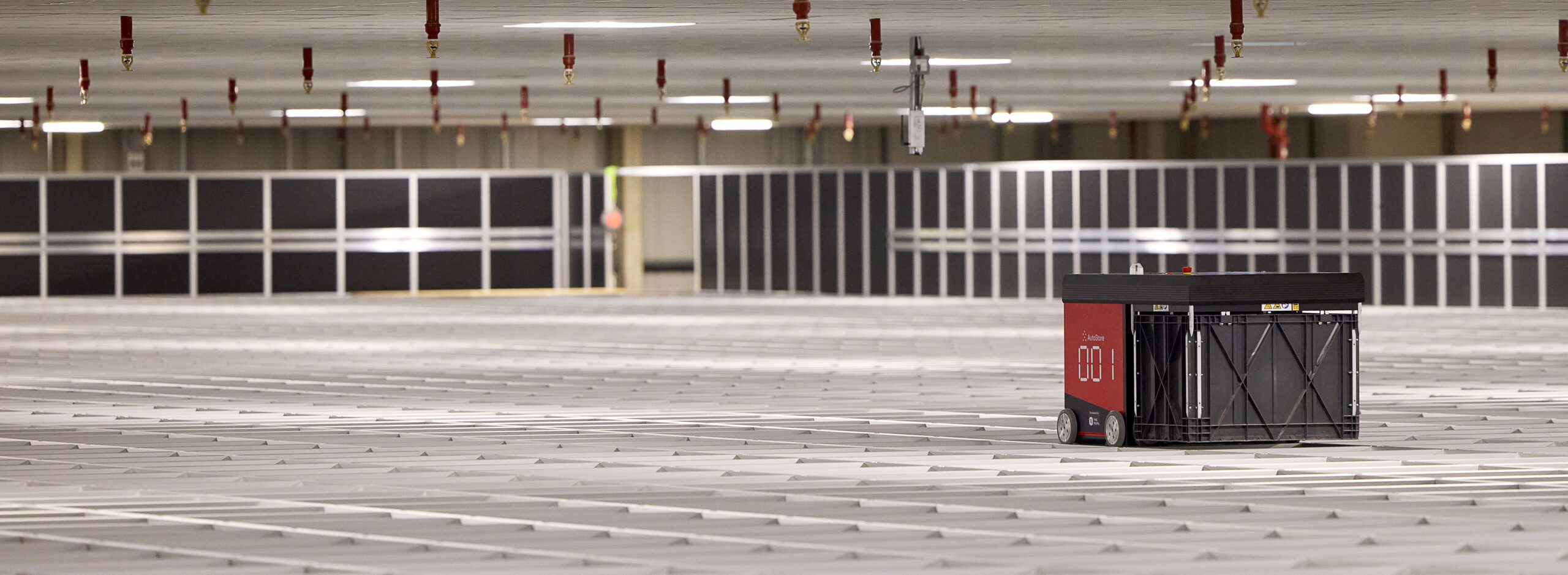
The company says it operates 796 AutoStore robots internally and has used its warehouse control system to deliver more than 11,000 bins to picking stations per hour. It also reports a 78% reduction in average pick waiting time within its own operation. Those figures describe THG’s internal network and should not be treated as guaranteed performance for external customers, where site design, order profile and system configuration will differ.
Its first major external example is Footasylum. The retailer’s AutoStore installation uses 85 R5 robots and more than 96,000 bin locations, with the complete live SKU range stored inside the grid. The project was delivered through Robotics-as-a-Service, demonstrating the lower-capital route that will now sit alongside conventional ownership.
That installation also shows why commercial structure and engineering design cannot be separated completely. Automation capacity has to be sized around inventory, order volume, peak demand and future growth. If the financing model makes later expansion difficult or expensive, an initially attractive project can become restrictive as the warehouse changes.
Hybrid structures may therefore appeal to operators that want to own predictable base capacity while retaining more flexibility around incremental automation. The precise balance will vary by customer, but the broader agreement allows financial design to become part of the implementation conversation rather than forcing every project through the same purchasing model.
Recent AutoStore research has pointed towards more connected warehouse automation, with operators increasingly combining dense storage, software, robotics and material handling rather than treating individual systems in isolation. Commercial flexibility adds another variable to that integration problem.
The expanded rights cover the complete AutoStore product range under CapEx. THG Fulfil’s RaaS offer remains focused on selected equipment, including R5 Pro and R5 Pro+ robots and several port configurations. Customers therefore have to consider both the financing structure and the precise equipment required for an individual operation.
The distinction is particularly relevant in larger fulfilment projects, where automation can represent a substantial share of the warehouse investment. Capital ownership can suit operators with long-term certainty around site use and demand, while service models can lower initial expenditure and provide another route for businesses where growth or contract duration is less predictable.
Neither structure removes the need for a robust operating case. Automation still has to improve throughput, storage density, labour deployment or service sufficiently to justify its cost. The value of the expanded THG agreement is that the commercial model is less likely to determine the decision before those operational benefits have been assessed.
THG Fulfil has therefore widened its AutoStore proposition without changing the underlying technology. The significance will be measured by whether access to CapEx, RaaS and hybrid structures allows more warehouse projects to proceed with financing arrangements suited to the operator, rather than forcing the engineering decision into a single ownership model.