IN Brief:
- WITRON has taken over the Norwegian robotics developer while retaining its existing operations and management.
- Grab handles cases up to 30 kg, while Sort processes 300 empty pallets per hour as standard and can scale to 600 or more.
- WITRON intends to offer the systems in new and existing warehouses; SOLWR Software AS is excluded from the transaction.
WITRON has acquired Norwegian warehouse robotics specialist SOLWR Robotics AS, adding autonomous case picking and empty pallet sorting to its logistics automation portfolio. The company, based in Ålesund, develops the Grab mobile picking robot and Sort pallet sorting system for retail and wholesale distribution. WITRON disclosed the transaction on 17 November, with the businesses expecting to combine their capabilities for existing facilities and new warehouse projects.
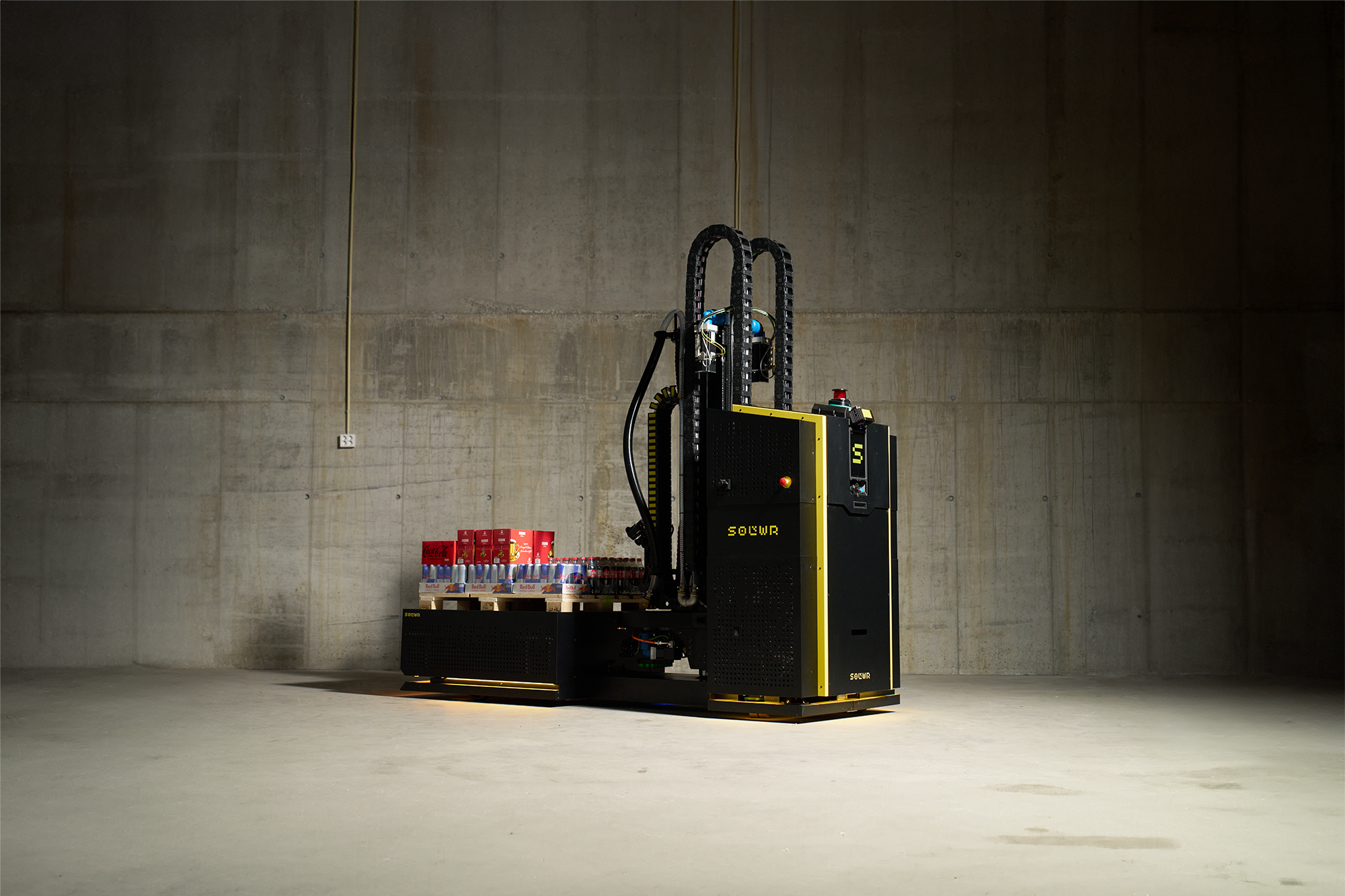
Grab is designed to travel through warehouse aisles, collect cases, and build pallets in an order suited to the receiving store. It can handle cases weighing up to 30 kilograms and is intended for ambient and fresh food operations. SOLWR is also planning a frozen-food version, although the companies have not reported an operational launch date for that application. Automated loading of roll containers is described as a future extension rather than a capability already in general service.
Grocery distribution often combines thousands of products with store-specific case quantities and delivery sequences. Grab is designed to travel between storage locations, retrieve selected cases, and place them on a load carrier in an order suited to the receiving store. Its usefulness in an existing warehouse depends on maintaining inventory accuracy, safe loads, and reliable movement through aisles that remain in use by people and other equipment.
WITRON says Grab can be connected to its system infrastructure or deployed independently with an existing warehouse management system. The product’s modular design is intended to support both new construction and retrofit projects. Site integration still depends on matching inventory locations, task data, charging arrangements, traffic routes, and safe stopping behaviour to the building’s actual operating conditions.
Retrofitting a warehouse places practical limits on robotic movement. Aisle width, racking, floor condition, pedestrian crossings, and replenishment activity constrain where a mobile system can travel and position a load. Changes to pick routes or stock presentation may be needed even where the installation avoids major fixed conveyors; WITRON has not provided a site-by-site installation cost or a uniform deployment time under the new ownership.
Grab is intended to work alongside employees as well as in automated picking operations. WITRON highlights the reduction of manual handling for heavy cases, which can otherwise involve repeated lifting and stacking during a shift. Safe mixed operation requires suitable detection, stopping, and route-management arrangements around pedestrian areas and other mobile equipment. The acquisition announcement does not disclose customer-specific productivity or injury reduction measurements, so these remain operational objectives rather than verified outcomes of the deal.
SOLWR’s second main product, Sort, handles empty pallets by type and quality. WITRON gives a standard capacity of 300 pallets per hour, scalable to 600 or more. Sorting empties is a separate task from fulfilling store orders, but it can influence warehouse flow because reusable pallets arrive with returns and inbound loads before being selected for further use. Separating unsuitable units and assigning acceptable pallets to the right stock can reduce unnecessary manual handling.
Grab and Sort serve different material flows. Grab assembles outbound store consignments from saleable cases; Sort identifies and separates the empty pallets returned to the distribution network. A common supplier might simplify support arrangements, but interoperability with warehouse control systems, maintenance obligations, and the customer’s equipment mix still has to be assessed for each installation.
SOLWR Robotics was founded in 2016 and employs more than 50 people across Ålesund, Trondheim, Oslo, and Gothenburg. Existing customers and partners identified by the companies include ASKO, H.I. Giørtz, COOP, and UK wholesaler James Hall & Co. Those relationships give the business a foothold in grocery distribution, where picking operations must meet store delivery sequences and often accommodate both fresh and ambient goods.
WITRON says SOLWR will retain its current sites, management, workforce, customer contracts, and service contacts. SOLWR Software AS is expressly excluded from the acquisition, an important boundary when considering what software assets and contracts transfer to the group. The companies have not disclosed the purchase price, financial terms, or a detailed timetable for product integration. Their statement also makes no commitment to a quantified number of additional installations.
The companies have not announced a combined installation programme or quantified financial benefits from the acquisition. Further operational evidence will depend on Grab’s integration with live inventory and task systems and Sort’s performance in routine pallet-return flows, as well as the ability to support equipment across different warehouse layouts. The product portfolio has expanded immediately; the scale and pace of future deployments remain undisclosed.