IN Brief:
- 7R City Park Berlin East will provide approximately 43,000m² of logistics space.
- The existing 20,000m² warehouse is more than 90% occupied.
- Two new buildings totalling 23,000m² are planned for 2027 and 2028.
7R is entering the German logistics-property market through a €70m brownfield development in Berlin’s Lichtenberg district.
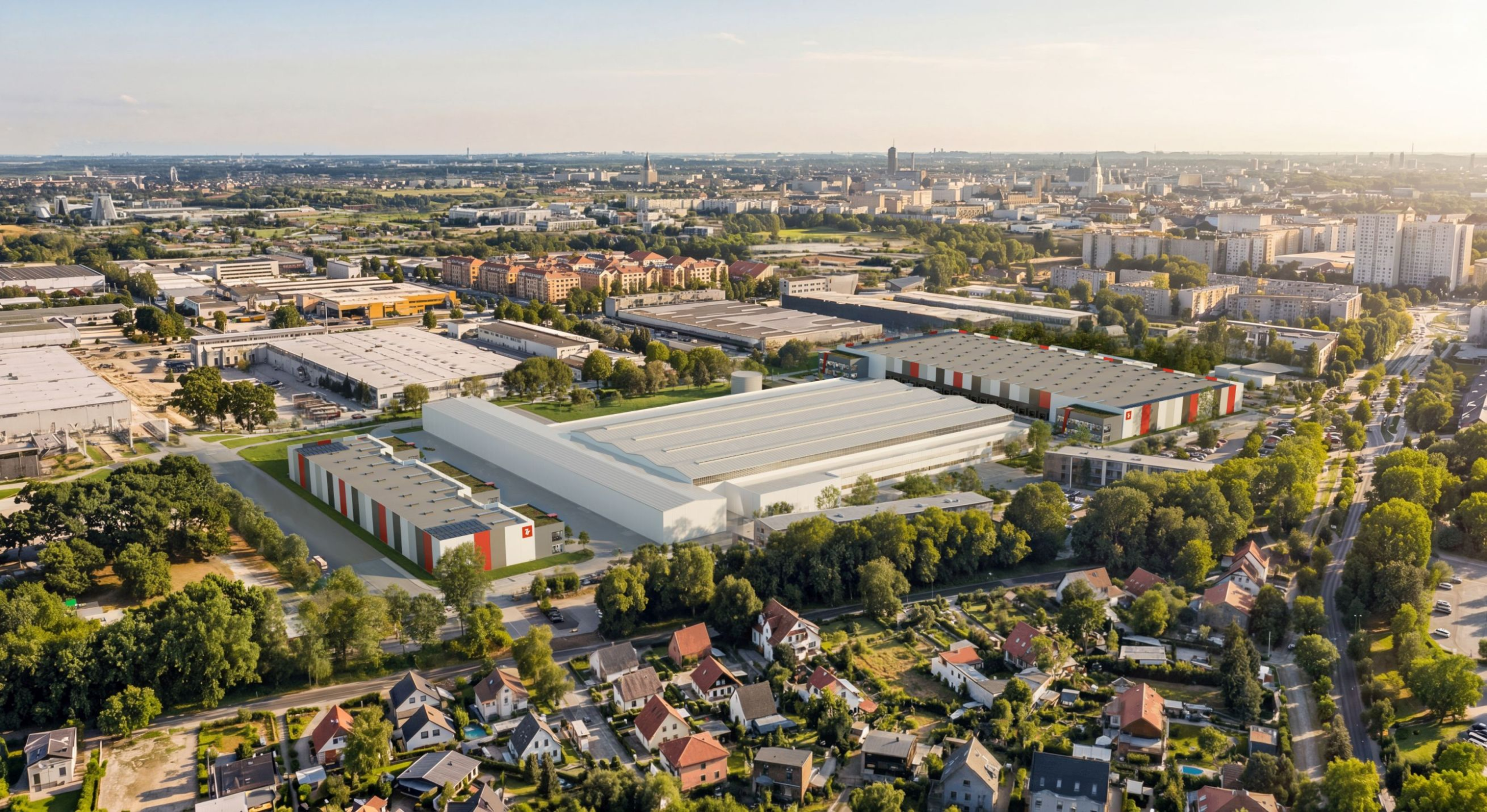
The developer has completed the principal formalities required to acquire part of the BEGEWO industrial site from KARL Gruppe. Its 7R City Park Berlin East project will combine an existing warehouse with two new buildings, creating a final complex of approximately 43,000m².
The acquired plot covers around 93,000m² and contains an operational warehouse of approximately 20,000m². More than 90% of the existing building is leased, providing rental income while the modernisation and expansion programme is prepared.
Two additional buildings will add approximately 23,000m² of warehouse and logistics space, with delivery planned in stages during 2027 and 2028. Existing tenant operations will continue while designs, approvals, and infrastructure works progress.
Units will be available from approximately 5,000m², with internal heights between 10 and 11.7 metres and floor loadings of seven tonnes per square metre. The proposed specification includes hydraulic docks, NFPA 13 sprinklers, building-management systems, LED lighting, and BREEAM certification.
The property lies around 10km from Alexanderplatz and approximately 20km from Berlin Brandenburg Airport. Connections to the A10 orbital motorway, A113, public transport, and regional intermodal terminals support urban distribution alongside national and international freight.
Financing combines 7R’s own capital, debt, and investment from the Polish International Development Fund 2, managed by PFR TFI. The fund will take a minority interest in 7R’s German subsidiary, supporting the company’s expansion into a larger and more competitive property market.
Rental income changes the development risk
An occupied brownfield asset provides a different financial structure from speculative construction on undeveloped land. Existing rental income supports the investment from the outset, while new capacity can be phased against occupier demand.
That model has become more attractive as financing remains selective and construction costs stay elevated. Developers can create value through refurbishment, energy upgrades, re-leasing, and more intensive use of industrial land rather than relying entirely on greenfield schemes.
Lichtenberg’s location within the Berlin boundary gives the site strong urban-logistics potential. Shorter final-mile routes can reduce vehicle mileage and improve delivery responsiveness, although city locations impose tighter controls on noise, traffic, yard activity, and operating hours.
7R is targeting Germany’s seven largest metropolitan markets, including Berlin, Hamburg, Munich, Cologne, Frankfurt, Stuttgart, and Düsseldorf. Those regions contain dense consumer and industrial demand while offering limited land for large modern warehouses.
NCCCL’s planned vertical warehouse in India reflects the same pressure to extract more capacity from constrained urban land. Berlin’s development model differs, but both projects respond to the declining availability of straightforward logistics sites close to major populations.
The former concrete-production site is undergoing a wider 200,000m² transformation through the BEGEWO programme. Logistics will sit alongside commercial activity, urban services, and smaller industrial businesses, creating a mixed employment district rather than an isolated distribution park.
Brownfield projects reduce pressure on undeveloped land while introducing additional technical uncertainty. Existing foundations, utilities, ground conditions, access routes, contamination, and building structures must be assessed before new space is integrated.
Maintaining operations during construction adds another constraint, because tenant traffic, loading areas, utility services, and emergency access must remain available. Phasing must separate building work from the income-producing operation without restricting either.
German warehouse and logistics take-up reached almost 6.1m m² during 2025, increasing by 14% from the previous year. Demand remains concentrated around major metropolitan areas, where ecommerce, shorter supply chains, and industrial distribution compete for limited space.
Urban occupiers increasingly require more than a basic shell. Electrical capacity, automation readiness, yard efficiency, employee access, and environmental performance influence whether a well-located building can support modern operations.
7R City Park Berlin East gives the developer an occupied platform from which to establish its German business while adding capacity in measured stages. The project will test whether its flexible urban format can secure tenants and institutional capital in a market combining strong demand with demanding planning and cost conditions.