IN Brief:
- UltraTech Cement has deployed 45 electric heavy-duty trucks for clinker transport in India.
- The trucks will move clinker from Rajasthan to grinding units in Uttar Pradesh.
- The deployment is expected to save about 2.9 million litres of diesel and more than 8,900 tonnes of CO2 annually.
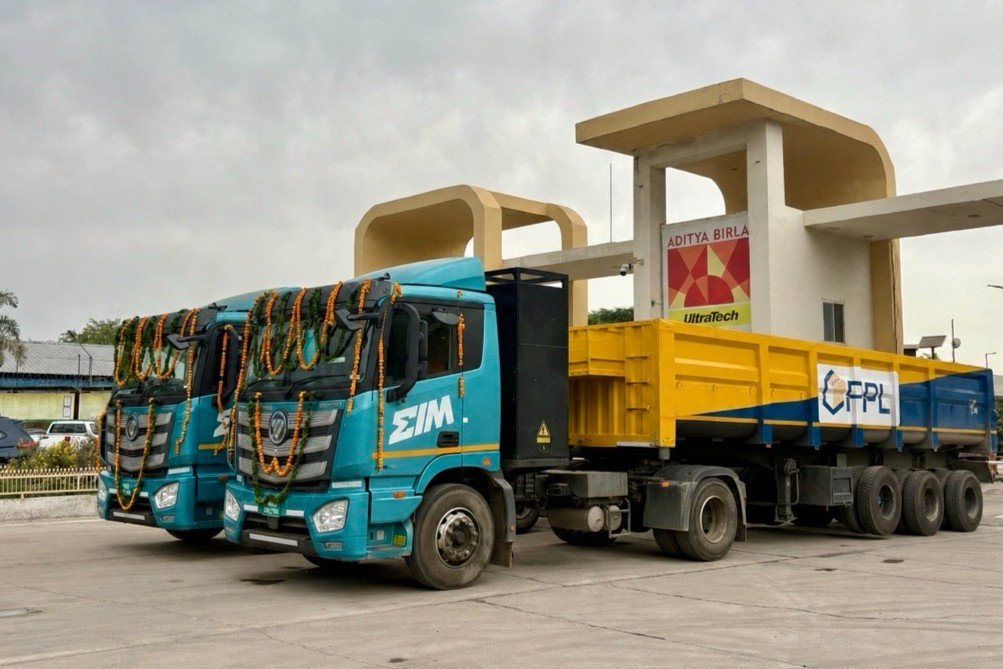
UltraTech Cement has deployed 45 electric heavy-duty trucks for clinker transport, expanding its electric truck fleet to 89 vehicles and pushing fleet electrification further into high-utilisation industrial freight.
The trucks will move clinker from UltraTech’s Kotputli Cement Works unit in Rajasthan to grinding units at Dadri Cement Works and Sikandrabad Cement Works in Uttar Pradesh. The route spans around 250km and passes through Haryana, giving the operation a defined corridor with repeatable vehicle movements.
UltraTech has partnered with Energy In Motion for the deployment. The vehicles are based around a heavy-duty electric tractor configuration using a swappable battery system, allowing the operation to reduce charging downtime on a route where asset utilisation and production continuity are central to the commercial case.
The deployment is expected to reduce diesel consumption by about 2.9 million litres annually and save more than 8,900 tonnes of CO2 each year. K C Jhanwar, managing director of UltraTech Cement, said: “This deployment demonstrates our commitment to building a future-ready logistics network while supporting the nation’s sustainability ambitions.”
Cement logistics gives electric freight a demanding test case. Clinker is dense, heavy, and moved in high-frequency flows between production and grinding operations. Fleet performance is judged against uptime, payload, route reliability, and the ability to keep plant logistics aligned with production needs, rather than only against vehicle emissions figures.
Fixed industrial corridors are becoming the most credible starting point for heavy-duty electrification. Known distances, repeatable schedules, depot-based control, and planned charging or swapping infrastructure reduce uncertainty. Similar operating logic is visible in the UK, where Masters Logistical has introduced electric trucks for British Sugar movements between fixed sites in a high-volume food manufacturing operation.
The route model does not solve every challenge. Heavy-duty electric trucks still depend on charging or swapping discipline, battery availability, workshop support, driver training, and payload economics. A vehicle that performs well technically can still fail commercially if it spends too much time idle, requires expensive contingency planning, or disrupts dispatch timing.
Battery swapping offers one route around long charging windows, particularly where trucks operate intensively and return to predictable points. It also introduces infrastructure requirements of its own, including battery inventory, safety procedures, standardisation, and maintenance processes. In industrial operations, the battery system becomes part of the logistics network rather than a vehicle accessory.
UltraTech’s decision also shows how transport decarbonisation is moving into the core of industrial strategy. Cement producers face emissions pressure across fuel, process chemistry, power, materials, and distribution. Freight is not the largest emissions challenge in cement, but it is measurable, controllable, and visible to customers, regulators, and investors.
High-frequency shuttle work provides a useful bridge between early electric truck trials and broader fleet replacement. Once operators understand range, payload, driver patterns, energy cost, maintenance, and route resilience on controlled lanes, they can make more disciplined decisions about where electrification should expand and where conventional vehicles remain necessary.
India’s heavy electric truck market is still developing, with vehicle supply, service networks, and energy infrastructure shaping the pace of adoption. UltraTech’s deployment places 45 vehicles into a demanding real-world cement lane, giving the company a larger evidence base than a small pilot. If uptime, payload, and operating cost hold up, similar heavy industrial corridors are likely to follow.