IN Brief:
- KNAPP has founded KNAPPRobotics.ai with a new laboratory in Somerville, Massachusetts, alongside its Graz robotics centre.
- The operation focuses on physical AI, computer vision, robot grasp planning, motion planning and warehouse execution applications.
- The company expects 30–35 employees by early 2027 and intends to accelerate product development and industrial deployment.
KNAPP has established KNAPPRobotics.ai Inc. and a robotics development laboratory in Somerville, near Boston, as part of a wider programme to turn artificial intelligence research into industrial warehouse systems. The new operation will work alongside the company’s existing robotics centre in Graz, Austria. Its remit spans software, robot control, product management and the development of applications that can be deployed in logistics facilities rather than remaining confined to laboratory demonstrations.
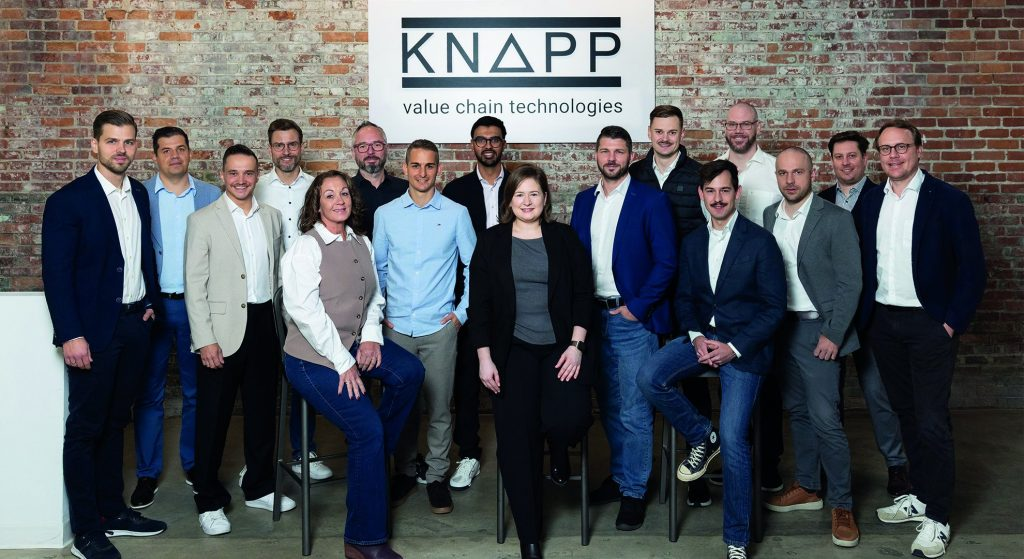
KNAPP plans to build the Somerville team to between 30 and 35 employees by early 2027, including approximately 20 software developers. Wolfgang Toferer is chief executive of KNAPPRobotics.ai, working with chief operating officer Christopher Reiß and vice-president Thomas Zilk. The recruitment mix is intended to combine staff with existing logistics engineering experience and robotics specialists from the Boston area. Those headcount figures describe the intended team at the next milestone, rather than its staffing on the announcement date.
The Boston laboratory and KNAPP’s robotics centre in Graz will share development responsibilities. Graz retains its logistics engineering knowledge and established robotics work, while Somerville concentrates on selected research-intensive technologies and their progression into industrial products. Bringing product management, development and deployment planning into the same organisation is intended to shorten the route from an evaluated robotic function to an application that can be supported across customer sites. That depends on engineering validation as well as on research performance.
Physical AI is one technical focus of the new laboratory. Cameras and other sensing equipment can capture an object’s position and apparent shape, after which perception software identifies it and selects a possible gripping point. Motion-planning tools determine a path compatible with the manipulator and its workspace before the robot attempts the pick. Reliable execution depends on handling unfamiliar items, obstructions and failed grasp attempts within the machine’s available reach, payload and safety limits.
KNAPP identifies piece picking, bin picking and cycle counting among the potential applications. Individual piece picking requires identification and manipulation of a selected product, whereas bin picking adds variable item position and partial occlusion within a container. Cycle counting compares observed inventory with the warehouse record without necessarily moving every item. The applications share vision and data-processing requirements but differ in the mechanical actions, tolerances and time available for each task.
KNAPP Brain is the company’s named platform for combining computer vision, AI, grip-point calculation, motion planning and continuous learning. Each function serves a different stage of the robotic task, from interpretation of camera data to generation of a movement plan and evaluation of the outcome. The company has presented the platform as a development foundation rather than announcing a new customer deployment arising from the Somerville lab. Practical implementation will require repeatable performance, fault recovery and interfaces to the warehouse control systems around each machine.
A robotic picking cell must also stay aligned with orders and stock records. It needs a task from the warehouse execution layer, confirmation that the intended item has been handled and a record of completion that downstream packing or conveyor systems can use. A faster grasping cycle has limited benefit if upstream bins are not presented on time or completed orders cannot leave the cell. Integration testing therefore has to consider item flow, task sequencing and exception handling alongside the robot’s perception accuracy.
Somerville places the hub within reach of the Massachusetts Institute of Technology and the area’s wider robotics research community. KNAPP joined MIT’s Industrial Liaison Program in 2026 after several years of collaboration with the university. The company intends to develop further relationships in robot learning, autonomous systems, computer vision and simulation. Those research links support access to expertise and methods, while the organisation’s own engineering teams remain responsible for turning them into products suitable for industrial use.
The move also gives KNAPP a dedicated group to coordinate decisions about which robotics capabilities enter its commercial product portfolio. Research teams can test a manipulation approach, but industrial delivery additionally requires defined hardware requirements, validation on representative stock, maintainable software and support procedures for customers. The Boston and Graz arrangement places those tasks in one development framework, linking selected research work with product engineering and implementation planning.
KNAPPRobotics.ai’s next stated milestone is a Somerville workforce of 30–35 by early 2027, with around 20 software developers. The organisation’s technical work spans perception, grasp planning and robotic movement for warehouse applications, supported by KNAPP’s Graz centre. Subsequent product releases and customer installations will provide the measurable evidence of how far those research functions have progressed into routine logistics operations.