IN Brief:
- GXO plans to begin a phased deployment of adaptive warehouse technologies at priority US sites in early 2027, continuing over approximately 12 months.
- The technology group includes pallet AMRs, robotic arms for unloading and packing, AI-enabled vision, wearable scanning, and flexible sortation.
- The announcement identifies no site count, individual customers, supplier contracts, or measured productivity improvements from the proposed rollout.
GXO Logistics plans to expand warehouse automation at priority sites across the United States, with installations scheduled to begin in early 2027 and continue in phases over approximately 12 months. The contract logistics group has identified pallet-moving autonomous mobile robots (AMRs), robotic unloading and packing, AI-enabled visual data capture, wearable scanning, and flexible sortation. The programme covers several handling stages rather than one standardised robot system, and equipment will be selected for the operating requirements at individual facilities.
Pallet movement, incoming freight handling, identification, and outbound sorting each require different equipment and controls. An AMR can transfer a pallet between defined positions, while a robotic arm can handle suitable cartons in an unloading or packing process. Cameras and wearable scanning equipment capture information about products or movements, and sortation machinery directs orders towards the correct dispatch stream. Their combined performance depends on the interfaces between these processes, including the transfer of physical loads and the associated inventory records.
A distribution centre’s sustained throughput is constrained by its slowest operating stage. Faster pallet transfers can leave handling equipment waiting if inbound unloading is limited, while additional unloading capacity may create a queue at identification or packing. Linking automation to a warehouse management system requires each transfer to be confirmed before the next task is released. GXO’s proposed combination of systems creates scope to address several bottlenecks, provided that traffic, storage positions, and order priorities remain coordinated.
GXO has identified consumer goods, food and beverage, omnichannel retail, aerospace and defence, and technology as sectors for the wider deployment. These operations place different demands on material handling. Retail fulfilment may involve large numbers of small orders moving towards short carrier cut-offs; industrial distribution may involve heavy units, irregular dimensions, controlled parts, and additional traceability checks. The technology selection and performance measures will therefore differ between facilities even where a similar type of machine is installed.
The company has not published the number or location of participating US sites, a robot count, named customer contracts, or the suppliers that will provide the different systems. It has also not assigned commissioning dates to individual facilities. The early-2027 start is a planned implementation milestone, while improvements to productivity, safety, inventory accuracy, and service levels remain anticipated benefits. No measured result from this particular rollout has yet been disclosed.
Pallet AMRs require predictable load presentation and managed routes. Each vehicle must be able to collect a compatible pallet, travel safely through shared working areas, and confirm its arrival at the receiving position. Floor conditions, pedestrian movements, vehicle intersections, pallet dimensions, and docking accuracy influence how reliably those movements can be completed. The warehouse and vehicle control systems must reconcile the physical handover with the inventory location record before another task is permitted to proceed.
Robotic unloading and packing pose different engineering problems. Cartons arriving in a mixed trailer can vary in size, weight, orientation, and packaging condition, which affects gripping and the ability to separate individual items safely. Arms may require different end effectors, vision inputs, or intervention procedures to accommodate that variation. A suitable installation can relieve repetitive handling work, but any measured gain depends on the products encountered, the proportion successfully handled automatically, and how exceptions return to the normal workflow.
Vision-enabled capture and wearable scanners are intended to reduce the need for employees to stop work and manually enter or scan information. Camera-based recognition still depends on readable labels or objects, sufficient lighting, clear sightlines, and the accuracy of the underlying inventory records. Wearable scanning moves the interface closer to the task, but reliable transaction confirmation remains necessary when an order, pallet, or storage location changes. GXO has not published a data-capture accuracy benchmark for the planned installations.
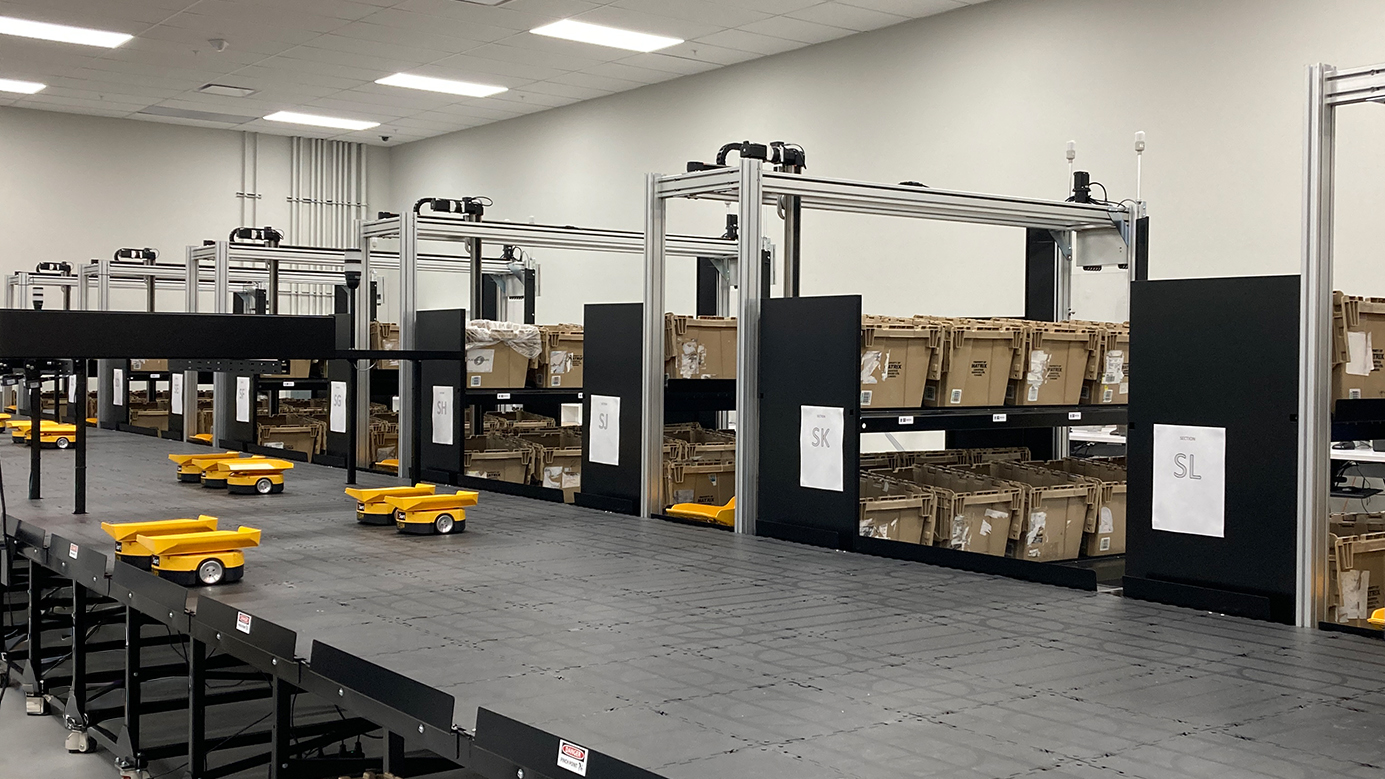
Sortation must associate each package with an order and outbound destination before conveying or diverting it. Mechanical capacity alone does not establish dispatch capacity: missing identifiers, exceptions, blocked exits, and carrier collection schedules affect the rate at which freight can leave the building. Modular equipment may enable changes in layout or throughput over time, but each site’s actual capacity will depend on its product mix and the interaction between induction, tracking, and discharge.
The plan is separate from GXO’s existing humanoid robotics programme with Apptronik, which concerns trials of a specific robot platform and a potential commercial service model. The newly described US deployment instead covers pallet AMRs, robotic arms, visual data capture, wearable devices, and sortation. GXO has not stated that humanoid machines form part of this programme, and the existing trials should not be counted as evidence of completed installations under the 2027 rollout.
Introducing equipment into occupied warehouses also requires continuity between manual and automated processes. An installation can be introduced by zone or task, leaving existing routes available while controls and handovers are tested. That approach requires safe segregation, maintenance access, employee training, and procedures for work to continue if equipment or a software interface fails. GXO describes the planned technologies as adaptable to existing workflows, but has not set out the commissioning arrangements for any particular facility.
The rollout is due to begin in early 2027 and extend across priority sites during the following year. Performance can then be assessed using pallet moves per labour hour, trailer unloading time, exception rates, inventory discrepancies, and dispatch completion against carrier cut-offs, provided the measures are collected consistently. GXO has not supplied baseline figures for those measures. The next operational evidence will come from the sites, systems, and customer processes selected for commissioning.