IN Brief:
- DSV has equipped its Venlo logistics centre with Exotec’s Skypod goods-to-person robotics system.
- Around 100 autonomous robots manage high-density bin and tray storage for retail fulfilment.
- The installation supports peak resilience, returns handling, automated box processing, and faster fulfilment.
DSV has partnered with Exotec to modernise fulfilment operations at its logistics centre in Venlo, the Netherlands, using an end-to-end Skypod robotic storage and retrieval system.
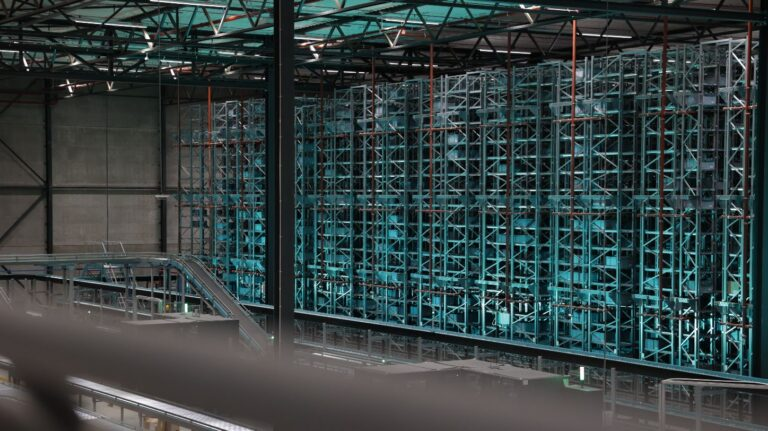
The installation uses around 100 autonomous Skypod robots to support fulfilment for multiple retail brands. The system manages dense bin and tray storage while bringing goods to operators, reducing travel time across the warehouse and creating a more flexible platform for fluctuating retail demand.
Alongside the robotics installation, the Venlo operation includes automated box opening, decanting, closing, and labelling. A mezzanine level is dedicated to returns, giving the site additional capacity for reverse logistics as retailers deal with rising volumes of customer returns and more complex inventory flows.
Goods-to-person automation changes the rhythm of fulfilment work. Instead of employees walking long routes between pick faces, robots move storage bins between racking and workstations. That can improve pick productivity, increase storage density, reduce physical strain, and help maintain service levels during peaks.
Retail logistics networks are being forced to absorb more variation. SKU ranges are wider, promotional cycles move faster, e-commerce demand is less predictable, and customer expectations around delivery and returns remain high. Operations built around fixed layouts and manual travel can struggle when order profiles shift quickly.
Robotic storage systems offer a more modular route to capacity. Operators can add robots, workstations, and storage modules as demand changes, rather than redesigning the entire building around a single forecast. That flexibility is valuable for third-party logistics providers supporting multiple customers from one site, where volumes, order profiles, packaging rules, and service levels can vary between brands.
The returns layer is especially important. Retail warehouses are no longer one-way distribution points. Products move back into the network for inspection, repacking, resale, refurbishment, supplier return, or disposal. Slow returns processing traps inventory and increases markdown risk, while poor visibility can leave stock unavailable even when it has physically returned to the building.
Across European fulfilment, automation projects such as Paxon’s automated Lyon operation for JDE Peet’s show how fulfilment is being redesigned around denser storage, faster handling, right-sized packaging, and better flow control. DSV’s Venlo deployment follows a similar direction in a broader multi-brand retail environment.
The emphasis on box handling also shows how warehouse automation is spreading beyond picking. Packing, labelling, decanting, carton opening, and returns processing all consume labour and create bottlenecks when demand rises. Automating those supporting tasks can improve throughput without requiring every part of the warehouse to be fully automated.
For warehouse teams, the project also shows why automation design is increasingly being judged across the whole operating loop. Picking speed matters, but the commercial gain comes when storage, packing, returns, labour planning, and carrier handover all improve together.
For DSV, the Venlo project strengthens the site’s ability to serve retail customers whose demand patterns are difficult to stabilise. The automated system gives the operation a tighter link between storage density, order release, workstation productivity, packing, and reverse logistics. That integrated approach is becoming more important as retailers expect fulfilment partners to absorb volatility without adding avoidable inventory or labour cost.
Labour availability, customer service requirements, and inventory pressure are likely to keep driving similar projects across Europe. The most successful deployments will be those that connect robotics to packing, returns, carrier processes, and customer systems, rather than treating automation as a standalone picking upgrade.