IN Brief:
- EUTRACO has opened six ultra-fast chargers and eight industrial batteries at Roeselare.
- The wider programme includes 30 chargers, 40 battery systems, and 3,500 solar panels.
- The operator now runs Belgium’s largest long-haul electric truck fleet.
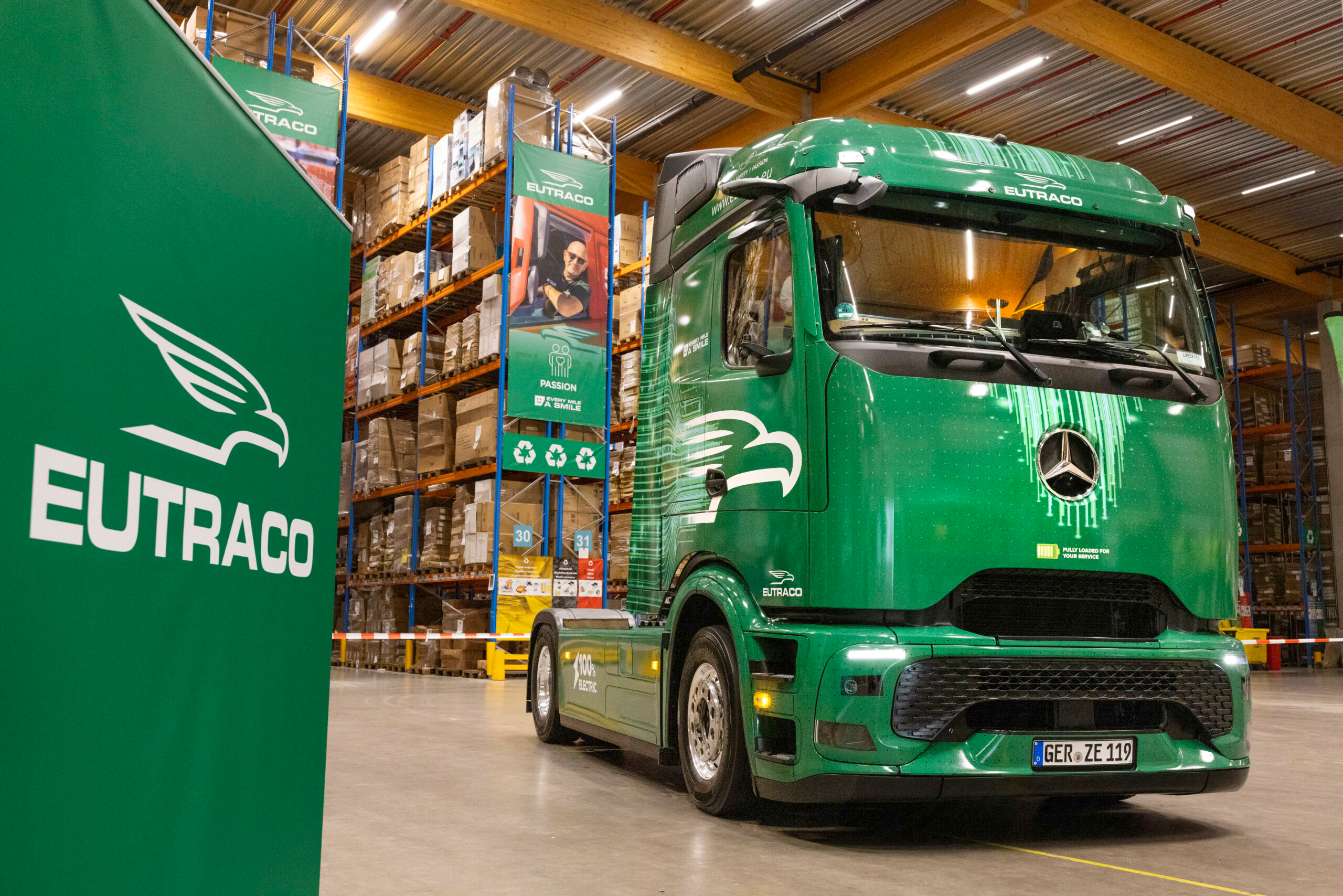
EUTRACO has opened six ultra-fast electric truck chargers and eight industrial batteries at its headquarters in Roeselare, Belgium, as the logistics operator expands its electrified freight infrastructure.
The installation was delivered by Insaver, part of the Luminus Group, and sits within a wider programme covering 30 ultra-fast charging points, 40 battery systems, and 3,500 solar panels across four sites. The sites include two locations in Roeselare, one in Ghent, and one in Willebroek.
The combined system provides 14.4MW of charging capacity, 2.3MWp of solar capacity, and 10MWh of battery storage. The infrastructure is designed to allow EUTRACO’s electric trucks to charge using locally generated renewable electricity, with batteries storing energy when solar production and fleet charging demand do not align.
EUTRACO operates 54 long-haul electric trucks, representing about one-third of its fleet and giving it the largest electric truck fleet in Belgium. With a full battery and trailer, the vehicles have a theoretical range of up to 500km, depending on cargo weight, traffic, and weather. Ultra-fast chargers can move the trucks from 20% to 80% charge in about 60 minutes, adding around 300km of range.
The company has tied the investment to its goal of operating completely emission-free by 2035. Each diesel vehicle replaced by an electric truck is expected to save up to 60 tonnes of CO₂ annually, giving the current fleet replacement programme a substantial emissions reduction profile over an eight-year operating cycle.
The project shows how heavy transport electrification is becoming an infrastructure exercise rather than a vehicle purchase alone. Electric trucks require grid capacity, charging windows, battery storage, depot layout changes, maintenance planning, route modelling, driver training, and energy management. A charger installed without those supporting systems can become a bottleneck rather than a solution.
Depot-level energy planning is becoming increasingly important as operators move from a handful of demonstration vehicles to larger fleet batches. Solar generation and battery storage can help reduce grid dependency, smooth peaks, and improve the use of locally produced electricity. For operators running predictable regional routes, the ability to charge at base between planned movements can make electrification more practical than relying entirely on public charging corridors.
The same infrastructure challenge is visible along major European freight routes, including the MAN-backed electric truck push on the Brenner freight corridor. Long-haul electrification will need both depot charging and corridor charging, with energy availability planned around duty cycles rather than simple charger counts.
Logistics property is likely to feel the effect quickly. Warehouses and distribution centres are already judged by location, dock configuration, yard depth, clear height, labour access, and road connections. Power availability is now moving up that list, particularly for operators running electric trucks, refrigerated fleets, automated warehouses, and battery-supported sites.
For customers, electrified transport also raises the quality of emissions data. As more operators link vehicles, charging, solar generation, and batteries into digital energy systems, shipment-level carbon reporting can move closer to real operational activity. That will become increasingly valuable as manufacturers, retailers, and food businesses face more pressure to demonstrate credible Scope 3 reductions.
EUTRACO’s system gives the market a practical example of fleet electrification built around site energy design. The measure of success will be utilisation: how often vehicles can run planned routes, how efficiently the batteries support charging demand, and how reliably the infrastructure holds up during operating peaks. If that model scales across multi-site networks, charging capacity will become a core part of logistics competitiveness.