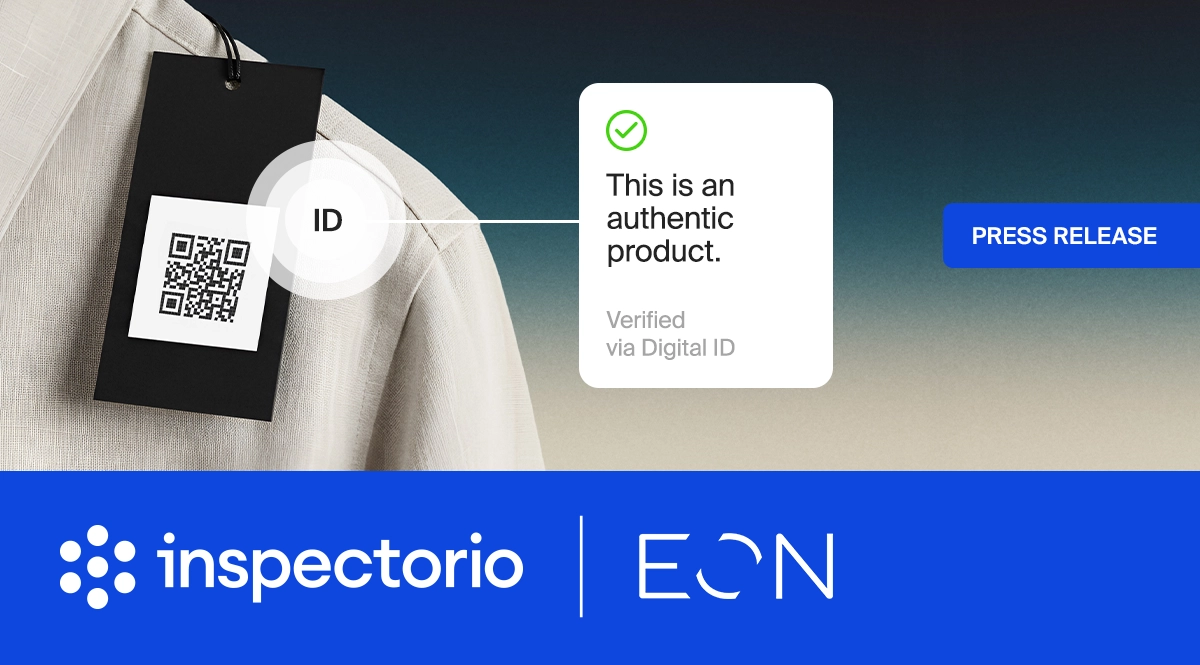
IN Brief:
- Inspectorio will feed product, material, supplier, traceability, compliance and sustainability data into EON Product Cloud.
- EON associates supply-chain records with serialised Digital IDs attached to individual products.
- The integration is intended to support Digital Product Passport programmes across millions of products.
Inspectorio and EON have formed a partnership connecting supply-chain traceability data directly with serialised Digital IDs, aiming to make Digital Product Passport programmes workable at product scale rather than as manually assembled pilots.
The integration connects Inspectorio’s platform with EON Product Cloud. Product, material, supplier, facility, traceability, compliance and sustainability information held in Inspectorio can flow into EON, where it is associated with a unique digital identity for the physical product.
The aim is to reduce the manual collection, transfer and maintenance of data between separate systems. For brands sourcing products through several tiers of factories and suppliers, that administrative burden is one of the practical obstacles to operating Digital Product Passports across more than a small set of product lines.
A passport is only useful if the information behind it can be trusted and kept current. Assigning a QR code or another data carrier to an item is comparatively straightforward; connecting that identifier to verified material, factory, compliance and sustainability records throughout the product lifecycle is the larger information-management task.
Inspectorio’s role covers that upstream dataset. Its platform manages information across suppliers, facilities, products and materials, while EON provides the serialised Digital ID and product-facing infrastructure through which different users can access the appropriate information. Those users can include consumers, regulators, repairers, resale businesses and recycling organisations, depending on the product and applicable rules.
The companies say the integration is intended to move customers from pilot schemes towards programmes capable of supporting millions of products. Reaching that scale requires more than database capacity. Product information has to be structured consistently, matched to the correct physical item and updated without introducing a separate manual workflow whenever a supplier or specification changes.
The regulatory environment is becoming more concrete. The European Commission launched its Digital Product Passport Registry and testing environment in July under the Ecodesign for Sustainable Products Regulation. Economic operators covered by the relevant rules will register unique product identifiers and associated metadata while the underlying product data remain decentralised.
Requirements will be introduced progressively across product groups rather than through one universal deadline. The first stated implementation deadline is 18 February 2027 for certain large batteries, with further categories expected to include textiles, steel and aluminium, tyres, furniture, ICT equipment and other products as implementing legislation develops.
That phased approach gives supply-chain teams a data-management problem before it gives them a labelling problem. Companies need to establish where required information originates, which organisation is responsible for maintaining it and whether existing quality, procurement and traceability systems hold it in a usable form.
A material-composition record may sit with one supplier, while facility information is held in an audit platform and compliance documentation is maintained elsewhere. Sustainability information can come from yet another system. A passport that requires staff to assemble those records manually for every product variant will become expensive to operate and difficult to keep current as volumes increase.
Direct system integration can reduce that duplication, but it also raises the importance of data governance. Automation transfers errors efficiently as well as correct information. Supplier identities, material references and product hierarchies therefore need stable definitions so that information from one platform is attached to the correct Digital ID in the other.
The EU framework reinforces that requirement because the DPP is intended to improve traceability, compliance verification and access to product information throughout the value chain. The Commission’s registry supports unique identifiers and metadata, while the detailed product information remains distributed across the systems operated by economic actors and their service providers.
That architecture avoids creating one central database containing every item of product data, but it makes interoperability essential. If identifiers, interfaces and data formats are inconsistent, a supply chain can still end up maintaining parallel records even when every individual system is technically digital.
The Inspectorio-EON partnership is therefore an infrastructure integration rather than simply a consumer-facing QR-code service. Its commercial value will depend on whether customers can reuse information already collected for quality, sourcing and compliance rather than building a second dataset solely for the passport.
The next evidence will come from production deployments. The companies have not named a launch customer or disclosed the number of products currently running through the combined integration. Measures such as update frequency, supplier coverage, exception rates and the proportion of passport data populated automatically will show whether the model can reduce the administrative workload it is intended to replace.