IN Brief:
- Parcelhero examines how delivery windows could continue shrinking towards 2030 as autonomous logistics technologies expand.
- The report cites an autonomous last-mile delivery market rising from around $28bn to more than $228bn by 2035.
- Longer-range scenarios include underground freight and distributed manufacturing, with the most distant concepts explicitly treated as speculative.
Parcelhero has published a long-range report on delivery and supply chain technology, examining how faster fulfilment, autonomous transport and more distributed inventory could alter the movement of goods over the coming decades.
Delivering the Future: Instant gratification – The Future of Supply Chains, Home Deliveries and Parcels separates its discussion into two very different horizons. The first looks towards 2030 and concentrates largely on technologies already entering commercial logistics. The second moves towards 2060 and beyond, where the scenarios become deliberately more speculative.
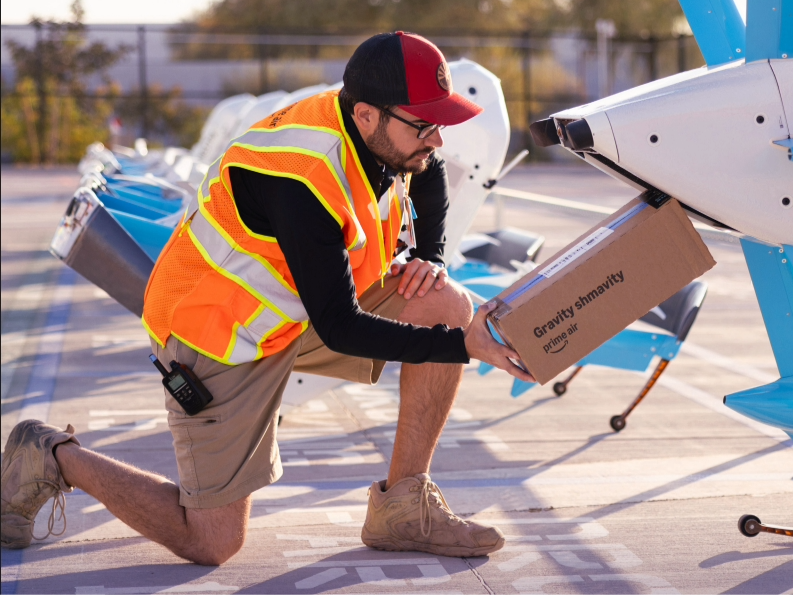
The nearer-term section examines rapid urban delivery, pavement robots, commercial drone networks and autonomous trucks operating on repeatable motorway routes between logistics hubs. Parcelhero argues that the gap between ordering and receiving goods will continue to shrink as those technologies develop alongside increasingly local inventory.
David Jinks MILT, Parcelhero’s Head of Consumer Research and author of the report, said: “Our report charts two horizons.” He describes one-hour delivery as an increasingly important benchmark and points to grocery services targeting delivery windows as short as 15 minutes.
Parcelhero also cites the expansion of drone delivery trials and networks and the development of autonomous road freight as evidence that some elements of faster delivery are moving beyond laboratory or demonstration projects. Their commercial roles remain strongly dependent on geography, regulation, route density and the economics of each journey.
The report puts the global autonomous last-mile delivery market at around $28bn currently and cites projections exceeding $228bn by 2035. Those figures describe a broad technology market rather than a single delivery mode, covering a period in which several competing forms of automation are likely to develop at different rates.
Shorter delivery windows place as much pressure on inventory strategy as they do on transport. A vehicle cannot compensate for stock positioned hundreds of miles away when the customer expects an order within minutes. Rapid services therefore require popular products to be held much closer to demand, supported by accurate forecasting and fast warehouse execution.
That creates a trade-off. Decentralised stock can reduce final delivery distance and response time, but it also divides inventory between more locations. Forecasting errors become expensive when one local site holds excess product while another runs short, particularly where fast service promises leave little time to rebalance stock between facilities.
Pavement robots and drones create similar operating questions. The vehicle attracts attention, but the service still depends on charging, maintenance, loading, authorised routes and systems capable of deciding which consignments are suitable for automated delivery. A small autonomous vehicle carrying one order is solving a different logistics problem from a van carrying dozens of parcels on a dense route.
Autonomous trucks offer another model because fixed hub-to-hub journeys provide a more controlled operating environment than complex urban streets. Automation can be concentrated on repeatable trunk routes while people remain involved in loading, local collection, final delivery and exception handling.
Parcelhero has already been applying automation to the administrative side of parcel shipping, including booking, tracking and customs support. The new report extends the company’s attention from transaction technology towards the physical structure of future delivery networks.
The second horizon is intentionally less certain. Parcelhero draws on longer-range scenario work to consider automated underground freight systems, floating warehouses and forms of distributed production that could move some manufacturing closer to the point of consumption.
Distributed manufacturing has a recognisable supply chain consequence even without assuming a particular technology wins. If selected components or finished products can be made economically nearer the user, networks could carry a different mix of raw materials, feedstocks and digital design information while moving fewer completed products over long distances.
The report also considers whether delivery connectivity might eventually influence residential property decisions. It raises the possibility that strong access to rapid delivery services could become an amenity in the way broadband and mobile coverage already influence some buyers, while busy commercial drone corridors could create the opposite response. Parcelhero presents this as a scenario rather than measured evidence of a current house-price effect.
At the furthest edge, the report discusses quantum teleportation. The term refers to experimental transfer of quantum information rather than the physical movement of parcels or matter, leaving it far outside any credible commercial logistics planning horizon. Its inclusion illustrates the deliberately broad outer boundary of the report rather than a technology roadmap for freight.
Jinks is explicit about the uncertainty in those distant scenarios, noting that no single future can be predicted with confidence. The practical decisions facing logistics operators arrive much sooner: how much stock to decentralise, which forms of automation lower total cost and which delivery promises customers value enough to support the infrastructure behind them.
Faster delivery has often been treated primarily as a transport problem. Parcelhero’s report instead points towards a wider network consequence, where inventory placement, warehouse automation, data quality and transport technology have to develop together. Cutting the final journey to minutes achieves little if the product is unavailable at the local node expected to fulfil it.