IN Brief:
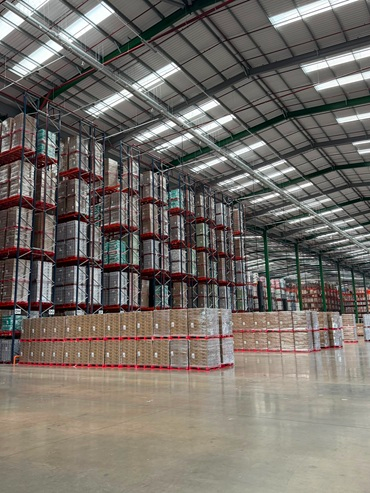
- The million-square-foot facility received 468 racking bays and more than 13,500 pallet positions.
- Precision floor grinding and embedded wire guidance support very-narrow-aisle truck operations.
- PD Industrial completed the end-to-end fit-out within a nine-week delivery programme.
PD Industrial has completed the fit-out of a one-million-square-foot logistics facility in Nuneaton, installing more than 13,500 pallet positions and the floor and guidance infrastructure required for very-narrow-aisle operations.
Delivered within nine weeks, the project covers 468 racking bays and provides 11,112 pallet positions across 5,556 double-stacked locations, together with another 2,466 single-stacked positions. Overhead sprinkler pipework was integrated into the racking, while warehouse labelling was installed to support inventory intake.
PD Industrial acted as principal designer and principal contractor under Construction Design and Management regulations, coordinating the storage installation, floor preparation, guidance system, safety infrastructure, and handover across the extensive internal footprint.
Precision floor grinding was required to achieve the tolerances needed by very-narrow-aisle trucks. Because these vehicles operate with limited clearance between the mast, load, and rack structure, particularly at height, variations that would be acceptable in a conventional warehouse can restrict travel speed or lifting performance.
Embedded wire guidance provides a fixed path through each aisle, allowing the truck to follow the signal without continuous manual steering. Narrower clearances can therefore be maintained consistently, while the operator concentrates on load positioning and retrieval.
High-density storage increases pallet capacity without extending the building, but the number of rack locations is only one measure of operational performance. Product dimensions, load weights, stock rotation, replenishment patterns, fire protection, maintenance access, and dispatch throughput all influence whether the capacity can be used efficiently.
The nine-week programme also reflects the cost of leaving major logistics property unproductive. Rent, financing, rates, recruitment, systems work, inventory commitments, and customer contracts may begin before the first pallet is received, turning any delay in the internal fit-out into a wider commercial exposure.
Warehouse shells increasingly require production-engineering levels of preparation before operations can begin. Floors, racks, sprinklers, barriers, labels, power, data, and materials-handling equipment must function as one system, because an error in any layer can restrict the performance of the equipment installed later.
The same integration challenge becomes more severe when automation is installed in an occupied facility. Live warehouse retrofits must reconcile new controls and equipment with inherited infrastructure and continuing operations, whereas Nuneaton offered a new space that could be prepared around a defined storage design.
Even on an empty floor, guidance and VNA equipment cannot compensate for rack geometry or surface tolerances that fall outside specification. The precision work completed before commissioning determines whether trucks can travel at their intended speed and whether loads can be placed accurately at higher levels.
The project also draws on a wider manufacturing supply chain. Racking, barriers, platforms, guards, guide systems, and structural components depend on steel processing and fabrication capacity, with new investment in steel production supporting warehouse and automation projects as demand for denser storage layouts grows.
Very-narrow-aisle storage occupies a useful position between conventional forklift racking and fully automated high-bay systems. It raises density substantially without imposing the fixed controls, capital cost, and operating logic of an automated storage and retrieval installation.
That flexibility can suit businesses whose product mix or volume remains uncertain. Trucks and racking can be modified more readily than a crane-based automated system, while guidance and tighter tolerances still support more disciplined movement than a standard wide-aisle layout.
The trade-off lies in throughput and labour dependence. VNA operations still require trained drivers and available vehicles, while a truck generally has to enter the aisle for each retrieval. Automated systems can move loads continuously and connect directly with conveyors or production lines, although they demand greater capital and more complex integration.
Travel beyond the rack face will also shape the site’s eventual productivity. Receiving, staging, replenishment, battery charging, marshalling, and dispatch can consume large amounts of labour when internal routes are poorly balanced, regardless of how densely pallets are stored.
The completed fit-out gives the occupier a prepared storage platform, but inventory software, fleet management, labour planning, and dock scheduling will determine how much of the theoretical capacity becomes usable throughput. A million square feet creates scale; disciplined movement prevents that scale from becoming distance and delay.