IN Brief:
- Logistics UK says repeated use of Operation Brock is consuming public funds while delaying cross-Channel freight.
- HGV queues on the M20 disrupt driver hours, delivery slots, production schedules, and Kent communities.
- A permanent solution would require secure holding capacity, welfare facilities, live information, and controlled vehicle release.
Logistics UK has renewed its demand for permanent freight-management infrastructure in Kent, arguing that repeated deployment of Operation Brock is consuming public funds while leaving hauliers and drivers exposed to avoidable delay.
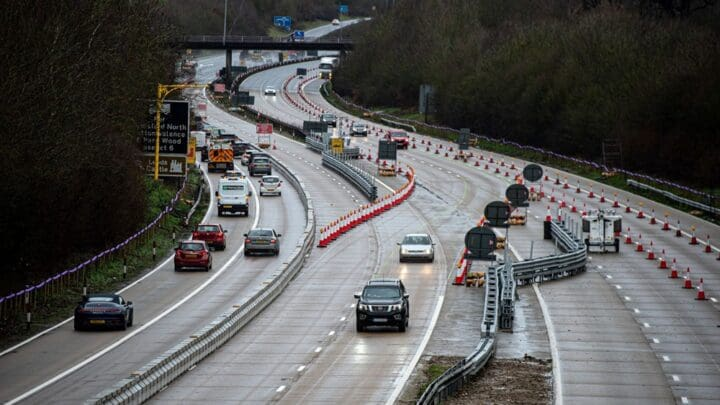
The traffic-management system creates a contraflow on the M20 and holds coastbound HGVs when disruption or peak demand threatens to overwhelm the Port of Dover and Channel Tunnel. Although the arrangement prevents queues from spreading uncontrolled across the county, it converts a strategic motorway into temporary lorry storage.
Drivers may spend hours waiting with limited access to toilets, food, rest facilities, and dependable information about when they will be released. Even after the queue begins moving, legal driving-time limits can prevent a driver from completing the onward journey, leaving the vehicle stranded at another point in the route.
The organisation’s latest intervention coincides with the summer travel period and the continued introduction of the EU Entry/Exit System, which replaces passport stamping with biometric checks. Any additional processing time at a high-volume crossing can reduce the margin available before freight begins accumulating on approach roads.
Operation Brock has also been activated because of adverse weather, ferry interruption, industrial action, border-system failures, and periods of heavy passenger traffic. Several of those triggers are predictable, yet the principal response remains temporary traffic control installed at recurring cost.
Once a vehicle enters the queue, the disruption spreads through its wider operating schedule. Delivery appointments are missed, trailers fail to return for later collections, and the driver and tractor become unavailable for other work.
Manufacturers can lose components required for a planned production run, while food and pharmaceutical loads may approach temperature or shelf-life limits. Even cargo that remains physically sound can generate storage, rescheduling, overtime, and customer-service costs far beyond the original transport charge.
The Short Straits retain a dominant position because Dover and the Channel Tunnel offer frequent departures, short crossings, and direct motorway access between southeast England and nearby continental markets. Alternative routes can absorb some traffic, but they cannot reproduce the same combination of journey time, frequency, and geographic convenience for every movement.
That concentration produces high efficiency during normal operation and rapid queue formation when capacity falls. A delayed ferry, failed border system, or modest increase in processing time can accumulate vehicles faster than neighbouring routes or terminals can absorb them.
A permanent site would need to manage freight
Replacing motorway queuing with a large parking area would relocate the problem without improving it, because a functioning freight-management facility needs secure access, driver welfare, live information, border support, and a controlled release process tied to available crossing capacity.
Vehicles would need to be separated by destination, carrier, cargo type, urgency, and regulatory status. Dangerous goods, live animals, perishables, pharmaceuticals, abnormal loads, and standard trailers cannot always wait or be handled under identical conditions.
Digital links between the holding facility, ferry operators, Eurotunnel, border agencies, hauliers, and drivers could allow vehicles to be released when both capacity and documentation are ready. Without that coordination, trucks may leave the site only to encounter another queue or be rejected because a customs reference or inspection requirement remains unresolved.
Sanitation, food, rest areas, and safe walking routes would form part of the operating infrastructure rather than an optional service. A rested driver with sufficient legal hours can resume the journey when released, whereas an exhausted driver merely transfers the delay to the first available stopping place after the crossing.
Secure parking could reduce theft, tampering, and unsafe roadside stopping, provided the site includes suitable lighting, surveillance, fencing, and controlled entry. Refrigerated trailers would need access to power or enough operational flexibility to maintain temperature during prolonged disruption.
Land selection will remain politically difficult because a facility large enough to hold peak freight volumes would generate concentrated HGV movements and occupy a substantial site. Nearby communities would expect firm controls on noise, lighting, air quality, traffic routing, and round-the-clock activity.
Additional capacity at other ports can diversify parts of the market. Construction of Immingham’s £200m Ro-Ro expansion is strengthening direct links with northern Europe, particularly for unaccompanied freight whose origins and destinations lie closer to northern industrial regions.
Those routes cannot remove Kent’s strategic role because a diversion through the North Sea may add too much distance or time to a movement between southern England and northern France, Belgium, or western Germany. Resilience requires both a broader port network and stronger management of the corridor carrying the greatest concentration of time-sensitive traffic.
Customs, safety and security, sanitary, and plant-health requirements have added more points at which a vehicle can be stopped by data rather than physical capacity. Permanent infrastructure could provide space for documentation problems and inspections to be resolved away from the live motorway queue.
Funding remains complicated because the cost of disruption is distributed among hauliers, cargo owners, drivers, ports, local authorities, government agencies, and customers. No single operator captures enough of the benefit to finance a national resilience asset independently.
Government coordination would therefore be necessary to align planning, road access, border requirements, technology, and long-term operating responsibility. The facility would also need enough flexibility to handle future changes in border processes rather than being designed around one temporary system.
Operation Brock should remain available until a replacement exists, since uncontrolled queues would impose greater disruption across Kent. Its recurring deployment nevertheless shows that an emergency mechanism has become part of the corridor’s ordinary operating model.
A permanent solution would preserve motorway capacity, provide humane conditions for drivers, and release freight in line with genuine border and crossing availability. Until then, each predictable peak will continue consuming road space, driver hours, and public funds to rebuild the same temporary answer.