IN Brief:
- TTI Algeciras has ordered 21 Kalmar hybrid straddle carriers for shuttle operations, with deliveries due by Q4 2027.
- The terminal currently runs 23 Kalmar straddle carriers and uses Kalmar to maintain eight ship-to-shore and 32 automated stacking cranes.
- TTI Algeciras is targeting annual handling capacity of 2.1 million TEU in 2028; the new fleet’s net size has not been confirmed.
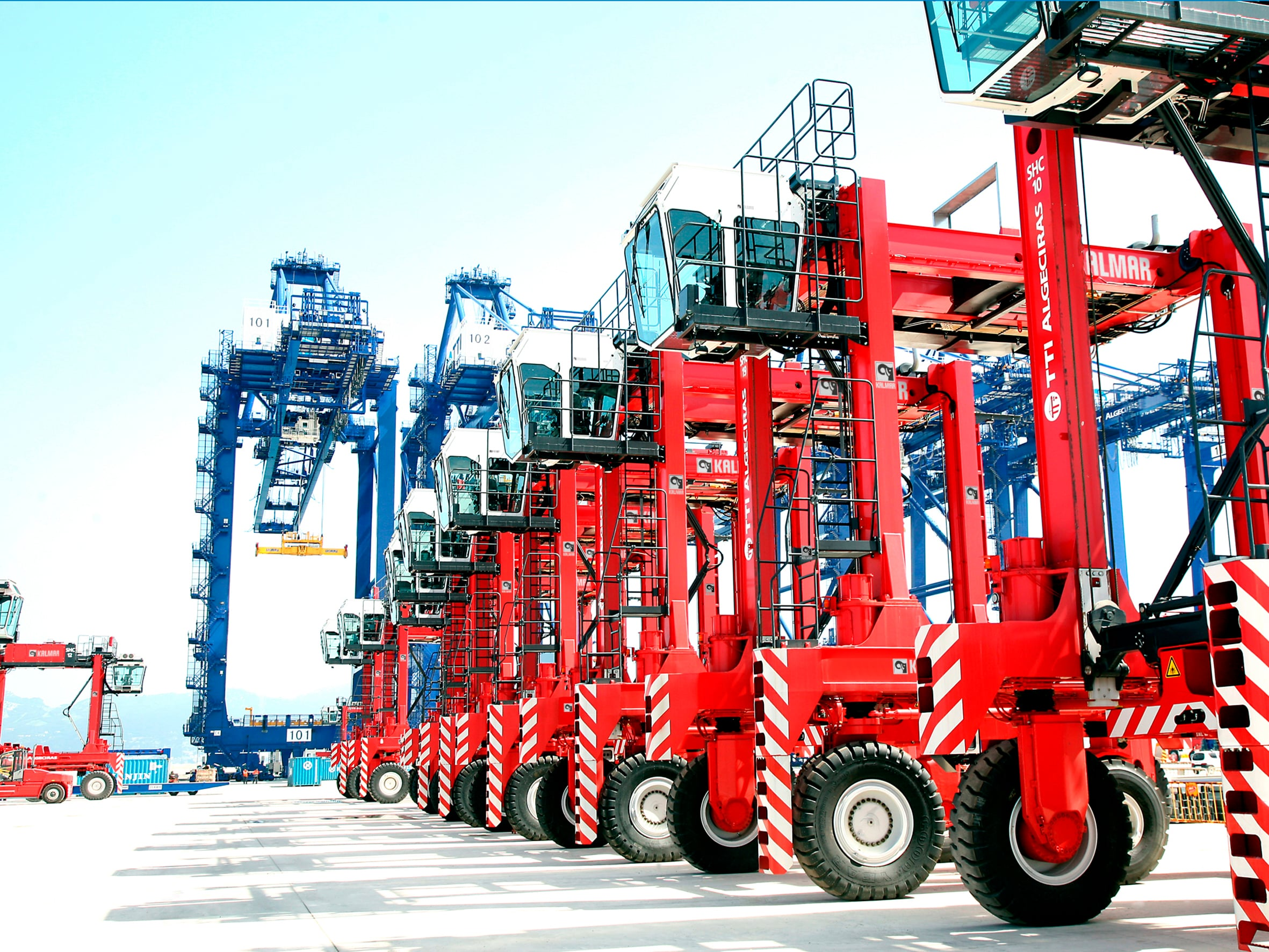
Kalmar has secured an order for 21 hybrid straddle carriers from Total Terminal International Algeciras (TTI Algeciras), which operates a semi-automated container terminal at Spain’s Port of Algeciras Bay. The equipment is designated for shuttle carrier work and is due to be fully delivered during the fourth quarter of 2027. Kalmar booked the contract in its fourth-quarter 2026 order intake. The contract price was not disclosed, and the customer has not specified how many older machines will remain in service after the new fleet is commissioned.
TTI Algeciras handles container calls at the Strait of Gibraltar, a location used by shipping services connecting the Atlantic and Mediterranean. Its operations combine ship-to-shore cranes, container transport machines and automated stacking cranes. Moving containers efficiently between the quay and the storage blocks requires all three systems to operate to coordinated schedules. Additional transport equipment can reduce a bottleneck between those areas, although quay capacity and the available storage positions still determine how many containers can be exchanged during a ship call.
The order specifies hybrid straddle carriers for shuttle duties. In this operating model, the carrier collects containers in the quay area and moves them to a transfer position associated with the stacking system, or completes the reverse journey for loading. It is therefore carrying containers between equipment zones, not necessarily performing every function of a conventional yard-straddling fleet. Reliable transfer timing limits crane waiting and reduces queues where several machines share the same routes.
Kalmar’s hybrid carriers use a diesel engine and electric power system with battery storage. Energy that would otherwise be dissipated during braking or load lowering can be recovered and reused, reducing the need for the engine to run at a constant high output. The manufacturer advertises fuel and emissions reductions of up to 40% against conventional diesel equipment. That figure is a product claim under unspecified comparison conditions, not a verified fuel saving for TTI Algeciras or a contractual performance guarantee.
Container terminals offer a suitable duty cycle for recovering energy because vehicles alternate acceleration, braking, empty travel, laden travel, hoisting and lowering across repeated movements. The usable energy depends on route length, load weight, operating speeds, time spent stationary and the control strategy. Batteries must also be kept within safe operating limits, with thermal management and maintenance appropriate to the ambient conditions. Hybrid operation reduces reliance on fuel without eliminating the diesel engine or its associated emissions.
The customer already runs 23 Kalmar straddle carriers. The new contract deepens that installed relationship, but adding the purchase quantity to the current fleet would give a misleading indication of future capacity: the order details do not identify which units will be retired, reassigned or kept. The fleet configuration will affect both maintenance workloads and the available reserve when a machine is removed from service. Depending on the replacement plan, the procurement could serve reliability and fleet renewal as well as throughput growth.
Kalmar also holds a separate service agreement for preventive and corrective mechanical maintenance of TTI Algeciras’s eight ship-to-shore cranes and 32 automated stacking cranes. Those crane populations work at opposite ends of the transport cycle. Quay cranes must be able to set down and collect containers without waiting indefinitely for a carrier; automated stacking cranes need receiving positions and clear movement permissions. A hybrid shuttle fleet will therefore need to be integrated with both crane groups rather than planned as an independent transport operation.
The terminal is undertaking a wider development programme intended to increase annual handling capacity to 2.1 million twenty-foot equivalent units by 2028. That figure describes a target level of handling capacity, not a forecast of the number of boxes that will necessarily move through the port each year. Quay capacity, yard layout, vessel call patterns, gate activity and the availability of trained operators or maintenance personnel will still determine how much of that potential capacity can be used.
The planned fourth-quarter 2027 deliveries precede the terminal’s 2028 handling capacity target. Commissioning in a working container terminal requires vehicle acceptance checks, operator and technician preparation, traffic routing, and communication with quay and yard equipment. Interfaces with automated stacking cranes also need reliable permissions governing where a vehicle may enter and when a container can be transferred. Kalmar has given a delivery completion window but no phased deployment programme or date for the first machine entering commercial service.
Hybrid machinery also changes maintenance requirements. The diesel engine and mechanical systems remain, while batteries, power electronics and high-voltage safety procedures add tasks to the service regime. Regenerative operation can reduce some mechanical braking loads, although actual component life depends on the machine and operating pattern. Kalmar’s existing maintenance presence may help standardise inspections and fault response, but no availability guarantee or long-term performance measure has been published for this new contract.
Choosing a carrier fleet involves balancing busy vessel windows against periods when fewer machines are required. A terminal needs enough transport movements to keep cranes working during peak calls, yet standing capacity creates maintenance and capital costs. The useful number of machines also changes with route lengths, the balance of import and export moves, and the yard’s ability to accept incoming containers. TTI Algeciras has confirmed its equipment order and its capacity objective, without publishing the fleet-sizing assumptions behind the procurement.
Delivery of the 21 hybrid carriers is scheduled to finish in the final quarter of 2027, ahead of TTI Algeciras’s targeted increase to 2.1 million TEU of annual handling capacity in 2028. Existing maintenance arrangements provide an established service interface, but measurable results will depend on how the new machines are brought into the live terminal operation. Fuel consumption, equipment availability and vessel turnaround can only be assessed against actual operating data after commissioning.