IN Brief:
- Kalmar will supply POK Zachód with an electric reachstacker ordered in the third quarter of 2026 and due in Q2 2027.
- The machine combines 45-tonne rated lifting capacity with a 533kWh battery and a spreader capable of tilting containers sideways by 55 degrees.
- A separate hydraulic gripper will handle steel slabs of up to 33 tonnes; the purchase is co-financed by the EU Just Transition Fund.
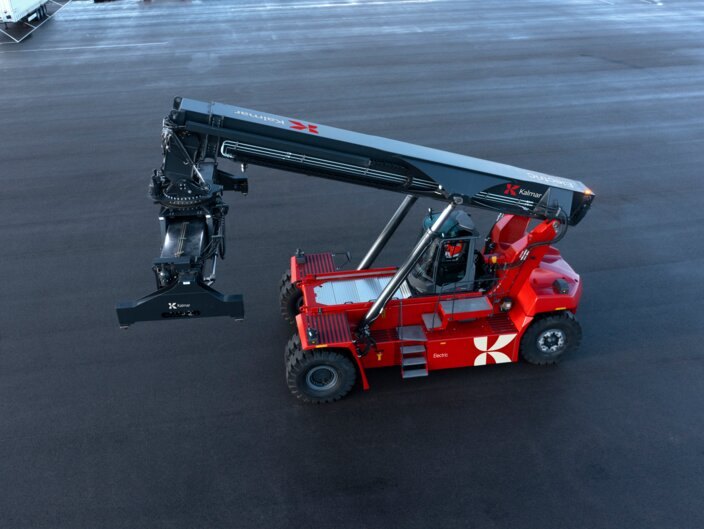
Kalmar has won an order for a customised electric reachstacker for POK Zachód, which handles steel and containers at Wojkowice in Poland. The machine will combine a side-tilting spreader for discharging bulk-loaded containers with a hydraulic gripper for lifting steel slabs. Kalmar says this is its first electric reachstacker configured to carry out both functions.
The order was included in Kalmar’s third-quarter 2026 intake and was announced on 13 November, with delivery scheduled for the second quarter of 2027. The reachstacker has a lifting capacity of up to 45 tonnes and a battery pack with nominal energy capacity of 533 kilowatt-hours. Its separate slab gripper is rated to handle loads of up to 33 tonnes, reflecting the different limits of the handling attachment and the base vehicle.
POK Zachód’s work includes moving standard shipping containers, discharging loose bulk material from containers and lifting steel slabs with a geometry unsuited to conventional container spreaders. The new machine is intended to support both specialised tasks, but each attachment has its own limits and handling procedure. Kalmar has not published an estimate of how many movements or existing machines the combined configuration might replace.
The spreader can tilt a container sideways through 55 degrees to assist gravity discharge of suitable bulk material. Material flow will depend on the loading arrangement, the size and shape of particles, moisture and whether material bridges or sticks within the container. The published specification does not provide a guaranteed emptying rate, so the angle alone cannot establish how quickly a discharge operation will finish.
A reachstacker lifting a loaded container must control several interacting forces. Load mass, lift height, boom extension and the position of the centre of gravity influence the stability of the vehicle. Adding a tilting function introduces a change in where the cargo mass acts during discharge. Engineers must therefore ensure that the permissible load remains within the equipment’s operating envelope throughout the movement, not merely at the point where the container is first lifted.
Steel slabs are held by the separate hydraulic gripper, which has a maximum quoted load of 33 tonnes. Its load limit is lower than the reachstacker’s headline 45-tonne lifting capacity, and neither figure applies indiscriminately at every boom extension or lifting height. Operators will need the machine-specific load chart and approved handling procedure before moving heavy slabs across the terminal.
The machine uses a battery pack rated at 533kWh nominal capacity. Electric traction removes exhaust emissions at the point of operation, but that battery figure does not establish running time or energy consumed per tonne handled. Lifting height, travel distance, attachment movements, ambient temperature and charging opportunities will affect the practical duty cycle once the machine enters service.
Charging infrastructure and shift planning will influence the eventual operating pattern. A terminal working across variable cargo flows must decide whether a machine can recharge during scheduled breaks or needs more frequent charging opportunities. The charger specification, charging rate and duty cycle have not been published with this order, so there is no firm basis for calculating operating hours, electricity consumption per lift or a comparison with diesel equipment at the site.
Electrification changes maintenance rather than eliminating it. The machine will need procedures for high-voltage isolation and electrical cooling systems, while tyres, hydraulics, boom equipment, spreader and slab gripper will continue to require routine inspection. Staff training must cover the different attachments as well as the charging and emergency arrangements established for the terminal.
The project is being co-financed through the European Union’s Just Transition Fund, a financing mechanism intended to support industrial and regional changes associated with decarbonisation. The disclosed order does not identify the size of the grant or a verified reduction in greenhouse gas emissions. The eventual carbon result will depend partly on electricity supply, machine utilisation and the equipment it replaces, none of which has been quantified in the release.
Using one carrier for two handling applications means the terminal must manage attachment changes and compatible work sequences. A container discharging area and a slab storage zone may have different traffic controls, ground loading limits and personnel exclusion arrangements. Final operating procedures will need to reflect those distinctions rather than assume that a shared machine imposes identical handling rules on both cargo types.
Delivery to POK Zachód is scheduled for the second quarter of 2027. The order, booked in Kalmar’s third-quarter 2026 intake and partly supported by the EU Just Transition Fund, establishes the proposed equipment specification; its productivity, charging pattern and operational emissions will require evidence from the actual deployment.