IN Brief:
- Deendayal Port Authority has received national recognition for container cargo handling performance.
- The award covers ports handling less than 0.5 million TEUs annually.
- India has launched a Logistics Port Performance Index to benchmark operational efficiency across ports.
Deendayal Port Authority has received national recognition for container cargo handling performance, as India introduces a new port benchmarking framework for maritime logistics.
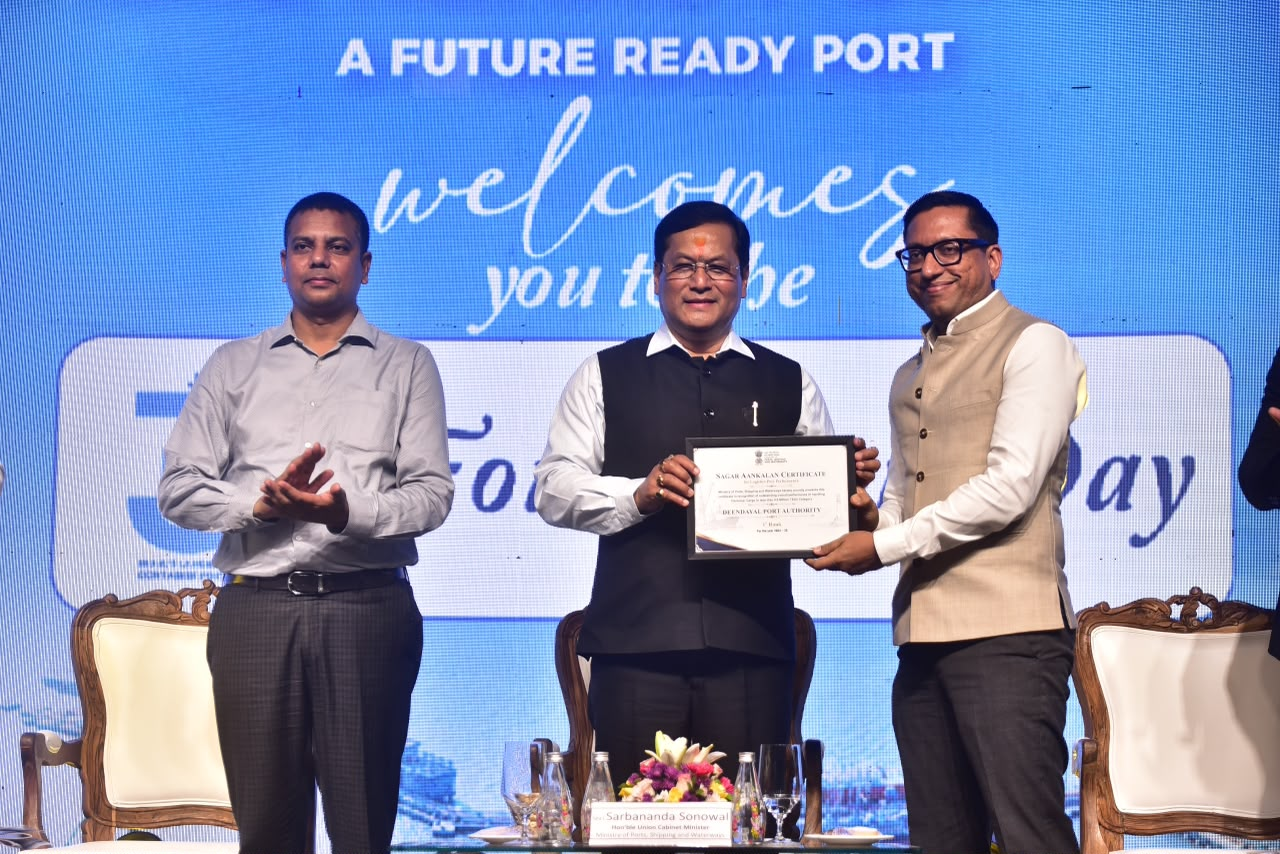
The Kandla-based port authority was recognised under the Sagar Aankalan Awards for FY 2024–25 in the category covering container cargo handling at ports processing less than 0.5 million TEUs annually. DPA Deputy Chairman Nilabhra Dasgupta accepted the award in Mumbai during the 37th Foundation Day celebrations of Jawaharlal Nehru Port Authority.
The award was announced alongside the launch of the Logistics Port Performance Index, a national benchmarking mechanism developed under the Sagar Aankalan initiative. The index assesses port performance across vessel turnaround time, cargo throughput, berth productivity, pre-berthing waiting time, idle berth time, and container dwell time.
The framework gives Indian ports a more transparent basis for year-on-year comparison across cargo segments. Rather than focusing only on aggregate tonnage, the index brings operating reliability and cargo movement speed into sharper view, aligning with India’s wider maritime and logistics policy goals under PM Gati Shakti, Maritime India Vision 2030, and Maritime Amrit Kaal Vision 2047.
For Deendayal Port, the recognition strengthens its position within India’s western maritime network. Kandla has long been an important gateway for bulk, breakbulk, liquid cargo, and containerised trade, serving industrial and inland markets across Gujarat, Rajasthan, northern India, and the wider hinterland.
Port performance is increasingly judged by reliability, predictability, documentation speed, dwell time, intermodal access, and the ability to prevent bottlenecks beyond the quay. A port can improve berth productivity while still creating supply chain friction if containers wait too long for clearance, road movement, rail evacuation, or transfer to off-dock storage.
That wider view of performance has become more important as Indian ports handle growing cargo volumes while inland logistics systems continue to face pressure. Trailer and driver availability, gate procedures, rail slots, customs processes, and warehouse capacity all influence whether a container actually leaves the port ecosystem efficiently.
India’s port sector is also becoming more data-led. Digital port systems, operational dashboards, online processes, grievance platforms, and trade facilitation tools are increasingly being grouped under the same reform agenda. Administrative speed and operational visibility both feed into trade competitiveness, particularly for time-sensitive and high-value cargo.
For shippers, the index metrics are practical rather than abstract. Vessel turnaround affects schedule reliability. Pre-berthing waiting time affects carrier cost. Berth productivity affects capacity. Dwell time affects inventory position, demurrage exposure, and working capital. Once those measures become visible and comparable, ports face stronger pressure to improve the parts of the chain that cargo owners experience directly.
Recognition for a port handling less than 0.5 million TEUs is also notable because smaller container ports and mixed-cargo gateways are critical to resilience. Large container hubs dominate headline volumes, but regional gateways reduce pressure on congested ports, support industrial clusters, and give exporters more routing options when road or rail capacity tightens.
DPA’s award therefore sits within a broader transition in Indian maritime logistics: growth by measured performance rather than volume alone. As manufacturing, exports, and port-led industrial development expand, the stronger ports will be those that can prove cargo can move through the full system with fewer delays, clearer handovers, and more reliable hinterland connectivity.