IN Brief:
- DP World has increased its Maputo container terminal investment from $165m to $200m.
- The revised capacity target is 650,000 TEU annually by Q2 2027, against a stated present capacity of 225,000 TEU.
- The programme is linked to quay improvements, larger vessels, cross-border road and rail connections, and an inland hub in South Africa.
DP World has raised its investment in Mozambique’s Maputo container terminal from $165 million to $200 million and increased the planned annual handling capacity from 530,000 to 650,000 twenty-foot equivalent units (TEU). The revised capacity target is set for the second quarter of 2027. An additional $35 million has been committed to the expansion already under way since 2025, rather than to a separate terminal development.
DP World puts the terminal’s existing annual handling capacity at 225,000 TEU, making the revised target almost three times that figure. Capacity describes the volume the facilities are designed to handle under suitable operating conditions; it is not a forecast that 650,000 TEU will necessarily pass through Maputo in 2027. Shipping services, yard space, handling equipment, road and rail connections, and inland demand will affect actual throughput. The operator has not allocated the additional $35 million among individual equipment purchases or civil works in its November update.
DP World group executive chairman Essa Kazim discussed the investment with Mozambique’s president Daniel Chapo on 18 November. Their meeting also covered further transport links and potential trade infrastructure serving neighbouring markets. DP World operates Maputo’s container terminal and has a stake in Maputo Port Development Company, holder of the wider port concession until 2058. The revised spending forms part of an existing operating and construction programme within that long-term concession.
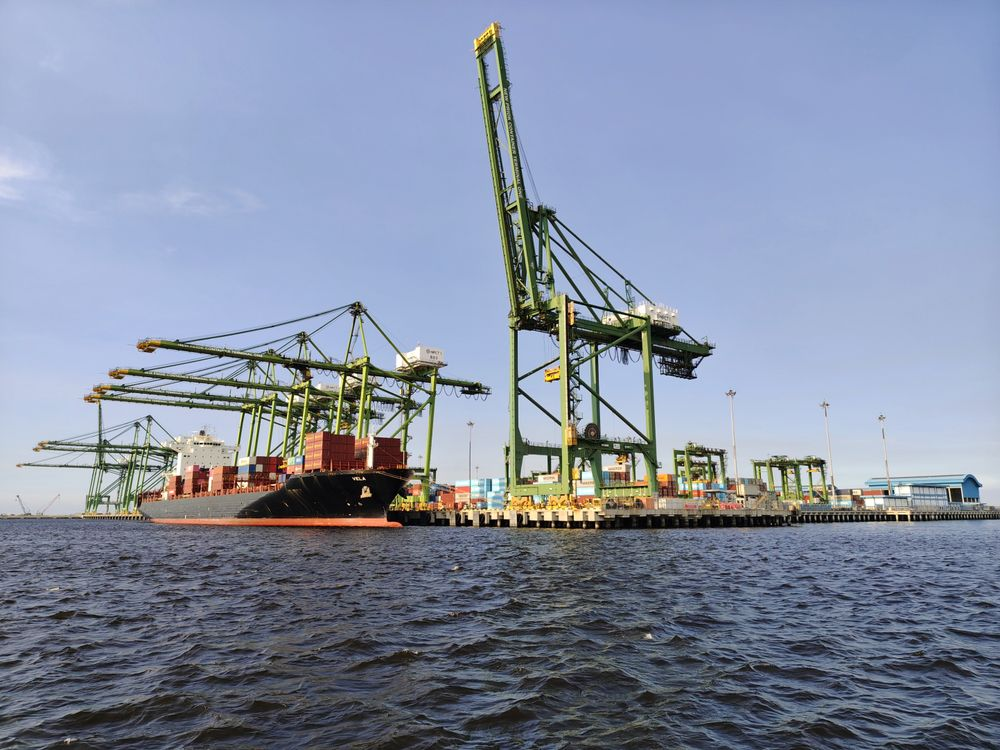
Work started under the original $165 million programme in May 2025. At that point, DP World described plans to extend total quay length to 650 metres, deepen the berth to 16 metres, enlarge the container yard by 6.48 hectares, and introduce three ship-to-shore cranes capable of serving post-Panamax vessels. The equipment plan also included additional rubber-tyred gantry cranes alongside the existing mobile harbour cranes. These were features of the earlier approved project; the November update does not provide a revised breakdown confirming which components, if any, the additional $35 million will change.
Deeper water and longer berthing space affect how container services can use the terminal. The permitted draught determines the size and loading condition of ships that can call without breaching navigational limits, while a longer quay provides greater flexibility to position vessels and cranes. Ship-to-shore cranes work across a vessel’s container rows, transferring units to the quayside, where terminal tractors and yard handling equipment take over. A larger theoretical vessel call does not automatically improve performance if transfer and storage processes cannot absorb the resulting container movements.
The proposed yard expansion and additional rubber-tyred gantry capacity would increase the number of container movements the terminal can manage behind the quay. An import box must be discharged, recorded, assigned to a storage position, released under the applicable customs process, and transferred to a collecting carrier. Export units follow the reverse sequence against a vessel cut-off time. Adding lift capacity at the quay will not remove queues if container stacks, gate appointments, or the transport network cannot absorb the traffic.
Maputo’s position gives the project a cross-border role. The port serves Mozambique and can also provide an ocean gateway for freight moving to and from South Africa and other Southern African markets. DP World is connecting its port operation with road and rail movements and its inland logistics hub at Komatipoort in South Africa. Cargo moving across that border has to be coordinated through customs and inland transport interfaces, so port expansion alone does not determine the total journey time faced by an importer or exporter.
Rail connections can help consolidate larger flows between production regions, inland depots, and the port, particularly where goods arrive in volumes sufficient to fill train services. Road haulage remains necessary for many factory and warehouse collections and for distribution beyond rail terminals. A combined operation therefore depends on containers and information passing cleanly between modes: correct equipment allocation, documentation, release status, and available terminal slots. The investment is intended to strengthen those connections, but DP World has not supplied a quantified reduction in corridor transit times.
A weekly China–Africa Link service is also scheduled to begin later in November, connecting Shanghai, Ningbo, and Nansha with Maputo and other African gateways. DP World has already outlined the China–Africa network expansion separately. The new rotation could give customers another scheduled option, but the final port sequence, vessel performance, and inland connections will determine achievable transit times and service reliability.
Industrial cargo arriving at Maputo may have onward destinations beyond Mozambique, making the border crossing and final delivery sequence as important as the vessel call. Exporters likewise depend on equipment availability, documentation, and a reliable window for placing containers at the terminal before loading. Inconsistent inland collections can fill available storage space even when the berth has spare capacity. DP World has not published cargo-specific forecasts showing which sectors will use the increased terminal capacity.
Larger handling equipment and a deeper berth will require operating crews, maintenance, electrical and control systems, and sufficient vessel demand to justify the investment. New cranes can increase the number of lifts available in a shift, but only when the yard and transport interfaces are coordinated with ship operations. The November update gives no revised project return calculation, guaranteed customer volumes, or detailed timetable for commissioning individual assets, leaving the financial contribution of each component unquantified.
The enlarged terminal is intended to reach its revised annual capacity in Q2 2027. Commissioning of cranes and yard equipment, completion of the quay and berth work, and the availability of reliable inland connections will determine when the new operating limit can be used. The planned 650,000 TEU capacity remains a future capability until the facilities are commissioned; actual cargo throughput will be established by subsequent port records.