IN Brief:
- Supply chains can now track freight location in real time, but often still lack verified identity data for the people physically handling goods.
- Manual checks, PDFs, email trails, and PIN codes create risk as loads are subcontracted through multiple tiers.
- Digital identity could strengthen chain-of-custody controls while helping logistics companies collaborate with more verified partners.
By Lyall Cresswell, Founder & CEO at Trustd
Supply chain visibility has been transformed. Shippers, 3PLs, and warehouse operators can track shipments in real time from origin to destination. But for all the investment in knowing what is moving and when, there remains a significant blind spot: the identity of the person physically handling freight at each touchpoint.
The industry still relies on PDF documents, email exchanges, and PIN codes to verify who collects and delivers goods. As loads are subcontracted two or three tiers deep, the gap between knowing where a shipment is and knowing who has it is a growing risk.
The hidden identity gap
Digital identities hit the headlines in 2025, when the UK government proposed using a digital identity programme to verify the right to work. It prompted backlash but, in tying digital identity to a political maelstrom, failed to highlight the positive outcomes we stand to gain from digital identities in business.
I’ve been talking about this for a long time now, but in logistics, the identity problem is pervasive. Our sector is extremely fragmented. That’s great, because it makes our sector resilient. But logistics fragmentation also has downsides. In particular, in the modern day, fragmentation makes it extremely difficult to know and trust the businesses and people with whom we might wish to collaborate.
At present, trying to verify the credentials of, say, a potential new carrier is manual and cumbersome. The necessarily meticulous identity and credential checks often mean onboarding a new supplier can take days, or even weeks. There are licences to check; there are insurances to check; there is the financial health of our partners to verify; on it goes.
Documents become unverifiable the moment they’re created: insurance expires, licences lapse, but the photocopies remain in circulation. For shippers, the exposure compounds at every tier. Your 3PL subcontracts to a carrier, who subcontracts again. By the time a driver arrives at the gate, there may be no way to confirm they are who they claim to be. TEG data shows that manual processes leave 68% of carriers unaudited by 3PLs in any given year.
So what happens? We don’t collaborate. Not very effectively, anyway. We have a favoured list of onboarded suppliers and when we need to subcontract, we receive tenders from two or three suppliers. That is a tiny fraction of the market. And of course, ignoring almost every player in the market leads to suboptimal outcomes, because the business best positioned to service a contract never tenders in the first place. There’s a round hole to fill, but you can only plug it with a hexagonal peg. It just about fits. But it’s far from perfect. How can one ever allocate the delivery of seriously valuable freight to an unknown driver who could quickly make off with the lot?
Verification as live infrastructure
Now, think about what happens when our businesses — and the individuals within our businesses — are using Trustd IDs. All of a sudden, there is no need to “onboard” a new supplier at all. All the checks have already been done. Not only have they been done, but through live APIs, they’re being done on a continuous basis. Should you wish to check a business or individual’s credentials, you simply check their digital identity profile. It’s all there. All on file. What about when one of the insurances of an existing supplier changes or lapses? You’re alerted instantly.
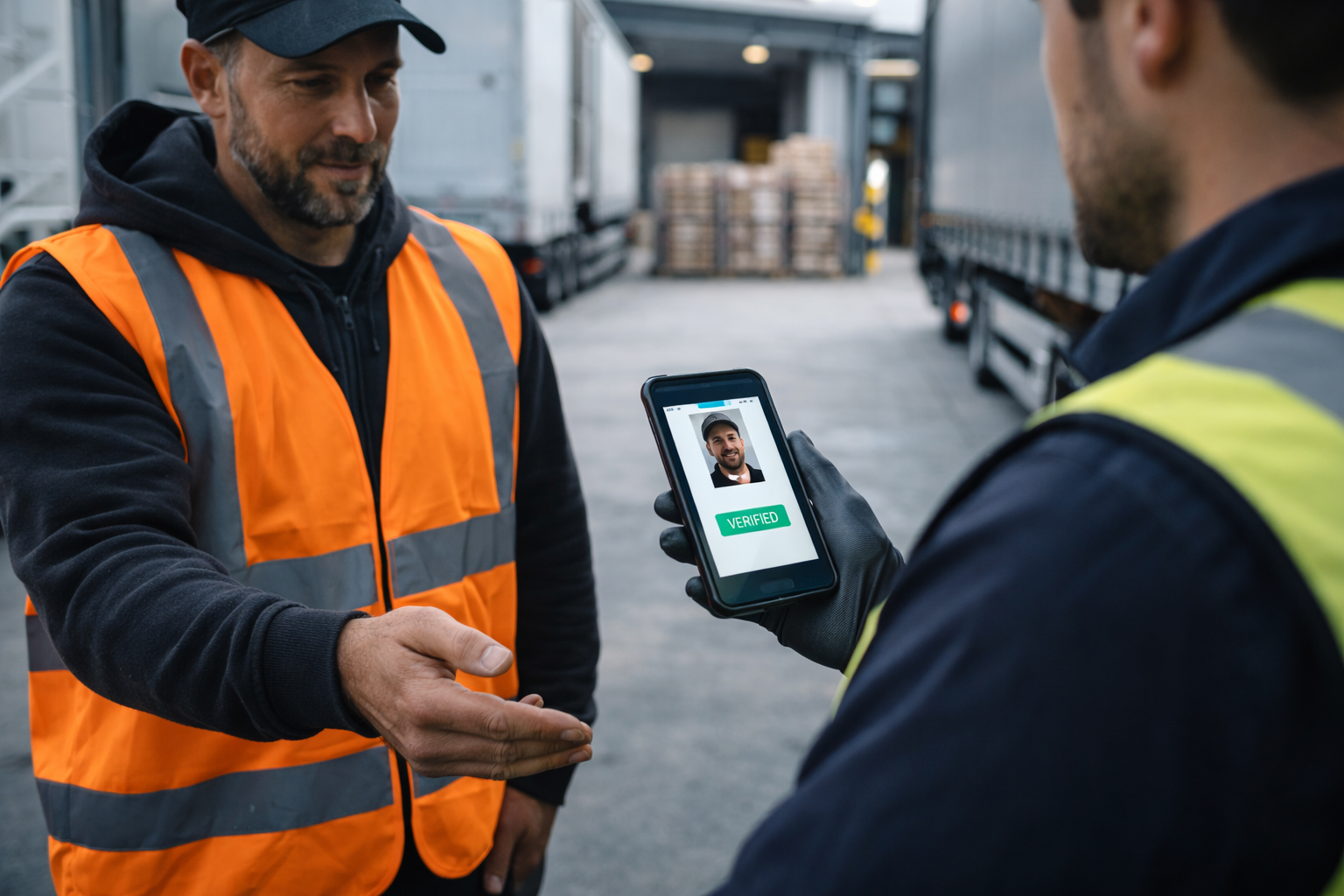
Digital identity applies the same principle to freight. At the point of collection, biometric verification confirms the right person is at the right place at the right time, creating an auditable chain of custody for every consignment.
True supply chain visibility means knowing not just what and when, but who. Digital identity closes that gap, unlocking collaboration with a far wider pool of verified partners. The collaboration gains, efficiency gains, and resilience gains on offer here are vast. They are why I believe everyone in our sector should be keeping a close eye on the emergence of digital identity technology this year, and indeed in years to come.
For more on the forces reshaping logistics in 2026, download ‘Five logistics shifts for 2026’, featuring perspectives from Kirsten Tisdale FCILT (Aricia), Malcolm Pope (LOGURU), James Mead (TEG), and Tristan Scaife (BCD).
This article originally appeared in the April 2026 edition of IN Supply. Read the full issue here.